
Retirement Strategies That Maximize Income, Eliminate Risk, and Help Ensure You Never Run Out of Money How to Achieve The Retirement Future Everyone Seeks
Most retirement plans are built on assumptions that no longer hold up—market averages, predictable tax rates, and the belief that time will always recover losses. But as you approach or enter retirement, the rules change. What worked during your accumulation years can become a liability during the withdrawal phase.
This blog is designed to help you rethink traditional strategies and discover a more engineered approach to retirement income—one focused on certainty, efficiency, and control.
Here, you’ll learn how to reduce or eliminate the biggest threats to your financial future, including market losses, rising taxes, hidden fees, and the silent erosion caused by lost time. We break down complex financial concepts into clear, actionable insights so you can make better decisions about your 401(k), IRA, and retirement income strategy.
You’ll also discover why many conventional approaches—like relying on average returns or the 4% rule—can expose you to unnecessary risk, especially when withdrawals begin. Instead, we explore strategies designed to protect your principal, improve compounding efficiency, and create predictable income streams that last.
Our focus is on helping you transition from “assets at risk” to a more stable and structured approach using fully performing assets—where growth, income, and protection work together instead of against each other.
Whether you’re still working or already retired, the goal is simple:
help you keep more of what you earn, generate more reliable income, and build a plan that doesn’t depend on hope, timing, or market luck.
If you’ve ever wondered:
* How to create tax-efficient retirement income
* How to avoid sequence of returns risk
* How to reduce fees and increase net returns
* How to design income that doesn’t run out
—you’re in the right place.
Explore the articles below and start building a retirement strategy based on engineering, not guesswork.

2026 SECURE Act Rules for Retirement Income Planning
2026 SECURE Act Secrets Revealed: Is Your Retirement Plan Ready for the New Rules?
Concerned about market losses, taxes, or income reliability?Take the 7 Question Retirement Stress Test →
![[HERO] 2026 SECURE Act Secrets Revealed: Is Your Retirement Plan Ready for the New Rules?](https://cdn.marblism.com/QXlgzCf5tOM.webp "[HERO] 2026 SECURE Act Secrets Revealed: Is Your Retirement Plan Ready for the New Rules?")
Start here: See what your retirement actually looks like → 👉 Book Your Million Dollar Hour™
Don’t Let the 2026 Roth Mandate Turn Your Retirement into a Government Payday
Look, I get it. You’ve spent the last two or three decades climbing the corporate ladder or building a business from the ground up. You’ve done the “right” things: maxed out the 401(k), checked the boxes, and ignored the daily noise of the market. You’ve been a "Quiet Builder."
But as we sit here in April 2026, the rules of the game have fundamentally changed. If you haven’t looked at your retirement architecture in the last six months, you aren't just behind: you’re likely leaking wealth to the IRS and Wall Street without even realizing it.
The SECURE Act 2.0 changes taking effect right now aren't just minor adjustments; they are structural shifts in how the government views your wealth. Specifically, for high-earning corporate executives and business owners, the "Roth Catch-Up Mandate" is the most significant tax-trap we’ve seen in years.
At Your Street Wealth, we don’t believe in "participating" in a broken system. We believe in engineering certainty. Let’s look at what’s actually happening and how you can protect your time and your money.
The Roth Catch-Up Mandate: A Tax-Collector’s Dream
Starting January 1, 2026, if you earned more than $145,000 in FICA wages last year, the government has decided they want their cut now. Any catch-up contributions you make to your employer-sponsored plan (like a 401(k) or 403(b)) must now be made on a Roth basis.
In plain English? You no longer get a tax deduction for those extra contributions. You pay the tax today at your highest marginal rate.
Wall Street will tell you this is a "great opportunity" for tax-free growth. But here is what they aren't telling you: if that Roth money is sitting in a traditional "Asset at Risk" (AAR): subject to the whims of the market: you are essentially paying a high tax bill today for the "privilege" of potentially losing that money in a market downturn tomorrow.

The Math of Recovery: Why Roth Losses are Lethal
In our Volatility Recovery Analysis, we look at the true cost of market participation. If you lose 30% in a traditional pre-tax 401(k), it’s painful. But if you lose 30% in a mandatory Roth account where you’ve already paid 35% or 40% in taxes to get the money in there, the math becomes catastrophic.
Remember, a 30% loss requires a 42% gain just to get back to zero. When you add the "Tax Leak" of the new Roth mandate, your "Compounding Efficiency" is gutted.
Wall Street treats your retirement like a game of "Participation." They want you addicted to the daily research, the buying, and the selling: the hidden complexity that drives their fees. They frame it as a false architecture of opportunity. In reality, it’s just gambling with your life’s work.
Single-Pillar Assets vs. Multi-Pillar Engineering
Most "Quiet Builders" are still using what we call the "Single Pillar" model. You have a bank account (Pillar 1: Liquidity), a brokerage account (Pillar 2: Growth), and maybe some real estate (Pillar 3: Income).
These are single-use tools. It’s like carrying around a pager, a calculator, a camera, and a map. In the 1980s, that was a great setup. In 2026, it’s "a Rolodex in a SpaceX world."
We use a different framework: Fully Performing Assets (FPA). Think of an FPA as the "smartphone" of the financial world. Instead of one pillar, a single FPA can provide 5 to 15 pillars of value simultaneously:
Uncapped Growth (UCG): Participating in the upside without the downside.
0% Floor (F): Protecting every cent of your principal and your gains from market loss.
Expanded Market Participation (EMP): Often delivering 110% to 200% of the index's growth.
Tax-Free Income: Strategically navigating the new SECURE Act landscape.
Asset Liability Management (ALM): Using the same principles institutional banks use to ensure they never run out of cash.
The 2026 Deadline: It’s Time for a Margin Audit™
The formal deadline for plan amendments is December 31, 2026. Your HR department or your "guy" at the big brokerage firm will likely send you a form letter telling you everything is fine. They’ll apply "conservative default amendments."
But "conservative" for the plan provider usually means "profitable" for them and "tax-heavy" for you.
As a high-earner, you are likely eligible for the Increased Catch-Up Limits (for ages 60–63), which now allow up to an additional $11,250. This brings your total catch-up limit to $35,750.
The question isn't whether you can contribute more. The question is: Is your current engine capable of handling that fuel? If your retirement engine has "leaks" in the form of fees, taxes, and market volatility, pouring more money into it won't get you to your destination faster. It just makes the puddle on the floor bigger.
This is where our Margin Audit™ comes in. We don’t look at "projections" based on hope. We look at the engineering of your balance sheet. We identify the "Sequence of Return Margin": how much market turbulence your plan can actually survive before it breaks.
Engineering Certainty in an Uncertain Age
Wall Street operates on a "False Model" driven by the Greed/Fear meter. When greed is high, they push you into risk. When fear is high, they tell you to "stay the course" while they continue to collect their fees.
We believe Peace is the path, and wisdom is the way.
Instead of -30% to +30% (the Wall Street roller coaster), we architect plans that operate between 0% and +30%. By eliminating the negative years through a rules-based strategy, your wealth "heals" and grows with mathematical precision.
The Million Dollar Hour™ Forecast
If you are a high-earning executive or business owner, you don't need another sales pitch. You need a blueprint.
The Million Dollar Hour™ Forecast is a paid, premium professional service ($995) designed for the "Architect" persona. We don't chase "mice" looking for "free cheese." We work with Quiet Builders who understand that true financial architecture is worth the investment.
In one 60-minute session, we conduct a full Margin Audit™ and Volatility Recovery Analysis. We help you "unlearn" the myths of market participation and replace them with the principles of institutional-grade banking architecture.
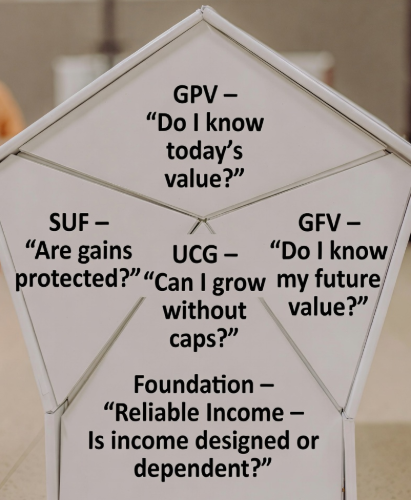
We address the five key questions every secure retirement foundation must answer:
GPV (Guaranteed Present Value): Do you know exactly what your assets are worth today, net of all leaks?
SUF (Safe Upper Floor): Are your gains locked in, or are they "spinning sharp knives"?
UCG (Uncapped Growth): Can you capture the market's wins without being held hostage by its losses?
GFV (Guaranteed Future Value): Can you point to a number on a calendar and know exactly what will be there?
Reliable Income: Is your income design built on a rock or on the shifting sands of a 4% "rule"?
Your Money, Your Rules, In Your Time, On Your Street
The 2026 SECURE Act changes are a wake-up call. The government and Wall Street have updated their "software" to extract more value from your hard work. It’s time you updated your architecture to protect it.
Stop "participating" in their risk. Start "performing" with your own engineered plan. Because at the end of the day, retirement shouldn't be a gamble. It should be the reward for a life well-lived.
The best retirement income strategies aren't found in a brochure; they are engineered in a lab. Let's look at the math, find the margins, and build something that lasts.
Ready for clarity instead of confusion?
The Million Dollar Hour™ is your educational, one-on-one retirement review that reveals where your plan leads : not just where it’s been.
👉 Schedule your session today.
You can keep participating… Or you can finally see the outcome. The Million Dollar Hour™ shows you exactly:
✔ Where you are ✔ Where you’re going ✔ How to fix the gaps 👉 Book your session now
Check out the Retirement Blueprint
Concerned about market losses, taxes, or income reliability?
Take the 7 Question Retirement Stress Test →