
Retirement Strategies That Maximize Income, Eliminate Risk, and Help Ensure You Never Run Out of Money How to Achieve The Retirement Future Everyone Seeks
Most retirement plans are built on assumptions that no longer hold up—market averages, predictable tax rates, and the belief that time will always recover losses. But as you approach or enter retirement, the rules change. What worked during your accumulation years can become a liability during the withdrawal phase.
This blog is designed to help you rethink traditional strategies and discover a more engineered approach to retirement income—one focused on certainty, efficiency, and control.
Here, you’ll learn how to reduce or eliminate the biggest threats to your financial future, including market losses, rising taxes, hidden fees, and the silent erosion caused by lost time. We break down complex financial concepts into clear, actionable insights so you can make better decisions about your 401(k), IRA, and retirement income strategy.
You’ll also discover why many conventional approaches—like relying on average returns or the 4% rule—can expose you to unnecessary risk, especially when withdrawals begin. Instead, we explore strategies designed to protect your principal, improve compounding efficiency, and create predictable income streams that last.
Our focus is on helping you transition from “assets at risk” to a more stable and structured approach using fully performing assets—where growth, income, and protection work together instead of against each other.
Whether you’re still working or already retired, the goal is simple:
help you keep more of what you earn, generate more reliable income, and build a plan that doesn’t depend on hope, timing, or market luck.
If you’ve ever wondered:
* How to create tax-efficient retirement income
* How to avoid sequence of returns risk
* How to reduce fees and increase net returns
* How to design income that doesn’t run out
—you’re in the right place.
Explore the articles below and start building a retirement strategy based on engineering, not guesswork.

401(k) Suitability Test: Is It Good for You?
Is Your 401(k) Good for You? The Test No One Ever Gave You

No hype. No universal guarantees. No promise that one strategy will fit every person.
Inspection does not manufacture safety. It does not guarantee an outcome. It determines which rules actually hold for this individual, under this law, with these terms, across this time horizon.
I only promise the truth. Nothing more.
The Match Is Not the Map: Test Your 401(k) Before You Trust It
Author: Frank L Day
The Questions That Start the Test
How do you know the 401(k) is good for you?
Is the matching component of your 401(k) compelling?
Is it better to put money in a 401(k) or elsewhere?
Why has no one ever created a test that shows you the results for now and in the future?
What are the actual priorities of your money by Require, Insist, and Demand?
What are the available categories of investment by Growth, Risk, and Safety?
What are the identities of the positive Pillars?
Until you discover the impact and test it against your present and future, you are just wandering in the wilderness.
That wilderness is not a lack of intelligence. It is moving without a tested map.
A 401(k) suitability test creates the map. It shows the assumptions, choices, costs, restrictions, consequences, and alternatives before you rely on the account to support your life.
Continue with Retirement Architecture Before Products. The question is not whether a familiar product sounds good. The question is whether its architecture performs the job your future requires.
The 401(k) Is a Tool—Not Automatically the Plan
A 401(k) is a defined-contribution account. Think of it as a container governed by plan-specific rules.
It may provide:
Payroll convenience
Employer matching contributions
Tax treatment
Employer contributions
A menu of investment choices
Portability, subject to applicable rules
Automatic saving
Those features may be valuable. But no single feature proves that the complete arrangement is suitable.
A matching contribution may be compelling. Test it alongside:
Vesting
Contribution requirements
Contribution limits
Administrative and investment fees
Available investment choices
Restrictions and access
Tax treatment
Liquidity
Employment changes
The income and legacy outcome
“Put money in the 401(k) or elsewhere?” is not answered by a slogan. It depends on your requirements, time horizon, tax circumstances, liquidity needs, employer match, plan rules, other resources, and desired future income.
Do not issue a universal verdict. Inspect the architecture.
The 401(k) Suitability Test
Use this sequence throughout:
QUESTION → TEST → PROVE → DECIDE → ACT
1. Define the Required Outcome
Question: What must the money accomplish?
Test: Define essential income, desired income, principal preservation, liquidity, tax coordination, family protection, and legacy goals.
Prove: Identify the resources available and the job each resource must perform.
Decide: Determine whether the 401(k) is being used for accumulation, income, protection, or another defined purpose.
Act: Assign the account a job. Do not let the account become the plan by default.
2. Inventory Benefits and Restrictions
List the match formula, vesting schedule, investment menu, fees, tax options, withdrawal rules, loan provisions, distribution choices, and employment-related restrictions.
Do not rely on a plan label. Read the actual terms.
3. Test the Match
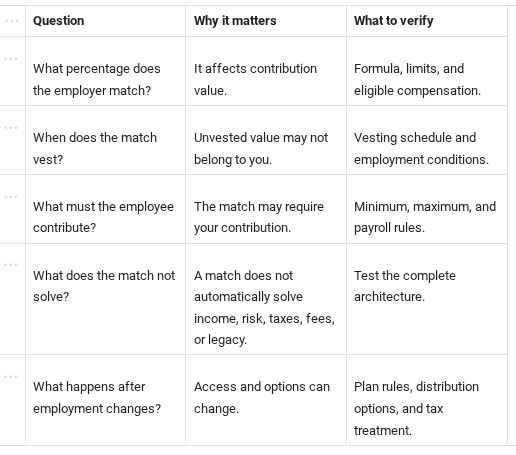
Decide: The match may improve the value of participation, but only after its conditions and net value are understood.
Act: Capture information before increasing reliance.
4. Classify Growth, Risk, and Safety
Categories may overlap. “Safety” is not a universal label. Test the actual feature, contract, fund, restriction, or account rule.
5. Identify the Positive Wealth Pillars
Positive Wealth Pillars are jobs that move the retirement system toward the required outcome:
Substance / Principal: Resources beyond immediate consumption.
Income: Resources structured to support cash flow.
Time: Resources that reduce future dependence on exchanging hours for money. Time cannot be refunded.
Peace: Confidence produced by inspection, testing, and design: not the absence of risk.
Preservation: Protecting resources needed for future jobs.
Protection: Reducing avoidable exposure through actual design and terms.
Production: Creating useful growth or output under stated assumptions.
Perpetuation / Legacy: Preserving what remains for family or chosen causes.
One investment may not perform every Pillar. A 401(k) menu may provide growth choices more directly than it provides income design, protection, tax coordination, or legacy architecture.
Ask what each dollar is supposed to do. Then test whether it does that job.
6. Measure Total Cost of Ownership
TCO—Total Cost of Ownership—includes more than the expense ratio.
Measure:
Fees
Taxes
Market volatility
Inflation
Complexity
Opportunity cost
Withdrawal effects
Sequence-of-returns risk
Lost time
Income limitations
These forces create Financial Gravity. The Six Wealth Killers are taxes, fees, market volatility, inflation, complexity, and poor income design.
A fee that adds no meaningful protection, efficiency, income, or output is a toll with no bridge.
Use PxRxT: Principal × Rate × Time. Protect the principal. Improve useful performance. Protect time.
The Math of Recovery is simple arithmetic:
A 25% loss leaves 75. A gain of 33.33% is required to return to 100.
A 30% loss leaves 70. A gain of approximately 42.86% is required to return to 100.
These are not forecasts. They are calculations showing why a loss changes the assignment given to future growth.
7. Compare Results Now and in the Future
The test must show two views.
Now: Contribution, match, fees, allocation, available categories, liquidity, and current risk exposure.
Future: Accumulation, sequence, withdrawals, taxes, inflation, income, recovery time, longevity, and legacy.
A $1.5M retirement account can look substantial while its income, tax exposure, fee drag, inflation sensitivity, recovery time, and legacy outcome remain untested.
The primary question is:
> What is the maximum lifetime income your assets can produce while preserving the greatest amount of generational wealth?
Do not confuse a balance with an outcome.
8. Stress the Choices
Use the Retirement Stress Lab. Test:
Equity
Income
Time
Inflation
Taxes
Events
Longevity
Legacy
Use OOM™—Odds, Opinions, Models:
Odds: What is probable under the actual conditions?
Opinions: Which assumptions are beliefs rather than evidence?
Models: What happens when assumptions are stressed?
Test declines, withdrawals, inflation, tax changes, health events, longevity, and employment changes.
9. Compare Alternatives or Complementary Locations
A 401(k) may be appropriate for one job and incomplete for another. Compare it with alternatives or complementary locations permitted by law and suited to the individual’s circumstances.
Compare architecture: not labels.
Wall Street can provide products. Main Street contains life’s demands. Your Street asks what architecture belongs between resources and required outcomes.
Some Money, Same Time. Different Rules. On Your Street. Different Outcomes.
10. Require Evidence Before Deciding
Require visible assumptions.
Insist on actual terms.
Demand a tested outcome.
A rouge appearance of suitability is not evidence of a tested outcome.
Activity Versus Outcome
Activity can feel responsible. Outcomes determine whether stewardship occurred.

The Framework Beneath the Test
The Engineered Retirement Blueprint provides the structure:
Balance Sheet = Source of Funds
Income Statement = Uses of Funds
Margin = The Battleground
Margin is what remains after the system absorbs costs, losses, taxes, inflation, and income demands.
This article primarily serves The 7 Disciplines of Retirement Wealth™:
Protect the Principal.
Protect Against Unnecessary Loss.
Protect Forward Progress.
Protect Time.
Increase Efficiency, Not Risk.
Upgrade Your Thinking.
Preserve Every Victory.
It especially serves Discipline 1, Discipline 2, Discipline 4, and Discipline 6. Ask:
Is your retirement plan designed to preserve your wealth engine?
How much of your retirement should be insulated from unnecessary loss?
How much future income is lost when time is lost?
Are you solving retirement with yesterday’s thinking?
Use the 9 Levels of Retirement Discovery™ as the diagnostic depth: Outcome, Cost, Opportunity, Barrier, Truth, Risk, Principle, Value, and Synergy.
The FBS Conjecture™ is a testable question about whether architecture—not product labels, advisor confidence, company reputation, or inside information—determines the outcome that must be inspected.
It is double-digit opportunity standing on a foundation of reliability. The foundation question comes first.
The Educational Comparison Laboratory
The Million Dollar Hour™ is an educational comparison laboratory where an individual’s actual 401(k) rules, match, numbers, assumptions, terms, time horizon, income needs, taxes, liquidity, and legacy priorities can be examined.
The purpose is not to manufacture safety or declare one account universally superior. The purpose is to test what the current architecture may accomplish now and later.

Bring the Assumptions
Bring your assumptions, account statements, income needs, tax concerns, benefit information, liquidity requirements, family priorities, and legacy goals. Test the destination before you trust the journey.
The Your Street retirement standard is testable. Apply Preserve, Protect & Prolong without avoidable leaks, drains, or losses.
Keep learning. Unlearn what no longer holds. Seek wisdom before consequences force the lesson. Retirement planning is stewardship, and stewardship requires inspection.
A 401(k) may be good for you. It may be incomplete for you. It may be valuable for one job and unsuitable for another.
Do not guess. Test.
Why accept uncertainty without a defined upside when you can compare it with approaches that may offer contractual certainty and defined upside—subject to the actual terms, limitations, costs, and claims-paying ability?
This article is for educational purposes only. It is not individualized financial, tax, legal, or investment advice. No universal guarantees are made. Contractual guarantees, if any, are subject to actual terms, limitations, costs, exclusions, restrictions, and claims-paying ability. Illustrations are not forecasts. Consult qualified financial, tax, legal, insurance, and estate-planning professionals before making decisions. Plan rules and tax treatment vary. A retirement plan must be testable to be valid.