
Retirement Strategies That Maximize Income, Eliminate Risk, and Help Ensure You Never Run Out of Money How to Achieve The Retirement Future Everyone Seeks
Most retirement plans are built on assumptions that no longer hold up—market averages, predictable tax rates, and the belief that time will always recover losses. But as you approach or enter retirement, the rules change. What worked during your accumulation years can become a liability during the withdrawal phase.
This blog is designed to help you rethink traditional strategies and discover a more engineered approach to retirement income—one focused on certainty, efficiency, and control.
Here, you’ll learn how to reduce or eliminate the biggest threats to your financial future, including market losses, rising taxes, hidden fees, and the silent erosion caused by lost time. We break down complex financial concepts into clear, actionable insights so you can make better decisions about your 401(k), IRA, and retirement income strategy.
You’ll also discover why many conventional approaches—like relying on average returns or the 4% rule—can expose you to unnecessary risk, especially when withdrawals begin. Instead, we explore strategies designed to protect your principal, improve compounding efficiency, and create predictable income streams that last.
Our focus is on helping you transition from “assets at risk” to a more stable and structured approach using fully performing assets—where growth, income, and protection work together instead of against each other.
Whether you’re still working or already retired, the goal is simple:
help you keep more of what you earn, generate more reliable income, and build a plan that doesn’t depend on hope, timing, or market luck.
If you’ve ever wondered:
* How to create tax-efficient retirement income
* How to avoid sequence of returns risk
* How to reduce fees and increase net returns
* How to design income that doesn’t run out
—you’re in the right place.
Explore the articles below and start building a retirement strategy based on engineering, not guesswork.

Average vs. Actual Returns: Mastering Retirement Compounding
Double-Digit Averages vs. Actual Compounding: The Math Wall Street Hopes You Never Do
![[HERO] Double-Digit Averages vs. Actual Compounding: The Math Wall Street Hopes You Never Do](https://cdn.marblism.com/Ks3hl7ihgW2.webp "[HERO] Double-Digit Averages vs. Actual Compounding: The Math Wall Street Hopes You Never Do")
Start here: See what your retirement actually looks like → 👉 Book Your Million Dollar Hour™
Alternative Hook Title: The Arithmetic of Illusion: Why Wall Street’s “Average” is Your Retirement’s Enemy
SEO Title: Average vs. Actual Returns: Mastering Retirement Compounding
If you are an engineer, a corporate executive, or someone who spent their career managing complex systems, you understand one fundamental truth: The quality of your output is entirely dependent on the integrity of your data.
In the world of financial planning, most “data” fed to the public is a collection of arithmetic illusions. Wall Street brokers love to quote “average annual returns.” They’ll tell you the S&P 500 has averaged roughly 10% over the last several decades. They use this number to build a "projection" of your future wealth.
But there is a massive, forensic gap between an Arithmetic Average and Actual Compounding. If your retirement plan is built on the former, you aren’t looking at a blueprint; you’re looking at a mirage.
At Your Street Wealth, we don’t play the "Participation" game. We use Asset Liability Management (ALM) and institutional-grade engineering to move you from speculation to certainty.
The Arithmetic Mean: A Mathematical Flaw
Let’s run a simple forensic audit on the word "average."
Imagine you have a $1,000,000 portfolio.
In Year 1, the market is up 25%. Your account grows to $1,250,000.
In Year 2, the market "corrects" by 25%.
If you ask a broker for the average return, they will say: (25% + -25%) / 2 = 0%. On paper, you broke even.
Now, let’s look at the Actual Compounding (CAGR):
Year 1: $1,000,000 + 25% = $1,250,000.
Year 2: $1,250,000 - 25% = $937,500.
Your "average" was 0%, but your actual wealth is down $62,500. You didn't break even; you lost 6.25% of your principal. This is what we call Volatility Drag, and it is the silent killer of retirement dreams.
The Math of Recovery: The Hidden Tax on Your Time
Wall Street relies on you not understanding the Math of Recovery. When you suffer a loss, you don't just lose money; you lose the time required to get back to zero.
A 10% loss requires an 11% gain to recover.
A 30% loss requires a 42% gain to recover.
A 50% loss requires a 100% gain just to get back to where you started.
When you are in the "Accumulation" phase of your life (your 30s and 40s), you have time to chase these recoveries. But for Quiet Builders aged 45–75, time is your most precious, non-renewable resource. Spending five years just trying to "break even" after a market crash is a luxury you cannot afford.
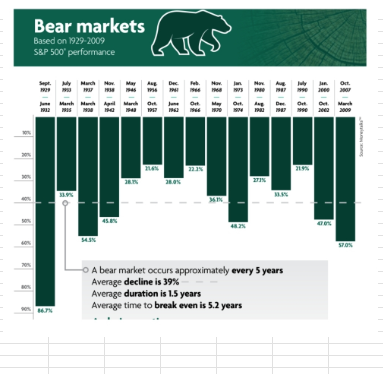
As the chart above illustrates, bear markets aren't anomalies; they are structural features of the traditional market. The average break-even time is over five years. In a modern retirement, "hoping" the market recovers before you need to take a distribution is not a strategy: it's a gamble.
If this concerns you, you’re not alone. Most people have never actually seen what their money is doing — or where it leads. 👉 In the Million Dollar Hour™, we map your exact outcome:
• Today’s value • Future income • Hidden risks • What it should be doing instead Book your session here →
From Participation to Engineering: GPV and GFV
Most retirement plans are built on Participation. You throw your money into a bucket (Stocks, Mutual Funds, ETFs) and hope the "Average" treats you well. This is a Single Pillar model. It does one thing: it fluctuates. It’s a Rolodex in a SpaceX world.
At Your Street Wealth, we replace Participation with Engineered Performance. We utilize Fully Performing Assets (FPA) that act like the "smartphone" of finance: consolidating 5 to 15 pillars of value (growth, protection, lawsuit protection, spousal continuation) into one vehicle.
The bedrock of this engineering is two metrics:
GPV (Guaranteed Present Value): Knowing exactly what your floor is today, regardless of what happens to interest rates or index volatility.
GFV (Guaranteed Future Value): A mathematically certain calculation of what your account will be worth at a specific point in time, allowing for a Margin Audit of your future lifestyle.
While Wall Street operates on a "False Model" driven by the Greed/Fear meter, our Win/Win Engineering Suite focuses on Compounding Efficiency.
Multiplication of Growth vs. Division of Loss
Traditional portfolios are subject to the Division of Loss. When the market drops 30%, your balance is divided.
Our FPA models utilize Uncapped Growth (UCG) and Expanded Market Participation (EMP).
Imagine a scenario where the market returns 10%.
Traditional Model: You get 10% (minus fees/taxes). If the market is -10% next year, you’re back to nearly square one.
Your Street Model: Through EMP, we can apply a 110% to 200% multiplier. That 10% market gain can be engineered into an 11% to 20% gain.
But here is the "Win/Win": When the market drops 30%, your account stays at 0%. You never participate in the downside. You essentially remove "Division" from your financial equation and replace it with pure "Multiplication."
The Sequence of Returns Risk: The Engineer’s Nightmare
For an executive moving into retirement, the greatest technical threat is Sequence of Returns Risk. This is the risk that the market crashes in the first few years of your retirement while you are also taking withdrawals.
If you are "Participating" in the market, a -20% year combined with a 5% withdrawal rate creates a catastrophic "leak" that most portfolios never recover from. It creates a downward spiral where you are forced to sell more shares at lower prices just to maintain your income.
Our strategies solve for this through Sequence of Return Margin. By engineering a Guaranteed Retirement Income that does not rely on selling depressed assets, we ensure that your "Actual Compounding" remains positive, even when the headlines are screaming about a recession.
The Million Dollar Hour™: Your Forensic Margin Audit
We recognize that most high-net-worth individuals are "Quiet Builders." You’ve worked hard, you’ve been successful, but you are financially fatigued by the noise and hidden complexity of Wall Street. You want a plan that grows and heals, rather than one that extracts and risks.
The Million Dollar Hour™ Forecast is not a sales pitch; it is a $995 professional engineering session. It is designed to find the "missing time and wealth" in your current trajectory.
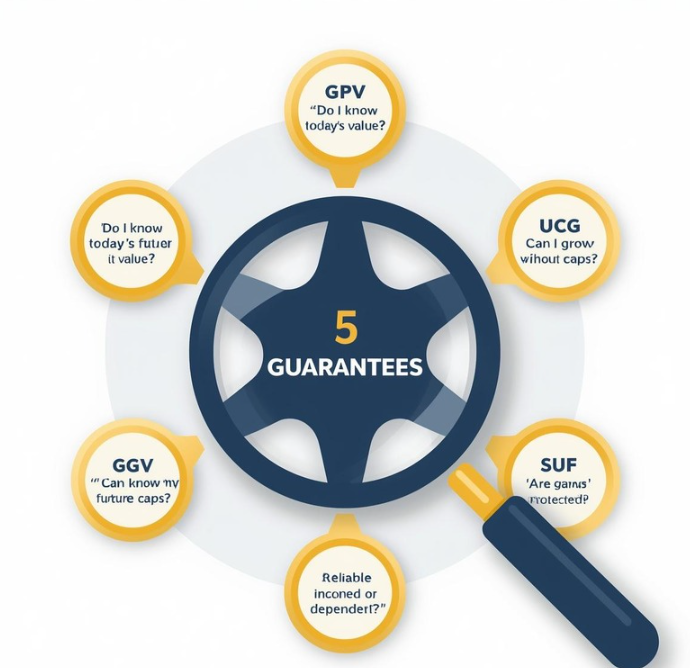
During this 60-minute session, we conduct a Volatility Recovery Analysis and a Margin Audit™ to answer the five questions Wall Street avoids:
What is your Guaranteed Present Value?
How is your gain protected from the "Math of Recovery"?
Are your gains truly uncapped?
What is your Guaranteed Future Value?
Is your income reliable or dependent on market permission?
Peace is the Path, Wisdom is the Way
If you are tired of "spinning sharp knives" with interest-rate ripples and market volatility, it is time to shift your perspective. Wealth is built on micro margins and institutional-grade architecture, not macro headlines and "average" returns.
Stop participating in a system designed to extract value from your uncertainty. Start engineering a future built on mathematical certainty.
Your Money. Your Rules. In Your Time. On Your Street.
Ready for clarity instead of confusion?
The Million Dollar Hour™ is your educational, one-on-one retirement review that reveals where your plan leads : not just where it’s been.
👉 Schedule your session today.
You can keep participating… Or you can finally see the outcome. The Million Dollar Hour™ shows you exactly:
✔ Where you are ✔ Where you’re going ✔ How to fix the gaps 👉 Book your session now
Check out the Retirement Blueprint