
Retirement Strategies That Maximize Income, Eliminate Risk, and Help Ensure You Never Run Out of Money How to Achieve The Retirement Future Everyone Seeks
Most retirement plans are built on assumptions that no longer hold up—market averages, predictable tax rates, and the belief that time will always recover losses. But as you approach or enter retirement, the rules change. What worked during your accumulation years can become a liability during the withdrawal phase.
This blog is designed to help you rethink traditional strategies and discover a more engineered approach to retirement income—one focused on certainty, efficiency, and control.
Here, you’ll learn how to reduce or eliminate the biggest threats to your financial future, including market losses, rising taxes, hidden fees, and the silent erosion caused by lost time. We break down complex financial concepts into clear, actionable insights so you can make better decisions about your 401(k), IRA, and retirement income strategy.
You’ll also discover why many conventional approaches—like relying on average returns or the 4% rule—can expose you to unnecessary risk, especially when withdrawals begin. Instead, we explore strategies designed to protect your principal, improve compounding efficiency, and create predictable income streams that last.
Our focus is on helping you transition from “assets at risk” to a more stable and structured approach using fully performing assets—where growth, income, and protection work together instead of against each other.
Whether you’re still working or already retired, the goal is simple:
help you keep more of what you earn, generate more reliable income, and build a plan that doesn’t depend on hope, timing, or market luck.
If you’ve ever wondered:
* How to create tax-efficient retirement income
* How to avoid sequence of returns risk
* How to reduce fees and increase net returns
* How to design income that doesn’t run out
—you’re in the right place.
Explore the articles below and start building a retirement strategy based on engineering, not guesswork.

How Much Do I Need to Retire? The Truth About Calculators
Is Your Retirement Income Calculator Lying? Why Your 'Magic Number' Might Be Off by a Decade
One of the fastest ways to uncover hidden risk is to take our 7 Question Retirement Stress Test.
![[HERO] Is Your Retirement Income Calculator Lying? Why Your 'Magic Number' Might Be Off by a Decade](https://cdn.marblism.com/D5eJlHSOGCT.webp "[HERO] Is Your Retirement Income Calculator Lying? Why Your 'Magic Number' Might Be Off by a Decade")
Start here: See what your retirement actually looks like → 👉 Book Your Million Dollar Hour™
The Volatility Tax: Why Your Retirement Calculator is a Work of Fiction
You’ve seen the commercials. A silver-haired couple laughs on a sailboat while a golden number: let’s say $1.5 million: glows on the screen. You go to a major financial website, plug in your current savings, your age, and an “average” return of 7%, and the calculator spits out a green checkmark.
Congratulations, you’re on track.
But if you’re a "Quiet Builder": someone who has spent decades accumulating wealth through discipline rather than hype: you probably have a nagging feeling in your gut. You look at your spreadsheet, then at the headlines, then back at the calculator, and the math doesn’t quite feel... real.
There’s a reason for that.
According to recent research, over two-thirds of retirement calculators are built on a foundation of optimism rather than engineering. They treat the stock market like a steady escalator, when in reality, it’s a series of trapdoors. If you’re basing your life’s freedom on a tool that ignores the "Volatility Tax," your "Magic Number" might actually be a decade of work away from the truth.
The Outcome Delusion: Why "Average" is a Marketing Term
Traditional retirement planning suffers from what I call the Outcome Delusion. Most calculators ask you for an "expected rate of return." You put in 7% or 8% because that’s what Wall Street tells you the S&P 500 "averages" over time.
But you don’t live in an average. You live in a sequence.
If you have $1 million and the market drops 30% in year one of your retirement, you now have $700,000. To get back to that original $1 million, you don’t need a 30% gain. You need a 42.8% gain.
This is the Math of Recovery. While the "average" return might look fine on a brochure, the actual dollar amount in your pocket is being cannibalized by the time it takes to break even. Wall Street loves to talk about "Participation": the idea that you just need to be "in the market." But participation is just a polite word for gambling with your time.
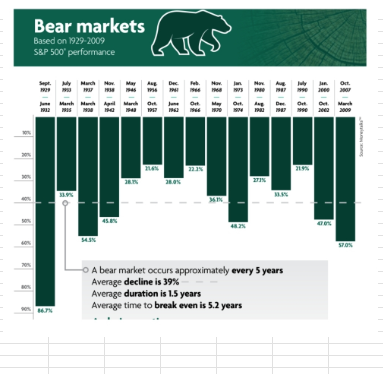
As the chart above shows, bear markets happen roughly every five years. If your retirement income calculator doesn't factor in the 5.2 years it takes (on average) just to break even after a crash, it isn't a financial tool: it’s a toy.
The Volatility Tax and the "Sequence of Return Margin"
When you are in the "Accumulation" phase of life, volatility is annoying. When you are in the "Distribution" phase (retirement), volatility is a predator.
If you are withdrawing money to live on while the market is down, you are effectively selling shares at a discount. You are locking in losses that can never be recovered. This creates a "Sequence of Return Margin" that is impossible to calculate using a simple web form.
Most people are "Quiet Builders" who have been successful despite the noise. You’ve used spreadsheets and basic tools because that’s what was available. But those tools are "Single-Pillar" solutions. They focus on one thing: growth. They ignore the leaks: fees, taxes, and the structural damage caused by market retractions.
At Your Street Wealth, we look at this through the lens of Engineering vs. Participation. Wall Street wants you to participate in their risk so they can collect their fees. We want to engineer a result that is "Reliable & Repeatable."
If market losses concern you, use the 7 Question Retirement Stress Test
to evaluate your current plan.
The "Rolodex in a SpaceX World" Problem
Think about the technology you used thirty years ago. You had a pager, a calculator, a camera, and a Rolodex. Today, all of those things are consolidated into your smartphone. It’s more efficient, more powerful, and takes up less space.
Traditional retirement planning: splitting money between stocks, bonds, and a savings account: is the financial equivalent of carrying around a Rolodex in a SpaceX world. It worked in the 1980s when interest rates were high and the world moved slower. It doesn't work for a modern retirement that might last thirty years in a high-volatility environment.
We categorize assets into four buckets:
Assets at Risk (AAR): Stocks, mutual funds, and variable annuities where you bear 100% of the downside.
Non-Performing Assets (NPA): Cash under the mattress or "dead" money that isn't keeping up with inflation.
Underperforming Assets (UPA): Low-yield bonds or outdated insurance policies with high fees.
Fully Performing Assets (FPA): The "Smartphone" of finance.
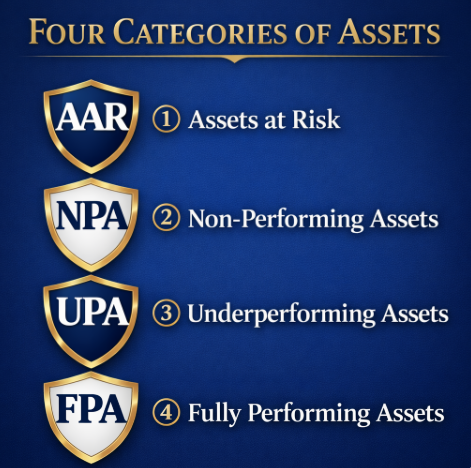
A Fully Performing Asset (FPA) is a multi-pillar vehicle. Instead of just "growing" (and potentially shrinking), an FPA provides 5–15 "pillars" of value, including Uncapped Gains (UCG), principal protection (the 0% floor), and tax-free income. This is where we move from "hoping" the calculator is right to "knowing" the math is sound.
The Margin Audit™: Finding the Leaks
The reason your "Magic Number" is probably wrong is that most calculators fail to perform a Margin Audit™. They don't account for the microscopic leaks that drain your wealth over decades:
The Tax Leak: If your $2M is in a 401(k), you don't have $2M. You have a joint account with the IRS, and they get to decide their share later.
The Fee Leak: A 1.5% fee on a portfolio that "averages" 7% isn't taking 1.5% of your money; it’s taking over 20% of your potential growth over time.
The Compounding Efficiency Leak: Every time the market drops and you have to wait 5 years to "break even," you’ve lost 5 years of compounding. That is a permanent loss of time.
Wealth is built on micro-margins, not macro-headlines. You don't need a "better" stock pick; you need better financial architecture.
Moving From Guesswork to Engineering
If you’ve been feeling a sense of disconnect between what the online calculators say and what you see in the world, you aren’t being "pessimistic." You’re being observant. You’ve noticed that the "False Model" driven by Wall Street greed doesn't account for the reality of your life.
This is why we don't offer "free" consultations that are actually just sales pitches for the same old mutual funds. We offer the Million Dollar Hour™ Forecast.
The Million Dollar Hour™ is a $995 engineering audit designed for the Quiet Builder. It’s high-friction because it requires you to be serious about your numbers. It’s high-clarity because it uses institutional-grade Asset Liability Management (ALM) to look at your specific situation.
We don't just "estimate" your income. We perform a Volatility Recovery Analysis to see how your current plan would survive a 2008-style event. We check your Compounding Efficiency to see how much of your growth is being eaten by invisible fees.
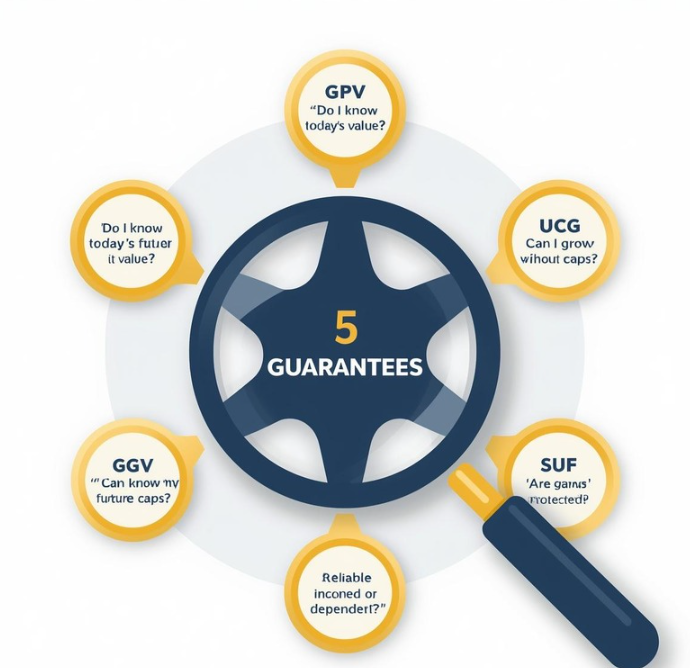
During this hour, we look for the "Gaps." We ask the questions most brokers avoid:
Can your growth be "locked in" so you never lose a penny to a market crash again?
Do you have Expanded Market Participation (EMP) that allows you to capture 110%–200% of market gains without the downside risk?
Is your plan a "Single Pillar" (if the market dies, the plan dies) or a "Multi-Pillar" (FPA) structure?
Peace is the Path, Wisdom is the Way
The goal of retirement planning isn't just to have a big number in a bank account. It’s to have Certainty.
The "Magic Number" is a myth because it’s a moving target. What you actually need is a Reliable Income Stream that is immune to the "Volatility Tax." You need a plan where your money follows your rules, in your time, on your street.
If you are tired of the "Outcome Delusion" and ready to unlearn the myths of Wall Street, it’s time to look at the architecture of your wealth. Stop asking a $0 website calculator how much you need to retire. Start asking an engineer how to protect the time you have left.
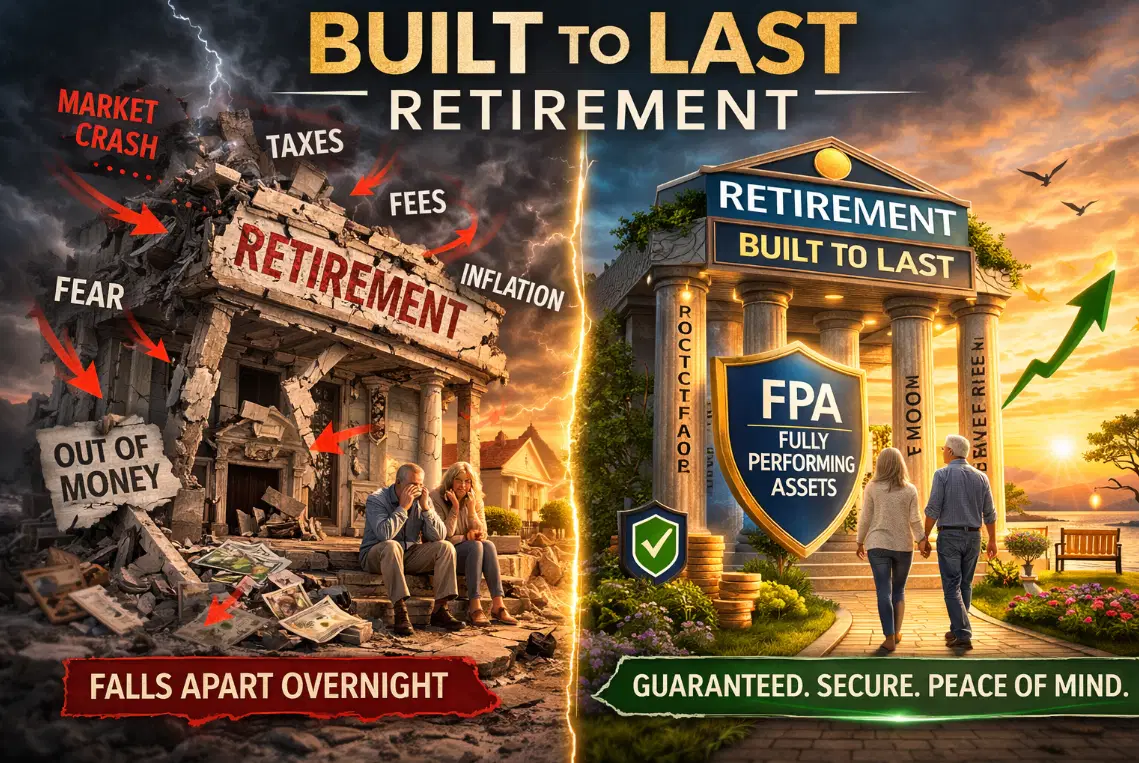
You’ve spent your life building. Now, let’s make sure the foundation is actually solid.
Ready for clarity instead of confusion?
The Million Dollar Hour™ is your educational, one-on-one retirement review that reveals where your plan leads : not just where it’s been.
👉 Schedule your session today.
You can keep participating… Or you can finally see the outcome. The Million Dollar Hour™ shows you exactly:
✔ Where you are ✔ Where you’re going ✔ How to fix the gaps 👉 Book your session now
Check out the Retirement Blueprint
Concerned about market losses, taxes, or income reliability?
Take the 7 Question Retirement Stress Test →