
Retirement Strategies That Maximize Income, Eliminate Risk, and Help Ensure You Never Run Out of Money How to Achieve The Retirement Future Everyone Seeks
Most retirement plans are built on assumptions that no longer hold up—market averages, predictable tax rates, and the belief that time will always recover losses. But as you approach or enter retirement, the rules change. What worked during your accumulation years can become a liability during the withdrawal phase.
This blog is designed to help you rethink traditional strategies and discover a more engineered approach to retirement income—one focused on certainty, efficiency, and control.
Here, you’ll learn how to reduce or eliminate the biggest threats to your financial future, including market losses, rising taxes, hidden fees, and the silent erosion caused by lost time. We break down complex financial concepts into clear, actionable insights so you can make better decisions about your 401(k), IRA, and retirement income strategy.
You’ll also discover why many conventional approaches—like relying on average returns or the 4% rule—can expose you to unnecessary risk, especially when withdrawals begin. Instead, we explore strategies designed to protect your principal, improve compounding efficiency, and create predictable income streams that last.
Our focus is on helping you transition from “assets at risk” to a more stable and structured approach using fully performing assets—where growth, income, and protection work together instead of against each other.
Whether you’re still working or already retired, the goal is simple:
help you keep more of what you earn, generate more reliable income, and build a plan that doesn’t depend on hope, timing, or market luck.
If you’ve ever wondered:
* How to create tax-efficient retirement income
* How to avoid sequence of returns risk
* How to reduce fees and increase net returns
* How to design income that doesn’t run out
—you’re in the right place.
Explore the articles below and start building a retirement strategy based on engineering, not guesswork.
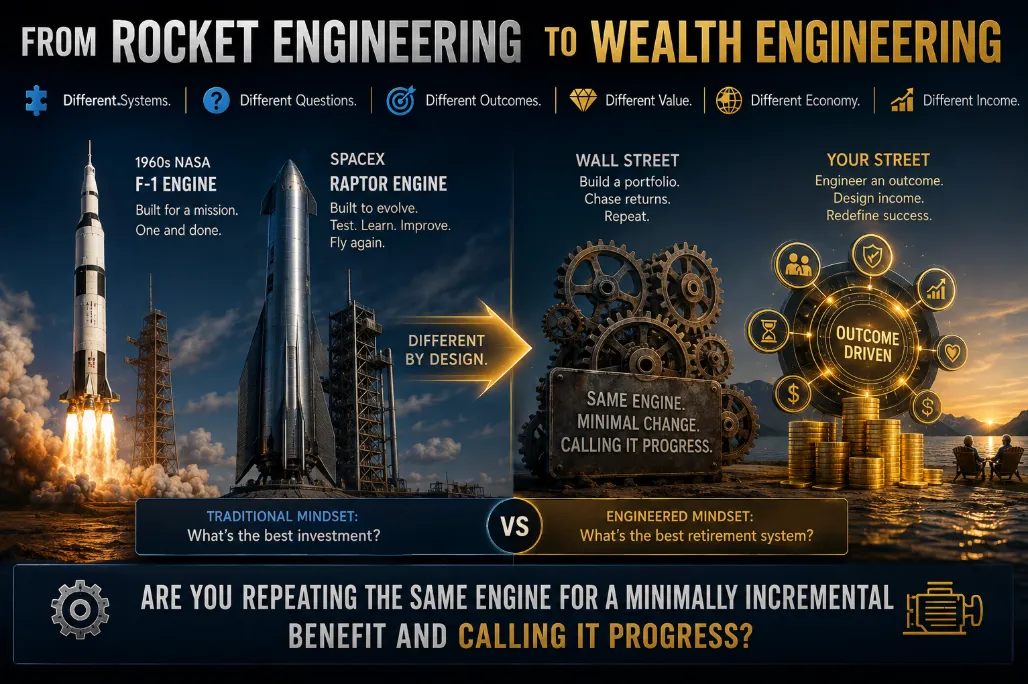
How to Engineer a Better Retirement Outcome
From F-1 to Raptor: Engineering Your Retirement Outcome

By Frank L. Day, inventor of Million Dollar Hour. One of the fastest ways to uncover hidden risk
is to take our 7 Question Retirement Stress Test.
When It's Time: The Retirement Engine: Fixed Model vs. Evolving Model
Retirement planning has an engineering problem.
Most people are taught to ask:
> “Which investments should I own?”
That question is not useless. It is simply incomplete.
A better question is:
> What must my wealth system accomplish?
Your income must last. Your lifestyle must survive inflation, taxes, volatility, health costs, and longevity. Your wealth should remain useful during your lifetime and meaningful for the people who follow you.
That is not a thrust problem.
It is an outcome problem.
Continue with The Million Dollar Hour™ Forecast Laboratory
Step 1: Disrupt the old model
The honest contrast is not old versus new.
NASA’s F-1 engine was not a static design that engineers refused to improve. The F-1 went through enormous testing, redesign, and problem-solving. Combustion instability threatened to destroy the engine in milliseconds. Engineers changed the injector design, added baffles, performed repeated test firings, and even used controlled explosive disturbances to test whether the engine could recover.
From 1967 to 1973, 65 F-1 engines powered 13 Saturn V launches without combustion-instability problems. NASA documents the engineering story here.
The better distinction is:
Fixed mission model versus evolving outcome model.
The F-1 was engineered to accomplish an extraordinary mission: get astronauts to the Moon and bring them home.
Raptor represents a different engineering ambition: build a transportation system that can continually improve across repeated missions.
Neither story requires attacking NASA. The F-1 was an extraordinary achievement. The lesson is the evolution of engineering thinking.

Step 2: Reveal the invisible enemy
Traditional Wall Street planning often follows this sequence:
Select → Allocate → Monitor → Rebalance
The underlying model is:
Money → Investments → Growth → Retirement
The investor adapts to the market.
That model can expose your retirement to what we call Financial Gravity™:
Market losses
Taxes
Fees
Inflation
Sequence-of-return risk
Lost recovery time
Poor income design
Complexity and delay
A 30% loss requires roughly a 42% gain just to recover. The account statement may eventually look better, but the lost years do not return.
That is why an Asset at Risk (AAR) is more than an account exposed to market volatility. It is a hidden liability when accumulated losses and lost time create negative margin.
Wall Street fees often remain in place through all of this. They become a toll with no bridge: a fee for failure that does not eliminate the wealth killers.
Step 3: Show the cost
The Wall Street Cycle is not theoretical. Markets experience routine 10%–20% swings, and major retractions averaging approximately 40% have historically appeared every several years.
In the Your Street Wealth model, each major retraction can cost a minimum of 3.3+ years of lost time. Across a lifetime, those interruptions may occur repeatedly.
That creates the 5x Accumulated Loss Truth:
A person may contribute $100,000 over time yet experience $500,000 or more in cumulative loss impact when volatility, withdrawals, missed compounding, and recovery periods are measured together.
The Shiny Object is the advertised 7%–10% average return.
The Dark Object is the total of all negatives:
The loss cycle
The time tax
Hidden fees
Taxes
Sequence risk
Compounding inefficiency
Average returns are “rouge” numbers when they ignore the negatives that determine actual income.
Only about 3% of participants are often described by industry titans as successful through a combination of skill and luck. Most brokers cannot deliver that success rate as a contractual outcome.
Participation is not engineering.
Step 4: Introduce the evolving model
Your Street changes the question and the sequence:
Measure → Stress Test → Engineer → Implement → Monitor → Improve
The model becomes:
Assets → Income → Inflation → Taxes → Risk → Longevity → Legacy
The retirement system adapts to the person.
That is the difference between Participation vs. Engineered Performance.
Wall Street manages investments.
Your Street engineers outcomes.
Some Money, Same Time. Different Rules. On Your Street. Different Outcomes.
Step 5: Give yourself a new identity
Become a Retirement Engineer.
Engineers do not ask whether a system looks impressive at launch. They ask whether it performs under stress, fulfills its mission, and improves over time.
Use the Engineered Retirement Blueprint:
Balance Sheet: The source of funds
Income Statement: The use of funds
Margin: The battleground between positive and negative outcomes
Then ask the primary question:
> What is the maximum lifetime income your assets can produce while preserving the greatest amount of generational wealth?
Anchor that question to Discipline 6 : Upgrade Your Thinking:
> Are you solving retirement with yesterday’s thinking?
Also serve Discipline 3 : Protect Forward Progress and Discipline 4 : Protect Time:
> How many years could your current strategy lose during the next major downturn?
> How much future income is lost when time is lost?
Money can recover.
Time never does.
Step 6: Explain the retirement engineering journey
The progression is clear:
1960s F-1 → Raptor 1 → Raptor 2 → Raptor 3 → Raptor 4 → ?
Compared with:
Traditional Portfolio → Retirement Stress Test → Wealth Engineering → Continuous Improvement
Public information about Raptor 4 remains limited. Raptor 3 is the better-documented current generation. Treat exact Raptor 4 specifications as projections, not established facts.
That distinction matters in retirement planning, too.
Do not confuse an opinion, projection, or model with a guarantee. Use OOM™: Odds, Opinions, Models: to stress-test every assumption.
A plan that cannot be tested is merely a promise.

Step 7: Show the difference
A single-purpose financial product is like an old pager, phone, television, or camera.
Each may work. Each has one primary job.
The consolidation of technology created the smartphone: one system combining communication, navigation, information, photography, and computing.
Traditional banks, stocks, and real estate can function as single-pillar assets. Fully Performing Assets™ are designed as multi-pillar assets, potentially coordinating five to 15 functions such as growth, protection, long-term-care support, liquidity, tax-efficient income, and legacy.
Within the Your Street framework, FPAs may use Uncapped Gains (UCG) and Expanded Market Participation (EMP). EMP is described as a 110%–200% multiplier on UCG. For example, a 10% UCG could become an 11%–20% credited gain, subject to the specific contract and its terms.
The objective is not to chase a bigger number.
It is to improve Compounding Efficiency without accepting unnecessary loss.
Step 8: Diagnose yourself
Use the nine levels of Retirement Discovery™:
Outcome: What income and legacy do you want?
Cost: What are taxes, fees, inflation, and volatility costing?
Opportunity: Which assets could become Fully Performing Assets?
Barrier: Which outdated beliefs control your decisions?
Truth: What is your actual return: not the average?
Risk: What could permanently destroy wealth?
Principle: Is the principal protected?
Value: What is the Present Value of your future money?
Synergy: Do your assets, income, taxes, risk, and legacy work together?
Then identify your retirement personality:
Orange: Actively trades under the tyranny of urgent headlines.
Red: Leaves everything alone and ignores drawdowns.
Yellow: Takes profits too early and interrupts compounding.
Green: Keeps learning, understands allocation, and engineers the outcome.
Continuous learning is not an optional upgrade for a Quiet Builder. It is stewardship.
Manage what you have been given. Unlearn what no longer serves the mission. Seek wisdom before consequences force the lesson.
Step 9: Give yourself a better standard
Use the six Power Pairs:
The Your Street standard is simple:
Preserve. Protect. Prolong.
Preserve the principal. Protect forward progress. Prolong income, usefulness, and legacy.
Peace is the path, wisdom is the way.
Step 10: Cross the bridge
Frank L. Day, Inventor of the Million Dollar Hour™ and the Complete Wealth Engineering™ Process, uses the Million Dollar Hour Income Analysis Comparison as a retirement laboratory.
The purpose is not to make a dramatic prediction. It is to measure your current design, compare retraction impacts, expose your Shiny Object and Dark Object, and determine whether your system has enough margin.
The paid $995 Million Dollar Hour Engineering/Margin Audit is built for high-intent Quiet Builders who want scrutiny rather than a sales pitch. For an average-sized qualifying account, the analysis is designed to reveal at least $20,000 in immediate value: a potential 20:1 benefit-to-cost ratio: along with permanent tuition for the Retirement Reliability Academy.
> No hype. No guessing. No borrowed certainty.
> I only promise the truth. Nothing more.
The goal is not to make you feel busy. It is to help you test whether your plan can produce reliable lifetime income while protecting the greatest amount of generational wealth.
The question is not whether the engine worked.
The question is whether you are willing to keep improving the engine.
Your Money, Your Rules, In Your Time, On Your Street.
Ready for clarity instead of confusion?
The Million Dollar Hour™ is your educational, one-on-one retirement review that reveals where your plan leads : not just where it’s been.
👉 Schedule your session today.