
Retirement Strategies That Maximize Income, Eliminate Risk, and Help Ensure You Never Run Out of Money How to Achieve The Retirement Future Everyone Seeks
Most retirement plans are built on assumptions that no longer hold up—market averages, predictable tax rates, and the belief that time will always recover losses. But as you approach or enter retirement, the rules change. What worked during your accumulation years can become a liability during the withdrawal phase.
This blog is designed to help you rethink traditional strategies and discover a more engineered approach to retirement income—one focused on certainty, efficiency, and control.
Here, you’ll learn how to reduce or eliminate the biggest threats to your financial future, including market losses, rising taxes, hidden fees, and the silent erosion caused by lost time. We break down complex financial concepts into clear, actionable insights so you can make better decisions about your 401(k), IRA, and retirement income strategy.
You’ll also discover why many conventional approaches—like relying on average returns or the 4% rule—can expose you to unnecessary risk, especially when withdrawals begin. Instead, we explore strategies designed to protect your principal, improve compounding efficiency, and create predictable income streams that last.
Our focus is on helping you transition from “assets at risk” to a more stable and structured approach using fully performing assets—where growth, income, and protection work together instead of against each other.
Whether you’re still working or already retired, the goal is simple:
help you keep more of what you earn, generate more reliable income, and build a plan that doesn’t depend on hope, timing, or market luck.
If you’ve ever wondered:
* How to create tax-efficient retirement income
* How to avoid sequence of returns risk
* How to reduce fees and increase net returns
* How to design income that doesn’t run out
—you’re in the right place.
Explore the articles below and start building a retirement strategy based on engineering, not guesswork.
How to Evaluate Stocks for Retirement
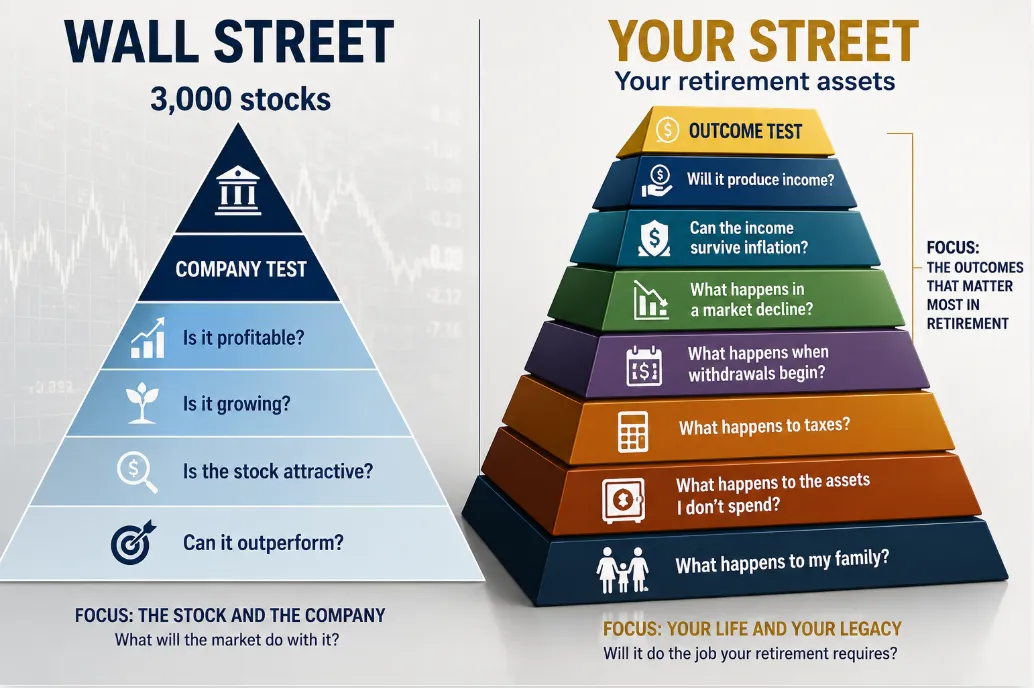
The Wall Street Quality Pyramid for Retirement
Start here: See what your retirement actually looks like → 👉 Book Your Million Dollar Hour™

By Frank L. Day, inventor of Million Dollar Hour. One of the fastest ways to uncover hidden risk
is to take our 7 Question Retirement Stress Test.
The Problem With Choosing a “Good” Stock for Retirement
1. Begin with the universe: not the assumption
The Russell 3000 represents approximately 3,000 U.S. public companies and covers roughly 98% of the investable U.S. equity market. It is a useful universe for illustration: not proof that every company inside it is equally strong, suitable, or retirement-ready.
FTSE Russell describes the Russell U.S. indexes here.
That distinction matters.
An index can give you access to thousands of companies. It cannot tell you which assets should produce your retirement income, protect your principal, absorb withdrawals, or support your family after you are gone.
This is the starting point for The Wall Street Quality Pyramid™.
It moves from what a company is to what an asset can actually do.
2. PROFITABLE: The first filter
A profitable company earns more than it spends over a stated period. That is useful information. It is not the finish line.
Profitability can fall as company capitalization declines. In some dated market measurements cited in the development of this framework, approximately 40%–43% of Russell 2000 companies were unprofitable. The exact figure varies by measurement date and definition, so it should never be presented as timeless or universal.
The lesson is simple:
A large market does not mean a large supply of equally productive businesses.
A company may be publicly traded, widely discussed, and included in an index while still losing money. A stock may rise because investors expect future profits. That does not make those profits present, durable, or available to fund your retirement.
Start with the question:
> Is this company profitable?
Then keep asking.
3. SOLID: A Your Street engineering filter
Solid is not an official Russell classification. It is not a third-party rating. It is a Your Street engineering filter.
A Solid company demonstrates more than one positive earnings report. It may show:
Consistent earnings
Positive cash flow
Manageable debt
A strong balance sheet
A durable competitive position
A sustainable business model
This is where the pyramid narrows.
Do not assign an unsupported percentage to the Solid category. The point is not to create a comforting statistic. The point is to improve the quality of the question.
A Solid company may be better equipped to withstand economic pressure than an unprofitable or heavily indebted company. But a strong company can still be purchased at a foolish price. It can still experience severe market declines. It can still be the wrong tool for a specific retirement job.
That is why company quality is necessary: but not sufficient.
4. INVESTABLE: Quality is not valuation
Investable is a separate valuation test.
A wonderful company may be a poor investment when its stock price assumes years of perfect execution. Conversely, a less celebrated company may become attractive when the price is justified by the business being purchased.
Ask:
> Is the price reasonable compared with the value, cash flow, risk, and future usefulness of the asset?
Do not confuse a great business with a great purchase.
Do not confuse a low price with a bargain.
Investability concerns whether the transaction makes mathematical sense. It does not automatically answer whether the asset belongs in a retirement-income design.
This is where many investors stop. Retirement planning must continue.

5. RETIREMENT-RELIABLE: The job test
Retirement-Reliable is uniquely a Your Street engineering filter. It is not an official market classification, index designation, or third-party rating.
The question changes from:
> Is this a good company?
to:
> Is this asset capable of doing the job my retirement requires?
Test the asset against the actual demands of retirement:
Will it produce usable income?
Can that income withstand inflation?
What happens during a market decline?
What happens when withdrawals begin?
How will taxes affect the income?
What happens to the assets not spent?
What happens to your spouse, children, and grandchildren?
A stock can pass the Profitable, Solid, and Investable filters and still fail the Retirement-Reliable test.
That is not a criticism of stocks. It is a recognition of design.
A hammer may be an excellent hammer. It is still not a complete house.

6. Compare the two questions
Wall Street often measures participation.
Your Street measures performance against a required outcome.
That distinction is foundational to Discipline 6 : Upgrade Your Thinking: accumulation strategies are not automatically retirement strategies.
A retirement plan must protect principal, reduce unnecessary loss, preserve forward progress, and protect time. Money can recover. Time never does.
7. Understand profit concentration
The market is not 3,000 equally strong businesses.
A historical profit-concentration observation supplied for this framework reported that the largest 100 U.S. companies accounted for 84.2% of corporate profits in 2015, compared with 48.5% in 1975. These are dated figures and require attribution to their original source. They should not be presented as current without verification.
The point does not depend on pretending those numbers are today’s numbers.
The point is that a relatively small number of large companies can generate a disproportionate share of corporate profits, while thousands of other companies make up the broader market universe.
So ask a better question than “Am I diversified?”
Ask:
> Am I diversified across assets that can perform the jobs my retirement requires?
Diversification across many uncertain assets may spread exposure. It does not automatically create reliable income.
8. Move from company selection to asset architecture
“Wall Street gives you thousands of choices. Your retirement doesn't need thousands of choices. It needs the right assets doing the right jobs.”
“That's why we don't just ask what an asset is worth. We ask what the asset is designed to do.”
This is the transition from Participation vs. Engineered Performance.
The traditional financial system can feel like a Rolodex in a SpaceX world: durable in its era, but incomplete for the speed, complexity, longevity, tax exposure, and income demands of modern retirement.
The Consolidation of Technology offers a useful analogy. Phones, pagers, cameras, calendars, televisions, and navigation systems once operated as separate tools. The smartphone consolidated many functions into one coordinated device.
Many traditional financial products remain single-use tools:
Banks may provide liquidity.
Stocks may provide growth potential.
Real estate may provide income or appreciation.
A Fully Performing Asset™, or FPA, is designed as a multi-pillar structure. Depending on the design, it may coordinate five to fifteen functions, including:
Growth
Protection
Income
Liquidity
Tax efficiency
Long-term care
Legacy
The objective is not to make one product do everything blindly. The objective is to engineer the right coordination.
9. Test the architecture through the nine levels
Use the 9 Levels of Retirement Discovery™ to move from general quality to personal usefulness:
Outcome: What income and legacy must the assets produce?
Cost: What taxes, fees, inflation, volatility, and lost time reduce the result?
Opportunity: Which assets are missing guarantees or productive functions?
Barrier: Which assumptions or outdated rules are limiting the design?
Truth: What is the actual return: not merely the average or projected return?
Risk: What losses could permanently destroy wealth or delay income?
Principle: Is principal protected before performance is pursued?
Value: What is the lifetime usefulness and present value of the money?
Synergy: Do the parts work together, or are they simply collected?
This is the logic of the Engineered Retirement Blueprint:
The Balance Sheet is the source of funds.
The Income Statement is the use of funds.
Margin is the battleground between positive and negative outcomes.
Audit the margin.
Inspect what you expect.
A plan that cannot be tested is merely a promise.
10. Begin the Complete Wealth Engineering Journey
The four categories: Profitable, Solid, Investable, and Retirement-Reliable: are not a prediction machine. They are filters for better decisions.
The journey continues through Fully Performing Assets™, Financial Torque™, and Complete Wealth Engineering™.
Financial Torque means improving the force and efficiency of the system without simply adding more risk. It asks whether each dollar, year, guarantee, tax decision, and income source is helping the rest of the structure perform.
This serves Discipline 1 : Protect the Principal, Discipline 2 : Protect Against Unnecessary Loss, and Discipline 5 : Increase Efficiency, Not Risk.
It also follows the Your Street standard:
> Preserve, Protect & Prolong: without leaks, drains, or unnecessary losses.
The Wall Street Cycle will continue to present routine 10%–20% swings and larger retractions. Historically, major declines have occurred repeatedly, and each substantial retraction can cost years of forward progress: especially when withdrawals begin at the wrong time.
Do not build a retirement plan around hope, headlines, or a single average return.
Use OOM™: Odds, Opinions, and Models: to stress-test every assumption.
I only promise the truth. Nothing more.
> No promises. No hype. Bring your assumptions, your numbers, and your questions. We'll test what is fact, what is opinion, and what is hope.
The Million Dollar Hour™ Forecast is a paid, one-on-one engineering review priced at $995. For an average-sized qualifying account, the immediate value may exceed $20,000, representing a potential 20:1 benefit-to-cost ratio. The offer also includes permanent tuition to the Retirement Reliability Academy.
Take one asset in your retirement plan and test it: Will it produce income, withstand inflation and market declines, support withdrawals, manage taxes, protect what you don’t spend, and serve your family? If you’re willing to test the answer, share the weakest point—or complete the Retirement Stress Test.
Use the session to examine your Margin Audit™, Volatility Recovery Analysis, Compounding Efficiency, and Sequence of Return Margin.
Choose architecture over participation.
Choose evidence over assumption.
Choose wisdom before another year disappears.
Your Money, Your Rules, In Your Time, On Your Street.
Peace is the path, wisdom is the way.
Research and classification note
The Russell 3000 is a market benchmark and investable-equity universe: not a retirement-quality ranking. “Solid” and “Retirement-Reliable” are Your Street engineering filters created to evaluate usefulness, reliability, and coordinated retirement performance. Historical profitability and profit-concentration figures must be reviewed against their original dated sources before publication or reuse.
Ready for clarity instead of confusion?
The Million Dollar Hour™ is your educational, one-on-one retirement review that reveals where your plan leads : not just where it’s been.
👉 Schedule your session today.