
Retirement Strategies That Maximize Income, Eliminate Risk, and Help Ensure You Never Run Out of Money How to Achieve The Retirement Future Everyone Seeks
Most retirement plans are built on assumptions that no longer hold up—market averages, predictable tax rates, and the belief that time will always recover losses. But as you approach or enter retirement, the rules change. What worked during your accumulation years can become a liability during the withdrawal phase.
This blog is designed to help you rethink traditional strategies and discover a more engineered approach to retirement income—one focused on certainty, efficiency, and control.
Here, you’ll learn how to reduce or eliminate the biggest threats to your financial future, including market losses, rising taxes, hidden fees, and the silent erosion caused by lost time. We break down complex financial concepts into clear, actionable insights so you can make better decisions about your 401(k), IRA, and retirement income strategy.
You’ll also discover why many conventional approaches—like relying on average returns or the 4% rule—can expose you to unnecessary risk, especially when withdrawals begin. Instead, we explore strategies designed to protect your principal, improve compounding efficiency, and create predictable income streams that last.
Our focus is on helping you transition from “assets at risk” to a more stable and structured approach using fully performing assets—where growth, income, and protection work together instead of against each other.
Whether you’re still working or already retired, the goal is simple:
help you keep more of what you earn, generate more reliable income, and build a plan that doesn’t depend on hope, timing, or market luck.
If you’ve ever wondered:
* How to create tax-efficient retirement income
* How to avoid sequence of returns risk
* How to reduce fees and increase net returns
* How to design income that doesn’t run out
—you’re in the right place.
Explore the articles below and start building a retirement strategy based on engineering, not guesswork.

Retirement Planning: Why Recovery is Killing Your Growth
The Unconscious Acceptance of Loss: Why Your Retirement Plan Is Built to Recover, Not Grow
![[HERO] The Unconscious Acceptance of Loss: Why Your Retirement Plan Is Built to Recover, Not Grow](https://cdn.marblism.com/KvHop1WHcnb.webp "[HERO] The Unconscious Acceptance of Loss: Why Your Retirement Plan Is Built to Recover, Not Grow")
Start here: See what your retirement actually looks like → 👉 Book Your Million Dollar Hour™
If you are an engineer, an architect, or a business owner, you’ve spent your entire career building things that are designed to last. You don’t design a bridge based on a "hope" that the wind won’t blow too hard. You don’t build a skyscraper and tell the client, "Well, the foundation might drop 30% this year, but it should average out over a decade."
That would be professional malpractice.
Yet, when it comes to retirement planning, most people are coached to accept a level of structural instability they would never tolerate in their professional lives.
Here is the framing question we need to address: "If your current retirement plan is producing lost time and lost money, what assumptions are you still accepting as true?"
If what you are producing is the opposite of what you are resisting, then resisting a stepped-up floor that never goes down means you may be unconsciously accepting the conditions that create loss, delay, and uncertainty.
1. The Myth of the "Normal" Rollercoaster
Traditional Wall Street planning has a way of gaslighting investors into believing that volatility is just "part of the game." They call it "Participation."
But let’s look at the actual Math of Recovery. Every downturn creates lost time, not just lost dollars.
If your $1M portfolio drops 20%, you have $800,000. To get back to $1M, you don’t need a 20% gain. You need a 25% gain. If you lose 30%, you need a massive 43% gain just to get back to the starting line.
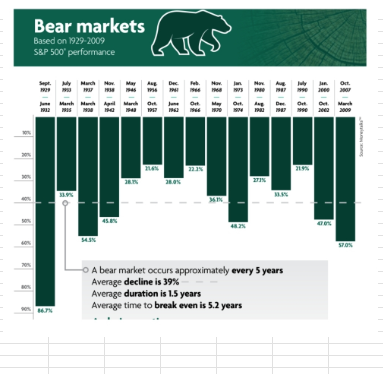
During that recovery period: which historically takes an average of 5.2 years: your money is not compounding. It is merely treading water. In the world of a "Quiet Builder," we call this The Unconscious Acceptance of Volatility. You’ve been told it's normal, but in reality, it is a structural flaw that extracts the one thing you can never get back: Time.
2. Recovery vs. Progression: The Hamster Wheel
A retirement plan built on traditional market participation is often forced into a cycle of: Gain -> Loss -> Recovery -> Repeat.
This is a plan built on recovery. A truly engineered plan is built on progression.
Imagine a "stepped-up floor" where every gain you make is locked in and becomes your new base. In this model, you aren't spending years trying to reclaim old ground. You are always moving forward from your highest point.
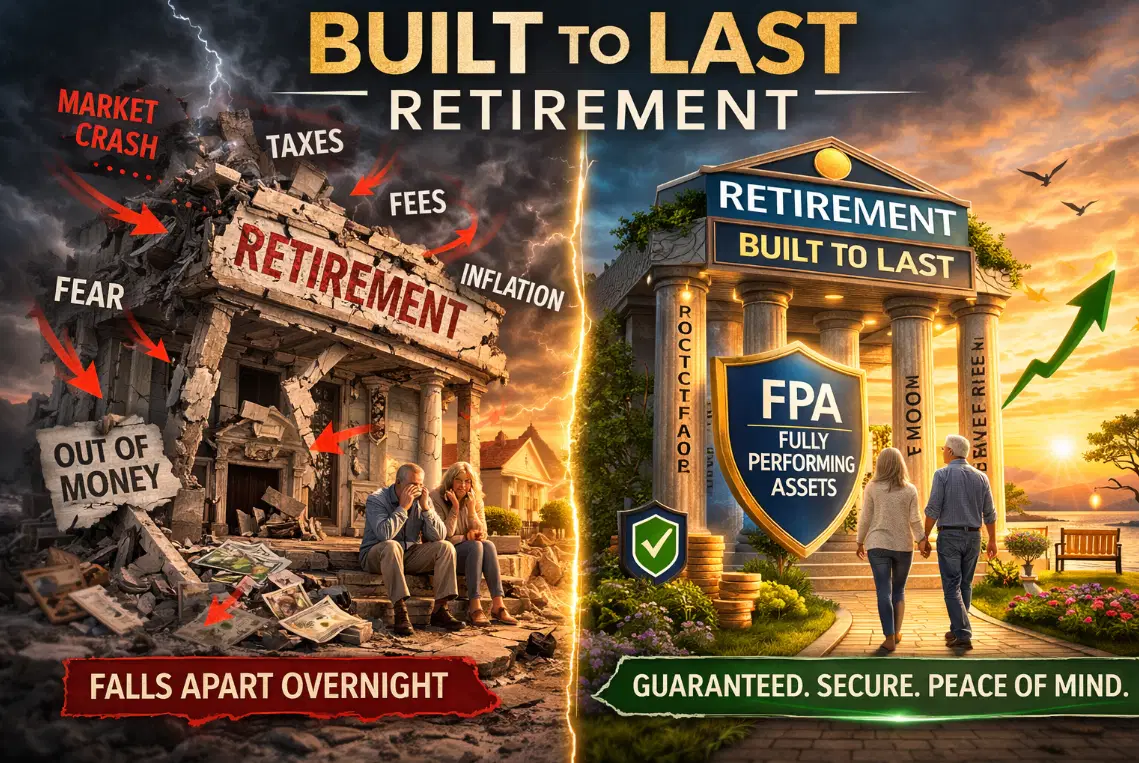
The question for your current advisor is simple: Is my strategy designed to grow, or merely to recover? If you are currently in "Assets at Risk" (AAR), you are participating in a gamble. If you move toward "Fully Performing Assets" (FPA), you are investing in architecture.
3. The Silent Killer: Sequence of Returns Risk
Wall Street loves to talk about "average returns." Averages are great for marketing brochures, but they are mathematically irrelevant to your actual retirement income.
Sequence of Returns Risk is the danger that the market takes a massive hit right as you begin to withdraw money. Two people can have the exact same 7% average return over 20 years, but if one person experiences losses in the first three years of retirement, they could run out of money a decade sooner than the person who saw gains early on.
Your "Sequence of Return Margin" is the buffer you have against this risk. If your plan doesn't have a defined floor, your sequence risk is effectively 100%. You are hoping the market behaves during your "Red Zone" (the years immediately preceding and following retirement). Hope is not a strategy; it’s a vulnerability.
4. Carrying Risk You Aren’t Being Paid to Take
During your accumulation years, market risk is a tool. You have time to offset the ripples of the market. But as you transition to the distribution phase, time becomes your scarcest asset.
Most retirees are still carrying "Accumulation-era" risk profiles in a "Distribution-era" life stage. This is like driving a race car in a school zone. It’s the wrong tool for the environment.
We often find that Quiet Builders are carrying "Assets at Risk" (AAR) simply because they don't know that Fully Performing Assets (FPA) exist. They are spinning sharp knives when they could be using institutional-grade engineering to lock in gains.
5. The Lack of a Defined Income Floor
A large account balance is a "Single Pillar" asset. If the market drops, your balance drops, and your potential income drops.
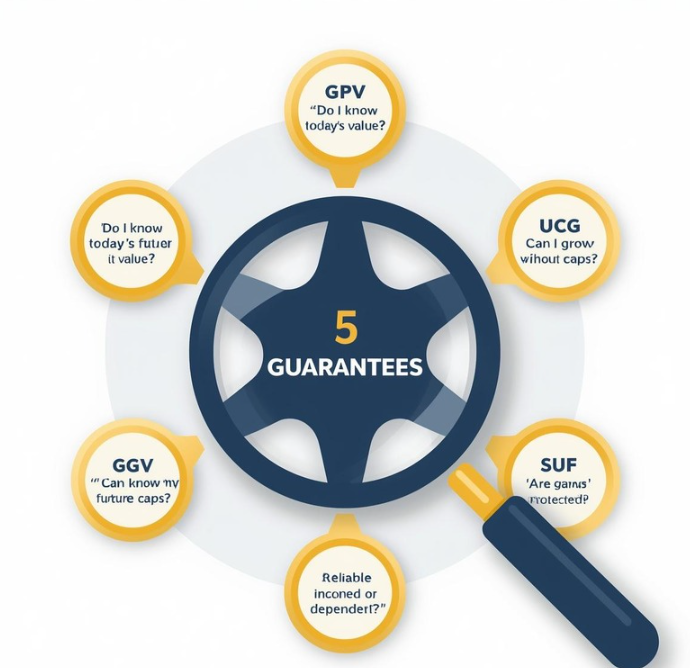
A true retirement plan should provide a Multi-Pillar foundation. Just as a smartphone replaced your pager, camera, map, and phone, modern banking architecture has consolidated financial "single-use" products into one vehicle.
We look for the 5-15 pillars of value, including:
Uncapped Gains (UCG)
Expanded Market Participation (EMP)
Guaranteed Principal Protection (The Floor)
Tax-Free Income potential
Long-Term Care benefits
If your plan focuses only on account balance and not on a defined income floor, your lifestyle is dependent on market whims rather than engineered certainty.
6. The Real Asset is Time, Not Return
The deepest truth of all is this: The most valuable asset you own is uninterrupted compounding time.
When losses occur, the compounding process stops. You then spend years "recovering" (as we discussed in Truth #1). By the time you get back to even, you’ve lost the most productive years of your money’s life.
By utilizing the Your Street Wealth approach: switching from the -30%/+30% Wall Street rollercoaster to a 0%/+30% Engineered Performance model: you protect the integrity of your time.
If this concerns you, you’re not alone. Most people have never actually seen what their money is doing — or where it leads. 👉 In the Million Dollar Hour™, we map your exact outcome:
• Today’s value • Future income • Hidden risks • What it should be doing instead Book your session here →
The Diagnostic: Is Your Retirement Engine Broken?
Most people don't realize their plan is broken until they try to put a load on it. At Your Street Wealth, we use two primary tools to find the cracks before they become catastrophes.
The 7 Question Stress Test
How much of your monthly income is legally guaranteed?
What specific portion of your principal can never decrease?
What is the mathematical impact of a 30% drop on your current lifestyle?
How many "leaks" (fees/taxes) are currently draining your compounding efficiency?
Does your plan use a "Rolodex" (Single Pillar) or a "Smartphone" (Multi-Pillar) model?
Are you being paid for the level of risk you are currently taking?
Is your income designed or is it merely dependent?
The 10 Reasons Your Engine is Stalling
From "Sequence Risk" and "Tax Volatility" to "Hidden Fee Extraction" and "Inflation Erosion," most traditional plans are running on a False Model driven by the fear and greed of Wall Street. They want you to "participate" because they get paid whether you win or lose.

Unlearning the Noise
The first step toward certainty is Awareness & Unlearning. You have to unlearn the myth that you must risk your principal to get a decent return. You have to unlearn the idea that a 1% fee is "small" when it actually extracts up to 30% of your potential gains over time.
We provide a Margin Audit™ and a Volatility Recovery Analysis to show you exactly where your current path leads. We don't guess. We engineer.
The Million Dollar Hour™ Forecast
For the "Quiet Builder" who is tired of the noise and wants a plan that reflects the same level of precision they put into their own work, we offer the Million Dollar Hour™ Forecast.
This isn't a "free consultation" where a salesman tries to pick your pocket. This is a $995, one-on-one professional engineering session. We perform a full Margin Audit™ of your current assets (AAR, NPA, UPA) and show you how to move them toward Fully Performing Assets (FPA).
In 60 minutes, we provide the architectural blueprint for a retirement that grows and heals, rather than one that merely survives the next market cycle.
Peace is the path, wisdom is the way. It’s time to move your money off of Wall Street and onto Your Street.
Your Money, Your Rules, In Your Time, On Your Street.
Learn more about the Million Dollar Hour™ Forecast here.
Ready for clarity instead of confusion?
The Million Dollar Hour™ is your educational, one-on-one retirement review that reveals where your plan leads : not just where it’s been.
👉 Schedule your session today.
You can keep participating… Or you can finally see the outcome. The Million Dollar Hour™ shows you exactly:
✔ Where you are ✔ Where you’re going ✔ How to fix the gaps 👉 Book your session now
Check out the Retirement Blueprint