
Retirement Strategies That Maximize Income, Eliminate Risk, and Help Ensure You Never Run Out of Money How to Achieve The Retirement Future Everyone Seeks
Most retirement plans are built on assumptions that no longer hold up—market averages, predictable tax rates, and the belief that time will always recover losses. But as you approach or enter retirement, the rules change. What worked during your accumulation years can become a liability during the withdrawal phase.
This blog is designed to help you rethink traditional strategies and discover a more engineered approach to retirement income—one focused on certainty, efficiency, and control.
Here, you’ll learn how to reduce or eliminate the biggest threats to your financial future, including market losses, rising taxes, hidden fees, and the silent erosion caused by lost time. We break down complex financial concepts into clear, actionable insights so you can make better decisions about your 401(k), IRA, and retirement income strategy.
You’ll also discover why many conventional approaches—like relying on average returns or the 4% rule—can expose you to unnecessary risk, especially when withdrawals begin. Instead, we explore strategies designed to protect your principal, improve compounding efficiency, and create predictable income streams that last.
Our focus is on helping you transition from “assets at risk” to a more stable and structured approach using fully performing assets—where growth, income, and protection work together instead of against each other.
Whether you’re still working or already retired, the goal is simple:
help you keep more of what you earn, generate more reliable income, and build a plan that doesn’t depend on hope, timing, or market luck.
If you’ve ever wondered:
* How to create tax-efficient retirement income
* How to avoid sequence of returns risk
* How to reduce fees and increase net returns
* How to design income that doesn’t run out
—you’re in the right place.
Explore the articles below and start building a retirement strategy based on engineering, not guesswork.
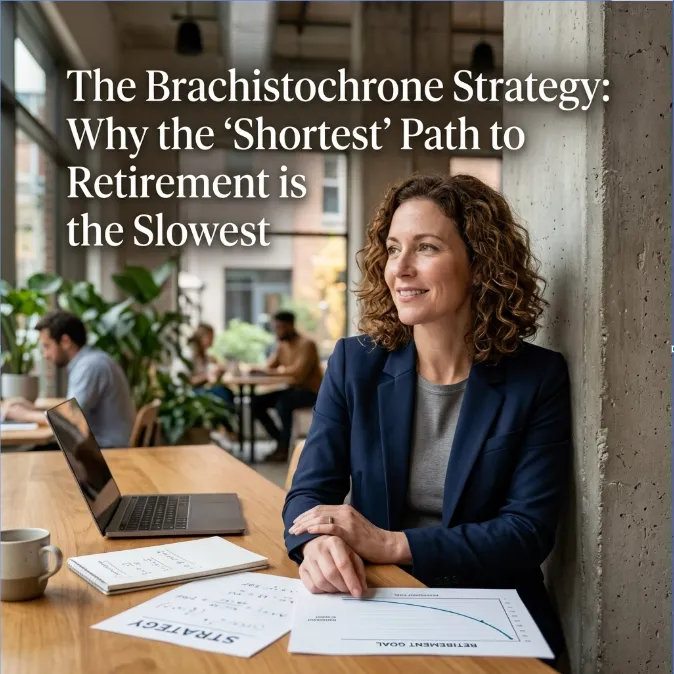
The Brachistochrone Strategy for Faster Retirement Planning
The Brachistochrone Strategy: Why the 'Shortest' Path to Retirement is the Slowest
One of the fastest ways to uncover hidden risk is to take our 7 Question Retirement Stress Test.
![[HERO] The Brachistochrone Strategy: Why the 'Shortest' Path to Retirement is the Slowest](https://cdn.marblism.com/piSFgcUfPI8.webp "[HERO] The Brachistochrone Strategy: Why the 'Shortest' Path to Retirement is the Slowest")
Start here: See what your retirement actually looks like → 👉 Book Your Million Dollar Hour™
The Physics of Wealth: Why Wall Street’s ‘Straight Line’ is Costing You Years
If you were to take a marble and race it down two different tracks: one a perfectly straight ramp and the other a steep, deep curve: which one would reach the finish line first?
Logic tells most people the straight line wins. After all, it’s the shortest distance between two points. But physics tells a different story. In a famous problem known as the Brachistochrone, the marble on the curved path (specifically a cycloid curve) hits the bottom significantly faster than the one on the straight line.
Why? Because the curve drops more steeply at the beginning, allowing the marble to gain massive velocity early on.
This is a powerful metaphor for retirement strategy. It reveals a principle most "Quiet Builders" miss: The shortest distance is not always the fastest path to the destination.
At Your Street Wealth, we look at your money through the lens of engineering, not just "participation." While Wall Street tries to sell you on the "Straight Line" of market averages, we focus on the architecture of velocity.
1. The Straight Line: Wall Street’s Slower Path
Most people are taught to believe that the direct path to retirement looks like a straight line:
Save consistently in a 401(k) or IRA.
Invest in the market and "ride the waves."
Wait 20–30 years.
Withdraw later and hope the math holds up.
This feels like the "shortest line" between where you are and where you want to be. It seems logical, predictable, and simple. But just like the straight line in the physics experiment, it is rarely the fastest route to financial independence.
The problem with the straight-line strategy is that it ignores momentum drag. In the financial world, momentum drag is caused by taxes, fees, and: most importantly: the Math of Recovery.
The Math of Recovery: Why Losses Steal Your Time
When your portfolio takes a hit, you don’t just lose money; you lose the time required to get back to where you started. This is the Volatility Recovery Analysis that most brokers won't show you.
The Math of Recovery: Why Losses Steal Your Time
10% Loss= Needs an 11.1% Gainjust to break even.
20% Loss= Needs a 25% Gainjust to break even.
30% Loss= Needs a 42.8% Gainjust to break even.
40% Loss= Needs a 66.7% Gainjust to break even.
50% Loss= Needs a 100% Gainjust to break even.
When you are in "Recovery Mode," your wealth has zero velocity. You aren't moving toward the finish line; you’re just trying to get back to the starting blocks. This is why the Wall Street "straight line" is actually the slowest path: it’s full of hidden stops and backward slides that steal years from your retirement date.

2. The Cycloid Curve: Engineering Early Velocity
In the Brachistochrone problem, the winning path is the cycloid: a curve that drops steeply at the beginning. By prioritizing speed early, the marble gains enough momentum to coast through the rest of the track while the "straight line" marble is still plodding along.
In retirement terms, this means front-loading your Compounding Efficiency.
Instead of just "participating" in the market and hoping for the best, an engineered strategy focuses on:
Reducing Loss Drag: Implementing a 0% floor so you never have to play the "Math of Recovery" game.
Increasing Early Cash-Flow Efficiency: Getting your dollars to do more than one job at the same time.
Improving Tax Positioning: Ensuring that "Future You" isn't a 50/50 partner with the IRS.
Protecting Against Sequence Risk: Designing a plan where the timing of market returns doesn't dictate your lifestyle.
The early part of the curve creates greater momentum. When you eliminate the periods where your money is "standing still" or moving backward, you create a Velocity Multiplier effect.
3. The "Smartphone" vs. the "Rolodex"
To understand why the Brachistochrone Strategy works, we have to look at the tools being used. Most traditional retirement plans are built on Single-Pillar Assets.
Think of banks, stocks, and real estate as "single-use" tools. They are like having a Rolodex, a pager, and a paper map. They were durable in the 1980s, but they are inadequate for the speed and technical demands of modern retirement planning. They are "Single-Pillar" because they usually only do one thing well (like growth or liquidity), but they often come with high fees or high risk.
At Your Street Wealth, we utilize Fully Performing Assets (FPA). Think of the FPA as the "smartphone" of finance. It consolidates 5–15 pillars of value: growth, protection, tax-free income, and long-term care: into one engineered vehicle.
By using FPAs, we can achieve Uncapped Gains (UCG) and Expanded Market Participation (EMP). This allows your wealth to capture the upside of the market (sometimes with a 110%–200% multiplier) while maintaining a 0% floor against losses.

4. Lost Time is the Real Enemy
The Brachistochrone principle teaches us that the path that gains speed fastest wins. In retirement, the strategy that preserves momentum wins.
Wall Street’s "False Model" is driven by fear and greed. They want you to stay addicted to the headlines, buying and selling, and chasing the "next big thing." This creates a high-vibration, high-noise environment where your Sequence of Return Margin is constantly under threat.
Every recovery period steals time. If you spend three years recovering from a 30% market drop, those are three years of your life you can never get back. You didn't just lose money; you lost the speed required to reach your destination.
Just as the brachistochrone curve reaches the destination faster than a straight line, the most effective retirement strategy is not always the most obvious one. The winning path is the one that builds speed early, protects momentum, and eliminates recovery time.
5. Architectural Precision: The Margin Audit™
For the "Quiet Builder": the successful individual between ages 45 and 75 who is tired of the noise: the answer isn't "more information." The answer is Architecture.
You wouldn't build a custom home by just buying a bunch of wood and "participating" in a construction site. You would hire an architect to create a blueprint that accounts for every load-bearing wall and foundation requirement.
Your retirement deserves the same level of engineering. We use a process called the Margin Audit™ to look for "leaks" in your current plan: unnecessary taxes, hidden fees, and unnecessary volatility risk.
We don't guess. We engineer.

The Choice: Participation vs. Performance
You have a choice in how you approach the final stretch of your financial journey:
Participation (Wall Street): You follow the straight line. You accept the 10-20% periodic drawdowns. You hope that "average returns" will be enough. You stay in a state of "financial fatigue," wondering if you’ll ever actually arrive.
Performance (Your Street): You follow the curve. You engineer a 0% floor to protect your momentum. You use FPAs to create multi-pillar stability. You focus on velocity and compounding efficiency.
One path is common; the other is architectural. One relies on luck; the other relies on rules.
Peace is the path, and wisdom is the way. If you are ready to stop chasing the "straight line" and start engineering the curve that gets you home faster, it’s time to change your perspective.
The Million Dollar Hour™ Forecast
The first step in moving from a "Straight Line" assumption to a "Time-Optimized" wealth curve is our Million Dollar Hour™ Forecast.
This isn't a high-pressure sales pitch or a "free" consultation designed to sell you a product. This is a $995, institutional-grade engineering session. We perform a deep-dive diagnostic on your current trajectory to see where your plan actually leads: not just where the brochures say it should.
We look at your Volatility Recovery Analysis and your Sequence of Return Margin. We identify the "Single Pillar" risks that are slowing you down and show you how to transition to a foundation of Fully Performing Assets.
It is 60 minutes of clarity designed to last for the rest of your life.
Because in the end, it’s Your Money, Your Rules, In Your Time, On Your Street.
Ready for clarity instead of confusion?
The Million Dollar Hour™ is your educational, one-on-one retirement review that reveals where your plan leads : not just where it’s been.
👉 Schedule your session today.
Concerned about market losses, taxes, or income reliability?
Take the 7 Question Retirement Stress Test →
You can keep participating… Or you can finally see the outcome. The Million Dollar Hour™ shows you exactly:
✔ Where you are ✔ Where you’re going ✔ How to fix the gaps 👉 Book your session now
Check out the Retirement Blueprint