
Retirement Strategies That Maximize Income, Eliminate Risk, and Help Ensure You Never Run Out of Money How to Achieve The Retirement Future Everyone Seeks
Most retirement plans are built on assumptions that no longer hold up—market averages, predictable tax rates, and the belief that time will always recover losses. But as you approach or enter retirement, the rules change. What worked during your accumulation years can become a liability during the withdrawal phase.
This blog is designed to help you rethink traditional strategies and discover a more engineered approach to retirement income—one focused on certainty, efficiency, and control.
Here, you’ll learn how to reduce or eliminate the biggest threats to your financial future, including market losses, rising taxes, hidden fees, and the silent erosion caused by lost time. We break down complex financial concepts into clear, actionable insights so you can make better decisions about your 401(k), IRA, and retirement income strategy.
You’ll also discover why many conventional approaches—like relying on average returns or the 4% rule—can expose you to unnecessary risk, especially when withdrawals begin. Instead, we explore strategies designed to protect your principal, improve compounding efficiency, and create predictable income streams that last.
Our focus is on helping you transition from “assets at risk” to a more stable and structured approach using fully performing assets—where growth, income, and protection work together instead of against each other.
Whether you’re still working or already retired, the goal is simple:
help you keep more of what you earn, generate more reliable income, and build a plan that doesn’t depend on hope, timing, or market luck.
If you’ve ever wondered:
* How to create tax-efficient retirement income
* How to avoid sequence of returns risk
* How to reduce fees and increase net returns
* How to design income that doesn’t run out
—you’re in the right place.
Explore the articles below and start building a retirement strategy based on engineering, not guesswork.
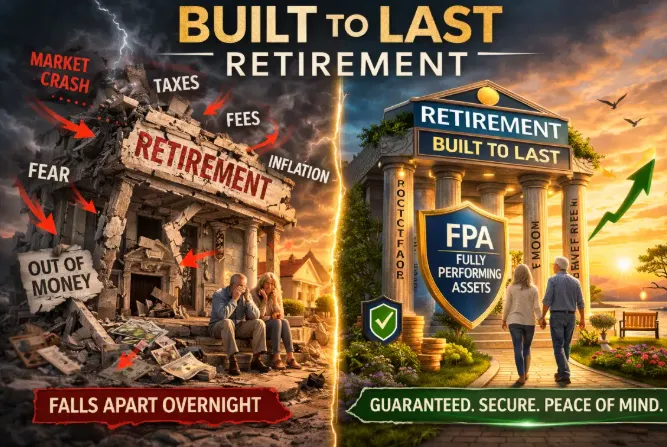
The Chaos Trap: Process Not Plan
The Chaos Trap: Why Your Retirement Needs a Process, Not a Plan
One of the fastest ways to uncover hidden risk is to take our 7 Question Retirement Stress Test.
![[HERO] The 'Hope' Strategy vs. The 'Heavily Founded' Plan](https://cdn.marblism.com/jTEDbl1C7OC.webp "[HERO] The 'Hope' Strategy vs. The 'Heavily Founded' Plan")
Start here: See what your retirement actually looks like → 👉 Book Your Million Dollar Hour™
If you’ve spent the last twenty or thirty years building a career, a business, or a family, you’re what we call a Quiet Builder. You’re not chasing hype. You’re not looking for a hot tip. You’ve done the work. Now you want to know whether the work will actually take care of you.
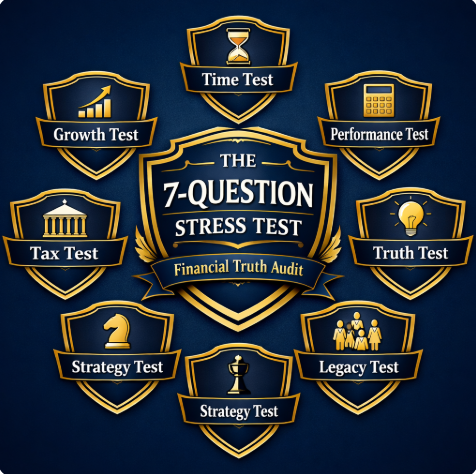
If that sounds like you, start with the 7 Question Retirement Stress Test to see whether your current plan is built on order or chaos. And if you’re ready for a higher-level diagnostic, the Million Dollar Hour™ Forecast is where theory gives way to measured reality.
That’s where retirement planning gets uncomfortable.
Because most people don’t actually have a process. They have a plan-shaped pile of assumptions.
And that matters, because you cannot produce order from chaos.
A traditional Wall Street “plan” often sounds polished, but underneath it is just a bundle of conditional events:
if the market recovers in time
if inflation behaves
if fees don’t drag too hard
if taxes don’t rise
if you don’t need income during a downturn
if sequence risk doesn’t show up at the wrong moment
That’s not a process. That’s chaos with nicer stationery.
A true process synchronizes multiple orchestrated steps to produce confidence. It does not wait for good luck. It does not depend on case-by-case improvisation. It is designed to work by rule, not by wish.
That is the real divide between Participation vs. Engineered Performance.
The Chaos Trap: Plans That Depend on Conditions
The traditional Wall Street model is built on motion, noise, and complexity. It encourages people to participate in products they do not control, risks they cannot time, and outcomes they cannot guarantee.
That may work when you’re 35 and still building. It gets a lot shakier when you’re 55, 62, or already retired.
Why? Because retirement is not just about growing money. It’s about protecting time.
And time gets wrecked when your so-called plan only works under favorable conditions.
If you lose money during the years when you need to draw income, the damage is not just numerical. It is structural. A decline in the wrong season can permanently reduce how much income your portfolio can support.
This is why we use the phrase Participation vs. Engineered Performance.
Participation means you are exposed and reactive.
Engineered Performance means the strategy is architected to create order.
Traditional retirement models are often built on single-pillar assets: banks, stocks, or real estate. Each may do one thing reasonably well, but each carries blind spots, fees, delays, or unnecessary risk. It’s a Rolodex in a SpaceX world.
And here’s the deeper problem: if you can only recognize the “best” solution after you arrive there, that is not planning. That is hindsight wearing a blazer.
The real opportunity is to learn before you leap, then choose with your eyes open.
To escape chaos, a person has to be ready and open enough to discover what is better, or even what is best, before the market teaches the lesson the expensive way. That is the whole point of education. Not pressure. Not hype. Clarity.
If it were your money, and it is, what would you do and allow?
That question simplifies everything. What would you allow to keep happening? Hidden fees? Uncontrolled losses? Average-based assumptions pretending to be certainty? And what would you choose instead if the math showed a better structure?
You need guidance before the fact so you can make your own decision on purpose, not become a victim of unchosen circumstances.

The Math of Recovery: Chaos Charges Interest
Here’s the simple math Wall Street rarely slows down enough to explain:
A 10% loss requires an 11.1% gain to recover.
A 20% loss requires a 25% gain to recover.
A 30% loss requires a 42.8% gain to recover.
A 40% loss requires a 66.7% gain to recover.
A 50% loss requires a 100% gain to recover.
That is The Math of Recovery.
So when someone says, “Just hang in there, the market always comes back,” the real question is: how much time did the recovery cost you?
That’s where retirement planning usually breaks down.
You can estimate income needs. You can estimate expenses. But when losses, fees, and taxes are not engineered around, you cannot confidently predict future portfolio value. The future becomes a moving target.
That’s why we use Volatility Recovery Analysis and examine your Sequence of Return Margin. If a major loss happens early in retirement, your withdrawals can compound the damage. You’re not just recovering dollars. You’re trying to recover time. And time does not compound backward.
Chaos does not just create stress. It creates delay. And delay in retirement can be expensive.

The 7-Step Process: How Order Gets Built
The goal is not more opinions. The goal is a process that creates order on purpose.
Here is the 7-step framework we use to help Quiet Builders move from financial chaos to financial architecture.

Step 1: Question Everything
Stop accepting “traditional” as “correct.”
A lot of people inherit beliefs about money the same way they inherit old tools in a garage. Durable? Maybe. Ideal for today? Not necessarily.
Start with the foundation and ask the most important question first:
Is your income designed or dependent?
If your retirement income depends on market performance, fund manager timing, or favorable headlines, then your plan is dependent. A real process begins by questioning whether the current model deserves your trust in the first place.

Step 2: Inspect What You Expect

Next, inspect the math behind the promises.
Most people know what they own, but they do not know how their current plan behaves under pressure. This is where The Margin Audit™ begins.
A proper inspection looks at:
risk exposure
fees
taxes
unrealized recovery time
income fragility
compounding efficiency
This is not about big headlines. It’s about micro margins. Wealth is usually lost in the cracks, not the commercials.

Step 3: Seek Unconditional Process

Now ask whether the system itself can produce order, or whether it simply reacts to chaos.
Wall Street often sells conditional outcomes:
if the market cooperates
if inflation stays manageable
if you don’t retire during a downturn
if fees don’t drag too much
if taxes don’t rise
if you don’t need money at the wrong time
That’s a lot of “ifs” for a retirement plan.
A true process seeks an unconditional process. This is where institutional-grade Asset Liability Management and modern banking architecture matter.
Instead of relying only on single-pillar assets, we evaluate whether the plan should shift core retirement dollars toward Fully Performing Assets (FPA), which can provide multiple pillars of value inside one structure.
Think of it like the Consolidation of Technology. We used to carry a phone, pager, camera, map, flashlight, and music player. Now one smartphone handles it all. Finance evolved too. Banks, stocks, and real estate are single-use tools. FPA is the multi-pillar model.
That is not hype. That is design.

Step 4: Determine Your Preferred Financial Rules
Once the process is sound, define the rules that fit your life.
This is where many plans finally become personal.
Your Money, Your Rules, In Your Time, On Your Street.
Instead of accepting whatever Wall Street is selling this quarter, a designed process asks:
What level of risk is acceptable?
What must be protected?
What must be liquid?
What income must be guaranteed?
What growth must be pursued without exposing the foundation?
This is also where we explain Uncapped Gains (UCG) and Expanded Market Participation (EMP) when relevant.
For example, if a strategy offers 110% to 200% participation on uncapped gains, then a 10% gain in the measured index may translate into an 11% to 20% gain in the asset, depending on the design. That’s very different from the old broker cliché that these strategies are “capped at 3%.” That’s usually outdated or incomplete framing.

Step 5: Forecast Your Future
Now we stop guessing and start measuring direction.
After the first four steps, the natural next step is not more theory. It is diagnosis.
This is where the Million Dollar Hour™ Forecast becomes essential for the Quiet Builder who is ready to move from chaos to order.
In this 60-minute professional review, we move from theory to reality. We review your current retirement structure, calculate what your money has actually done instead of what you were told it did, measure exactly how many years have been lost to Wall Street’s deception of the averages, and show the personalized, guaranteed path forward.
That matters because Wall Street planning often leans on averages that look respectable on paper but collapse under real-life sequencing, losses, fees, taxes, and withdrawals. Average returns can make a volatile portfolio look smoother than real life. But real life does not arrive as an average. It arrives year by year, loss by loss, withdrawal by withdrawal. That is why averages can flatter a plan that is quietly breaking your future.
The Million Dollar Hour™ Forecast is the diagnostic tool that exposes that gap. It shows the difference between a sales illustration and a real-world retirement path. It gives you a measured view of where you are, what it has cost you, and what changes when the negative years are engineered out.
This is not entertainment. It is a paid, professional, high-level review for people who value their time and want architectural certainty.
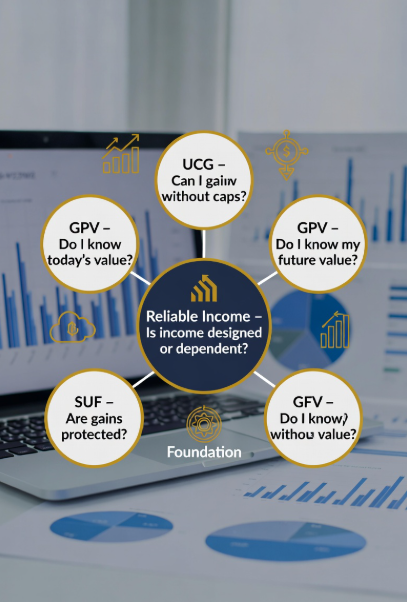
The forecast helps answer:
Where is your current plan actually leading?
How efficient has compounding really been?
Exactly how many years has volatility cost you?
How much damage came from the deception of averages?
What would change if the negative years were engineered out?
What does a personalized, guaranteed path forward look like?

Step 6: Run a Side-by-Side Forecast
Once the numbers are clear, we compare.
This is where the split between Participation vs. Engineered Performance becomes obvious.
Participation
built on market exposure
exposed to losses
dependent on recovery
vulnerable to sequence risk
often buried in fees and tax drag
range: -30% to +30%
Engineered Performance
built on rules
designed around protection
focused on compounding efficiency
structured for income durability
rooted in modern banking architecture
range: 0% to +30%
That comparison matters because once the negative side is removed, the math changes. You stop spending years trying to get back to zero. You stop donating time to volatility.
Step 7: Run a Margin Between the Two
This is where clarity becomes decision-making.
A side-by-side comparison is helpful. But a real decision requires measuring the gap between the two paths.
That is the purpose of The Margin Audit™.

We quantify the “cost of doing nothing” by measuring:
time lost to volatility
wealth lost to fees and taxes
recovery years created by market declines
missed compounding efficiency
the difference between conditional participation and engineered order
This is not theory. It is a mathematical review of what your current structure is costing you.
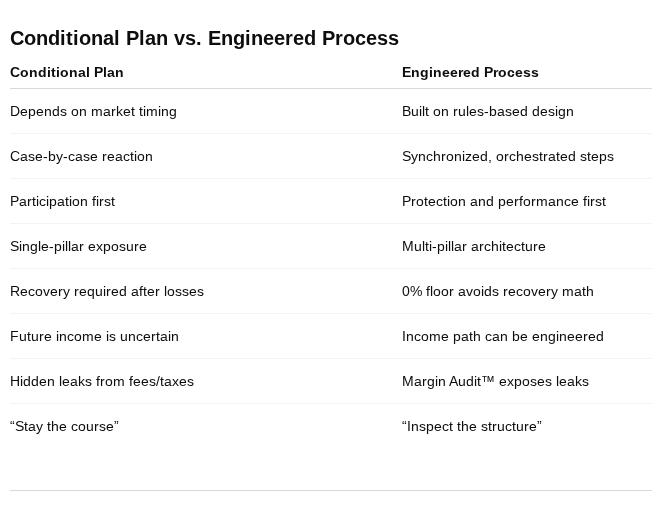
Process vs. Plan
Here’s the clean comparison.
If your retirement only works when conditions are favorable, it’s not a process. It’s a conditional event.

Why Guidance Matters Before It’s Too Late
One of the biggest traps in retirement planning is believing you will know the right answer when you see it.
But if you only realize something was right after you arrive, the decision window may already be gone.
That is why guidance matters.
Not so someone can think for you. So you can think clearly enough to decide for yourself.
The goal is not dependency. The goal is direction.
And direction gets clearer when you understand this: People only make mistakes when they think they know enough to understand how it might succeed but haven't learned enough to not know how it will fail. Chaos thrives in that gap between partial understanding and real certainty. Order begins when people are willing to inspect the failure points, not just admire the possible upside.
That is what a good process does. It helps you avoid becoming a victim of unchosen circumstances and gives you a way to make measured decisions before chaos sends you the bill.

The Better Standard
Wall Street’s false model thrives on fear and greed. High greed usually means higher exposure to loss. High fear often signals lower exposure and more caution. But headlines are not a strategy.
Engineering is a strategy.
This is why we write these articles the way we do. The blog is the free educational beacon. The real work is the architecture.
For high-intent readers who want precision, the Million Dollar Hour™ serves as a professional, paid review built for the Architect mindset. It is designed to help Quiet Builders unlearn old myths, understand modern financial architecture, and make decisions that can last for life.
The Million Dollar Hour™ is the order-making discovery session. It is the necessary next step for the Quiet Builder who is done with assumptions and ready for measurement. It is where the noise gets stripped away, the numbers get tested, the deception of averages gets exposed, and the process becomes visible.
If you value your time, want a high-level review, and are ready to see whether your current structure is producing chaos or certainty, this is where that answer gets engineered.
Peace is the path, wisdom is the way.
Ready for clarity instead of confusion?
The Million Dollar Hour™ is your educational, one-on-one retirement review that reveals where your plan leads — not just where it’s been.
👉 Schedule your session today.
Concerned about market losses, taxes, or income reliability?
Take the 7 Question Retirement Stress Test →
You can keep participating… Or you can finally see the outcome. The Million Dollar Hour™ shows you exactly:
✔ Where you are ✔ Where you’re going ✔ How to fix the gaps 👉 Book your session now
Check out the Retirement Blueprint