
Retirement Strategies That Maximize Income, Eliminate Risk, and Help Ensure You Never Run Out of Money How to Achieve The Retirement Future Everyone Seeks
Most retirement plans are built on assumptions that no longer hold up—market averages, predictable tax rates, and the belief that time will always recover losses. But as you approach or enter retirement, the rules change. What worked during your accumulation years can become a liability during the withdrawal phase.
This blog is designed to help you rethink traditional strategies and discover a more engineered approach to retirement income—one focused on certainty, efficiency, and control.
Here, you’ll learn how to reduce or eliminate the biggest threats to your financial future, including market losses, rising taxes, hidden fees, and the silent erosion caused by lost time. We break down complex financial concepts into clear, actionable insights so you can make better decisions about your 401(k), IRA, and retirement income strategy.
You’ll also discover why many conventional approaches—like relying on average returns or the 4% rule—can expose you to unnecessary risk, especially when withdrawals begin. Instead, we explore strategies designed to protect your principal, improve compounding efficiency, and create predictable income streams that last.
Our focus is on helping you transition from “assets at risk” to a more stable and structured approach using fully performing assets—where growth, income, and protection work together instead of against each other.
Whether you’re still working or already retired, the goal is simple:
help you keep more of what you earn, generate more reliable income, and build a plan that doesn’t depend on hope, timing, or market luck.
If you’ve ever wondered:
* How to create tax-efficient retirement income
* How to avoid sequence of returns risk
* How to reduce fees and increase net returns
* How to design income that doesn’t run out
—you’re in the right place.
Explore the articles below and start building a retirement strategy based on engineering, not guesswork.
The Engine Paradox: Wall St Building Wealth or Burning Fuel
The Engine Paradox: Is Wall Street Building Wealth or Just Burning Fuel?
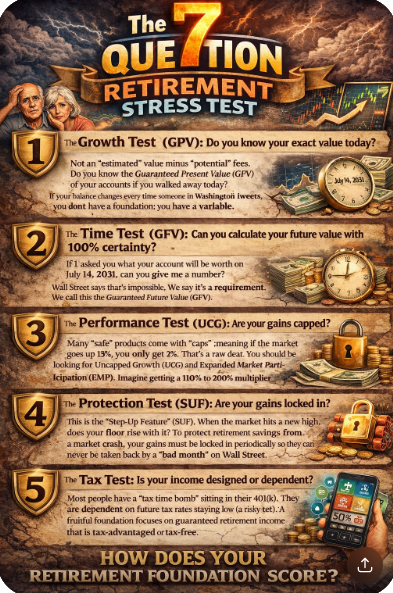
One of the fastest ways to uncover hidden risk is to take our 7 Question Retirement Stress Test.
![[HERO] The Engine Paradox: Is Wall Street Building Wealth or Just Burning Fuel?](https://cdn.marblism.com/OIcfC6huxlz.webp "[HERO] The Engine Paradox: Is Wall Street Building Wealth or Just Burning Fuel?")
Start here: See what your retirement actually looks like → 👉 Book Your Million Dollar Hour™
The Engine Paradox: Is Wall Street Building Wealth or Just Burning Fuel?
If you owned a car that leaked half its fuel every time you hit a red light and occasionally rolled backward down the hill you just climbed, you’d stop driving it. You certainly wouldn’t pull into the gas station and brag to your friends about how much "performance" you’re getting.
Yet, this is exactly how most people handle their retirement accounts.
Welcome to the Engine Paradox. It’s the logical loop that Wall Street Wally uses to keep you trapped in a cycle of "Participation" while he collects his 1.5% Ransom. If you’re a Quiet Builder: someone who has spent decades working hard, staying under the radar, and accumulating a respectable nest egg: you’re likely starting to realize that the "engine" you were sold isn’t actually designed to get you to the finish line. It’s designed to keep you buying more fuel.
The Two Questions Wally Can’t Answer
Let’s look at the "Broken Engine" logic through two simple questions that expose the False Model of traditional financial planning:
If Wall Street is a "reliable engine," why do we keep growth at risk? If the system actually worked the way the brochures say, you wouldn’t need to keep your winnings on the table. You’d move that growth to safety the moment it appeared.
If the engine is unreliable, why do we keep feeding it more resources? If you know the market can (and will) retract, why would you continue to pour your hard-earned capital into a machine that can’t guarantee it won’t consume your principal?
The reality is that Wall Street isn't an engine of wealth creation for you; it’s a "Participation" machine for them. They want you to believe that "time in the market" is the only way, but they rarely mention the Math of Recovery. When you hit a 30% "pothole" in the market, you don't just need a 30% gain to get back to even. You need a 42% gain just to see the surface again. While you’re spinning your wheels trying to recover, Wall Street Wally is still collecting his fee on whatever is left.
The 4 Wealth Killers
In our Margin Audit™, we look at the four specific leaks that drain your engine of its power. If you don't plug these holes, it doesn't matter how much "growth" you see on paper.
Retractions (Market Losses): The 18-month Pothole that resets your compounding clock.
Time: The only asset you can’t buy back. Spending five years recovering from a crash is five years of your life stolen.
Taxes: The silent partner who takes a cut of the "growth" but never shares in the "loss."
Fees: The 1.5% Ransom that Wally collects whether you win or lose.
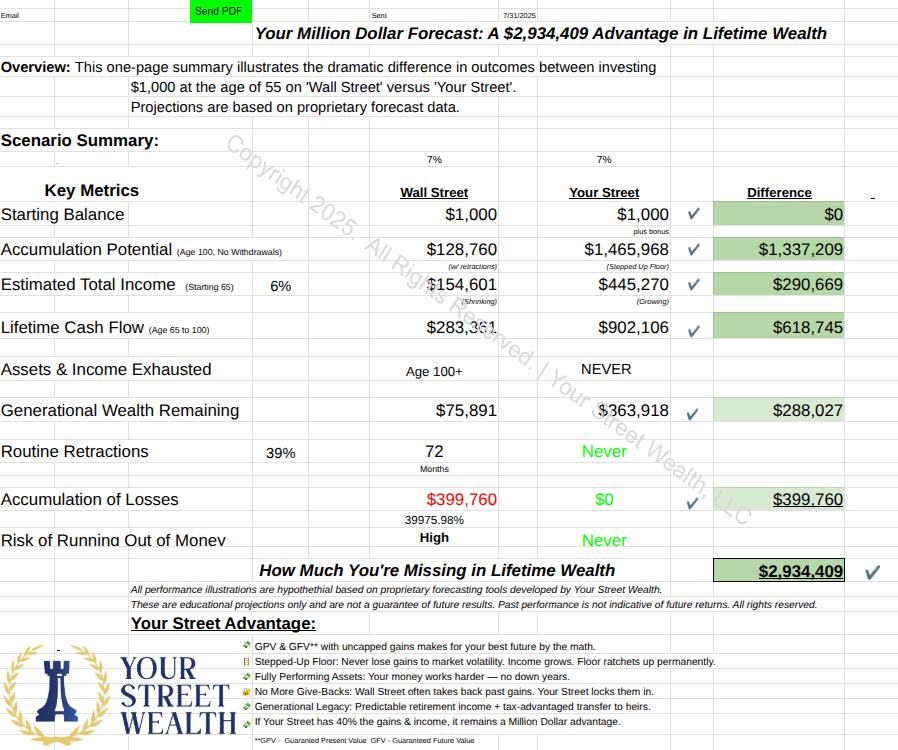
The Tax Trap: A Wealth Killer in Disguise
One of the most offensive parts of the "Broken Engine" logic is how taxes interact with market volatility. Think about this: If your account grows by $100,000, you are now liable for taxes on that growth (depending on the account type). But if the market retractions hit and you lose that $100,000 the following year, does the government give you a refund on the tax liability you were mentally preparing for?
No. In many cases, you are paying taxes on growth that can be lost in an instant. That’s the Tax on a Mirage. It’s a "Wealth Killer" of the highest order. It’s like paying a toll to cross a bridge, getting halfway across, and then having the bridge collapse. You’re back where you started, but you’re still out the toll money.
The 1% Guarantee Challenge
Here’s the blunt question Wall Street never wants to answer: If Wall Street is such a world-class wealth engine, why won’t they guarantee even 1%?
In any other industry, a high-performance machine comes with a warranty. If a company told you their engine was elite, but also told you that every breakdown, every backslide, and every failure was your problem, you’d laugh them out of the room. Yet that’s exactly how the Wall Street model works. They hand you 100% of the risk and 0% of the guarantee and still expect you to call it a plan.
Think about it: Wall Street calls their model "safe" and "proven," yet they won’t even guarantee you a basic bank savings rate. If the engine were truly reliable, they’d at least match the floor of a local savings account. Instead, they leave your floor at rock bottom while they collect their 1.5% Ransom on the way down. That’s not a warranty. That’s a sales pitch with no accountability.
That’s what makes the Engine Paradox so obvious once you see it. A real engine protects progress. A real system locks in gains. A real design doesn’t force you to rebuild from scratch every time the market hits an 18-month pothole. If new growth can vanish on the next downturn, the engine isn’t performing. It’s just burning fuel and calling it motion.
This is also where Participation vs. Engineered Performance becomes crystal clear. Participation says, “Take the ride, absorb the losses, hope the math works out.” Engineered Performance says, “Protect the gain, defend the margin, and grow from a stronger floor.” That difference matters because the Math of Recovery is ruthless. Lose 30%, and you need 42% just to get back to even. Add taxes and fees to that mess, and now you’re not just recovering money. You’re recovering time.
And that brings us right back to the Tax on a Mirage. Wall Street is happy to celebrate the paper gain on the way up, but when that gain disappears, the system has no warranty, no floor, and no apology. You can estimate what income you’ll need in retirement. What you cannot predict is future portfolio value when losses, fees, and taxes are still allowed to punch holes in the tank.
That’s why the issue isn’t whether the market sometimes goes up. Of course it does. The issue is whether the system is engineered to keep what it earns. If it can’t guarantee even 1%, protect new growth, or shield your progress from being taxed and then erased, calling it a wealth engine is generous. Calling it broken is more honest.
The "Rolodex in a SpaceX World"
Traditional retirement strategies: the kind your father used in the 1980s: were durable for their era. But today? They are a Rolodex in a SpaceX world. The speed of information, the volatility of global markets, and the complexity of modern tax codes have rendered the "Buy, Hold, and Hope" model obsolete.
Wall Street uses hidden complexity to drive daily research and addictive buying and selling. They want you checking your apps, feeling the "Greed/Fear" meter swing, and staying glued to the headlines. Why? Because as long as you are "Participating," they are profiting.
Engineering Certainty: The Your Street Way
At Your Street Wealth, we don't believe in "Participation." We believe in Engineered Performance. We use institutional-grade Asset Liability Management (ALM): the same architecture used by major banks: to build a plan that prioritizes certainty before growth.
We categorize assets into four stages, which we call the Asset Pyramid:
NPA (Non-Performing Assets): Your emergency fund and "infant" cash.
AAR (Assets At Risk): The "teens" of your portfolio. Great for growth, but they need to be managed and eventually moved as you age.
UPA (Under-Performing Assets): Cash sitting idle that isn't working for you.
FPA (Fully Performing Assets): The Foundation.

The "Smartphone of Finance"
If traditional assets (Stocks, Real Estate, Banks) are "single-pillar" tools: like having a separate pager, camera, and map: then Fully Performing Assets (FPA) are the "smartphone" of finance.
An FPA consolidates 5 to 15 "pillars" of value into one vehicle. This includes:
Uncapped Gains (UCG): The ability to participate in market upside.
Expanded Market Participation (EMP): A multiplier (often 110% to 200%) on those gains.
The Stepped Up Floor (SUF): This is the game-changer. Once you achieve growth, that growth is locked in. It becomes the new "floor." If the market retractions hit, you don't go backward. You stay level, ready to grow again from your highest point.
This moves you from the Wall Street range of -30% to +30% (where a loss kills your momentum) to the Your Street range of 0% to +30%.
The Rule of 100 vs. Wally’s Ransom
The Rule of 100 is a simple mathematical guideline: Subtract your age from 100. That is the maximum percentage of your wealth that should be "At Risk." As you get older, your allocation to safety should increase.
Wall St Wally hates this rule. Why? Because safety-first assets often don't carry the high management fees he relies on. He will lie to you, telling you that you’re being "too conservative" or that you’ll "miss out on the recovery." What he’s really saying is, "I don't want to lose my 1.5% Ransom on the money you move to safety."
Peace is the Path, Wisdom is the Way
If you’re feeling financially fatigued, it’s not because you aren’t working hard enough or because you don't have enough "opportunity." It’s because your engine is broken. You are participating in a system designed to extract value from your time and your capital.
True wealth isn't built on macro headlines; it’s built on Compounding Efficiency and Volatility Recovery Analysis. It’s about ensuring that your income is designed, not just dependent on the whims of a ticker tape.
You can spend your retirement spinning sharp knives, hoping the next interest rate ripple doesn't catch you off guard, or you can choose a path of architectural precision.
The first step for any Quiet Builder is to stop the leaks. You need to unlearn the myths of "Participation" and learn the fundamental financial architecture that keeps your growth safe. This isn't about chasing the next "hot tip." It’s about The Margin Audit™: finding the hidden fees, the tax traps, and the unnecessary risks that are stalling your engine.
You’ve spent your life building. Now it’s time to protect what you’ve built.
Your Money, Your Rules, In Your Time, On Your Street.
Ready for clarity instead of confusion?
The Million Dollar Hour™ is your educational, one-on-one retirement review that reveals where your plan leads : not just where it’s been.
👉 Schedule your session today.
Concerned about market losses, taxes, or income reliability?
Take the 7 Question Retirement Stress Test →
You can keep participating… Or you can finally see the outcome. The Million Dollar Hour™ shows you exactly:
✔ Where you are ✔ Where you’re going ✔ How to fix the gaps 👉 Book your session now
Check out the Retirement Blueprint