
Retirement Strategies That Maximize Income, Eliminate Risk, and Help Ensure You Never Run Out of Money How to Achieve The Retirement Future Everyone Seeks
Most retirement plans are built on assumptions that no longer hold up—market averages, predictable tax rates, and the belief that time will always recover losses. But as you approach or enter retirement, the rules change. What worked during your accumulation years can become a liability during the withdrawal phase.
This blog is designed to help you rethink traditional strategies and discover a more engineered approach to retirement income—one focused on certainty, efficiency, and control.
Here, you’ll learn how to reduce or eliminate the biggest threats to your financial future, including market losses, rising taxes, hidden fees, and the silent erosion caused by lost time. We break down complex financial concepts into clear, actionable insights so you can make better decisions about your 401(k), IRA, and retirement income strategy.
You’ll also discover why many conventional approaches—like relying on average returns or the 4% rule—can expose you to unnecessary risk, especially when withdrawals begin. Instead, we explore strategies designed to protect your principal, improve compounding efficiency, and create predictable income streams that last.
Our focus is on helping you transition from “assets at risk” to a more stable and structured approach using fully performing assets—where growth, income, and protection work together instead of against each other.
Whether you’re still working or already retired, the goal is simple:
help you keep more of what you earn, generate more reliable income, and build a plan that doesn’t depend on hope, timing, or market luck.
If you’ve ever wondered:
* How to create tax-efficient retirement income
* How to avoid sequence of returns risk
* How to reduce fees and increase net returns
* How to design income that doesn’t run out
—you’re in the right place.
Explore the articles below and start building a retirement strategy based on engineering, not guesswork.

The One Question with Three Different Answers. How Much
How Much Do I Need to Retire? The One Question with Three Very Different Answers.
Start here: See what your retirement actually looks like → 👉 Book Your Million Dollar Hour™

One of the fastest ways to uncover hidden risk is to take our 7 Question Retirement Stress Test.
Three Answers or more to One Significant Question.
If you are nearing retirement, you’ve likely spent late nights staring at a calculator screen, typing in various numbers, and asking the same question over and over: "How much do I need to retire?"
It’s the quintessential retirement question. It feels responsible. It feels mature. It feels like the kind of thing a "Quiet Builder" should be focused on.
But here is the hard truth: That question is actually an adolescent’s attempt to find safety in a world they don’t yet understand.
In financial planning, there is a distinct difference between "Adolescent Participation" and "Adult Architecture." Adolescents look for a "number" because a number feels like a shield. They assume that if they hit the target, the game is over and they’ve won.
Adults, however, realize that the "number" is just a starting point: and often a deceptive one. Maturity requires a critical assessment of the past to learn how to apply wisdom to the future. It requires moving yourself forward by modeling the cold, hard truth.
When you ask, "How much do I need?" you get three very different answers depending on which "Street" you are standing on.
The Pivot: From "How Much?" to "What is About to Happen?"
Before we look at the answers, we have to fix the question.
The mature question isn’t "How much do I need?" The mature question: the one that expresses true vulnerability and wisdom: is: "What is about to happen to me?"
Wall Street loves to answer the question you asked because it keeps you in a state of dependence. They don't want to answer the question you need answered, because the answer involves precision, engineering, and accountability: things traditional market products simply cannot provide.
Let’s look at how the three different financial worlds answer the retirement riddle.
1. The Wall Street Answer: The Adolescent’s Empty Promise
Wall Street’s answer to "How much do I need?" is almost always a target number. They’ll tell you that if you hit $1 million, $2 million, or 10x your salary, you’re "ready."
This answer is built on what we call the Peter Pan Fallacy. Peter Pan never grows up, so he blindly assumes his market account of "Assets at Risk" will go up by 7–10% every single year like clockwork.

But Peter Pan eventually has to come back from fiction. Wall Street’s "Rule of 100" and its fictitious growth projections ignore the three horsemen of retirement destruction:
The Math of Recovery: If you lose 30%, you don’t need a 30% gain to get back to even. You need 42%. If you lose 50%, you need 100%.
Sequence of Returns Risk (SORR): A market drop in the first three years of retirement can turn a "perfect" plan into a disaster, even if the long-term average return looks fine on paper.
The Invisible Lien: Hidden fees, taxes, and inflation act as a leak in your bucket, extracting value while you’re told to "just stay the course."
Wall Street wants you to look at the last 12 months so the pain of the past is quickly forgotten. They treat your retirement like a "Rolodex in a SpaceX world": a legacy system that simply cannot handle the speed and risk of modern economics.
2. The Main Street Answer: The Cynic’s Dead End
Main Street (banks and traditional savings) offers a different kind of "safety." Their answer to "How much do I need?" is usually: "A lot more than you have, and even then, you'll probably lose to inflation."
This is the world of Non-Performing Assets (NPA). It’s safe from market crashes, but it’s a slow bleed. In this world:
You won't grow.
You will lose purchasing power every year.
You are trapped in a "Single Pillar" model that only does one thing (store money) while ignoring the 5–15 other pillars you need for a functional retirement.
Main Street isn't a strategy; it’s a bunker. And you can’t live a vibrant retirement in a bunker.
3. The Your Street Answer: The Architect’s Engineering
At Your Street Wealth, we don’t give you a "guess" based on a target number. We provide a Million Dollar Hour™ Forecast.
Our answer to "How much do I need?" is to take you to the century mark: age 100: and look backward. We model the hard truth of your current trajectory. We don't ask you to hope; we ask you to "Inspect what you Expect."

The next 10–40 years will not behave like the last 40 years. That is the baseline. So we use the past as a view of the feature so you can decide what is about to happen to you: not so someone else can decide it for you. If you let someone else tell you what is about to happen without understanding it yourself, that is continued adolescent behavior framed to make you a victim. No adult behavior should accept that.
When we run a Margin Audit™, we reveal exactly what is about to happen to you. We look at the "Double Decade" of 2001–2021, where the market dropped a combined 110%, requiring a 200% gain just to break even. We show you how those retractions cost 15 years or more of lost time: time you can never regain.
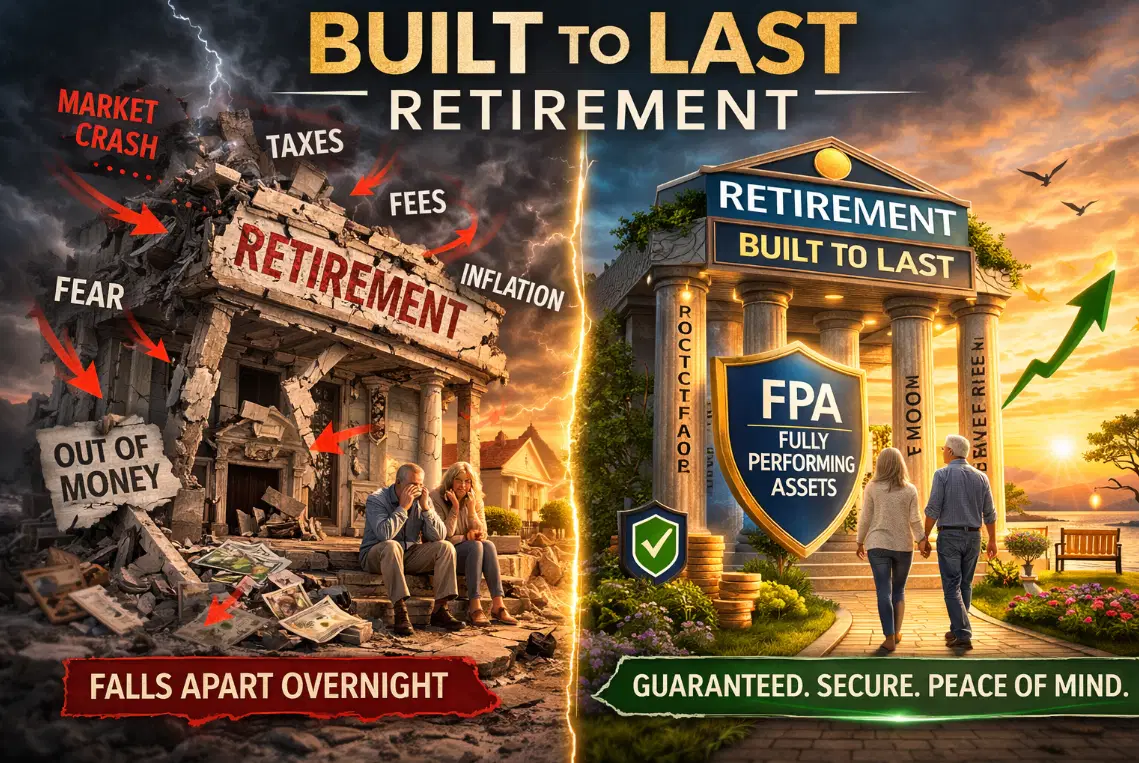
Instead of "Assets at Risk," we focus on Fully Performing Assets (FPA). Think of FPA as the "smartphone" of finance. Just as your phone consolidated your camera, GPS, and computer into one device, FPA consolidates 5–15 pillars of value (growth, protection, tax-free income, LTC, and guarantees) into one vehicle.
Why Your Street is Different:
Guarantees vs. Probabilities: We use contractual engineering instead of market projections.
Uncapped Gains (UCG): We provide the upside of the market without the "sharp knives" of market losses.
Expanded Market Participation (EMP): We use multipliers that can turn a 10% gain into an 11% or 20% gain, debunking the "cap" myths told by traditional brokers.
Volatility Recovery Analysis: We ensure your plan doesn't require "recovering" because it never took the hit in the first place.
Adult Understanding vs. Adolescent Dependence: We show you what no one has ever shown you, so you can understand what is about to happen instead of staying dependent on someone else’s story.
The Choice: Reality vs. Remorse
Many people reach age 65 and ask, "Why didn't anyone ever tell me this could happen?" They realized too late that they were following a "False Model" driven by the greed and fear of Wall Street.
It is better to ask that question today while you still have the "Currency of Time" on your side.
As we discussed in Back to the Financial Future, money can recover, but time never does. If you are still operating on a 20th-century plan in a 21st-century world, you aren't planning; you're gambling.
The next 10–40 years are always going to be different from the last 40 years. Use the past to see the pattern. Use the pattern to understand the feature. Then decide what is about to happen to you before it happens. That is adult behavior.
Adolescent behavior says, "Just tell me what to do." Victim behavior says, "I guess I have to live with whatever happens." Adult behavior says, "Show me the math. Show me the margins. Show me the path." That is why the Million Dollar Hour™ is different. It tells you what no one has ever shown you, so you can improve your understanding in a way you likely never have before about what is about to happen to you.
Maturity is realizing that peace is the path and wisdom is the way. It’s choosing to be the Architect of your future rather than a Participant in someone else’s experiment.
Only an adolescent would accept a financially unreliable future. An adult demands certainty.
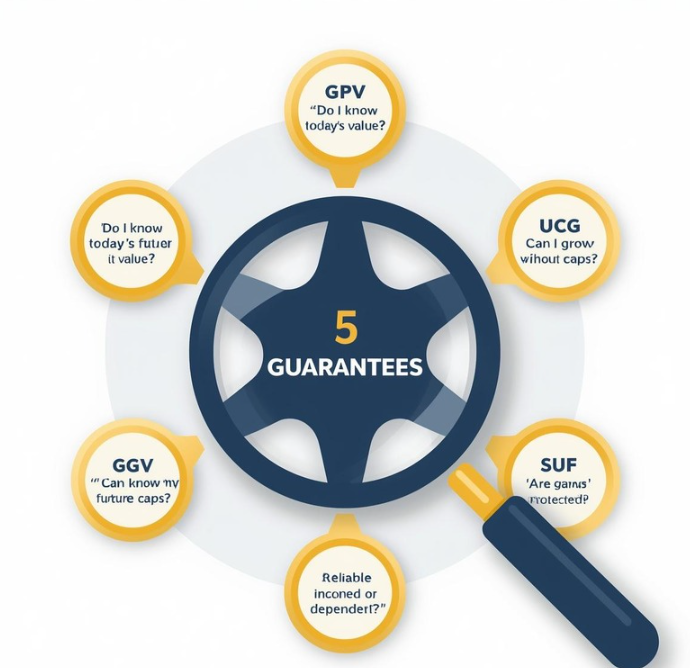
We developed the Million Dollar Hour Income Analysis™ so you can look annually at "What is about to happen to me?" continuously improving your future. There is no greater advantage than continuous improvement.
Ready for clarity instead of confusion?
The Million Dollar Hour™ is your educational, one-on-one retirement review that reveals where your plan leads : not just where it’s been.
👉 Schedule your session today.