
Retirement Strategies That Maximize Income, Eliminate Risk, and Help Ensure You Never Run Out of Money How to Achieve The Retirement Future Everyone Seeks
Most retirement plans are built on assumptions that no longer hold up—market averages, predictable tax rates, and the belief that time will always recover losses. But as you approach or enter retirement, the rules change. What worked during your accumulation years can become a liability during the withdrawal phase.
This blog is designed to help you rethink traditional strategies and discover a more engineered approach to retirement income—one focused on certainty, efficiency, and control.
Here, you’ll learn how to reduce or eliminate the biggest threats to your financial future, including market losses, rising taxes, hidden fees, and the silent erosion caused by lost time. We break down complex financial concepts into clear, actionable insights so you can make better decisions about your 401(k), IRA, and retirement income strategy.
You’ll also discover why many conventional approaches—like relying on average returns or the 4% rule—can expose you to unnecessary risk, especially when withdrawals begin. Instead, we explore strategies designed to protect your principal, improve compounding efficiency, and create predictable income streams that last.
Our focus is on helping you transition from “assets at risk” to a more stable and structured approach using fully performing assets—where growth, income, and protection work together instead of against each other.
Whether you’re still working or already retired, the goal is simple:
help you keep more of what you earn, generate more reliable income, and build a plan that doesn’t depend on hope, timing, or market luck.
If you’ve ever wondered:
* How to create tax-efficient retirement income
* How to avoid sequence of returns risk
* How to reduce fees and increase net returns
* How to design income that doesn’t run out
—you’re in the right place.
Explore the articles below and start building a retirement strategy based on engineering, not guesswork.

Wall Street Average Return Myths vs Real Retirement Growth
Wall Street’s 'Average Return' Secrets Revealed: Why Real Compounded Growth Is the Only Math That Matters
One of the fastest ways to uncover hidden risk is to take our 7 Question Retirement Stress Test.
![[HERO] Wall Street’s 'Average Return' Secrets Revealed: Why Real Compounded Growth Is the Only Math That Matters](https://cdn.marblism.com/lruR0qZqNIe.webp "[HERO] Wall Street’s 'Average Return' Secrets Revealed: Why Real Compounded Growth Is the Only Math That Matters")
Start here: See what your retirement actually looks like → 👉 Book Your Million Dollar Hour™
Average Returns Are the Wall Street 'Participation Trophy': Here’s the Real Math
If you’ve spent any time looking at retirement brochures or sitting across from a traditional broker, you’ve heard the "10% average" speech. It’s the industry’s favorite bedtime story. They point to a colorful chart, show you a zig-zagging line trending upward, and tell you that as long as you "participate" in the market, time will heal all wounds.
But for the Quiet Builder: the person who has spent thirty years stacking capital through discipline and actual work: there is a nagging feeling that this math doesn't add up.
You’re right. It doesn’t.
Wall Street runs on "Marketing Math." Retirement, however, requires "Engineering Math." In the world of engineering, an average doesn’t keep a bridge standing. If a bridge is structurally sound 364 days a year but collapses on day 365, the "average" stability is 99.7%. But the bridge is still at the bottom of the river.
In this post, we’re going to perform a structural audit on the "Average Return" myth and reveal the hidden Volatility Tax that is quietly eroding your ability to retire with certainty.
The Pavlovian Trap: Marketing Math vs. Reality
Wall Street has conditioned investors to focus on the wrong number. They want you to focus on the Arithmetic Mean (the average). But your bank account only cares about the Geometric Mean (the actual compounded growth).
Let’s look at a simple, brutal example of "Carnivore Math."
Imagine you have $1,000,000.
Year 1: The market drops 30%. You now have $700,000.
Year 2: The market gains 30%.
The broker tells you, "Good news! Your average return is 0%. We’re back to even."
Except you aren't. 30% of $700,000 is only $210,000. You now have $910,000. You are still down $90,000, even though your "average return" was zero. This $90,000 gap is the Volatility Tax. It is the invisible friction that stops your wealth from actually compounding.
The Math of Recovery: Why Losses Are Not Created Equal
This is where the physics of loss becomes terrifying for those approaching retirement. When you lose money, the math required to get back to "break-even" is not a 1-to-1 ratio. It’s a steep, uphill climb.
If you lose 30%, you don't need a 30% gain to recover. You need a 42.86% gain just to get back to zero.
If you lose 36% (a standard bear market), you need a 56.25% gain to recover.
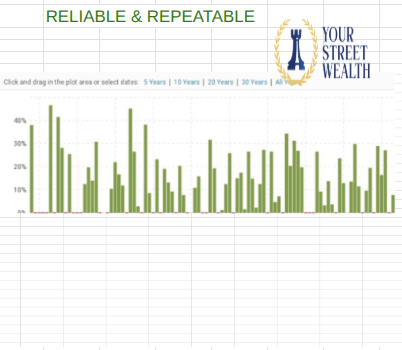
When you are in the "Participation" phase of life, you might have time to wait for these massive recovery spikes. But when you are a Quiet Builder looking at the next 20–30 years of retirement, you don't have a "Time Recovery" pillar to lean on. You are dealing with Sequence of Returns Risk. A big loss in the first five years of retirement can effectively end the plan, regardless of what the "average" return looks like ten years later.
Participation vs. Engineered Performance
Most people aren't planning; they are "participating." Participation is a polite word for gambling with the hope that the macro headlines eventually favor your micro-margin.
At Your Street Wealth, we look at retirement through the lens of Asset Liability Management (ALM). We don't care about the noise of the S&P 500 this week. We care about Compounding Efficiency.
True compounding only happens when you eliminate the "zeros" and "negatives." If you can't go backward, every forward step is permanent growth. This is the difference between a "Single Pillar" strategy and a "Multi-Pillar" architecture.
The Rolodex in a SpaceX World
Traditional retirement strategies (Stocks, Bonds, Real Estate) are what we call "Single Pillar" assets.
Stocks: Provide growth, but zero protection.
Banks: Provide safety, but zero growth (often negative growth after inflation).
Real Estate: Provides income, but low liquidity and high "leaks" (taxes/maintenance).
Using these individual tools to build a modern retirement is like trying to manage your life with a Rolodex, a pager, and a paper map. They worked in the 1980s, but we live in a SpaceX world now.
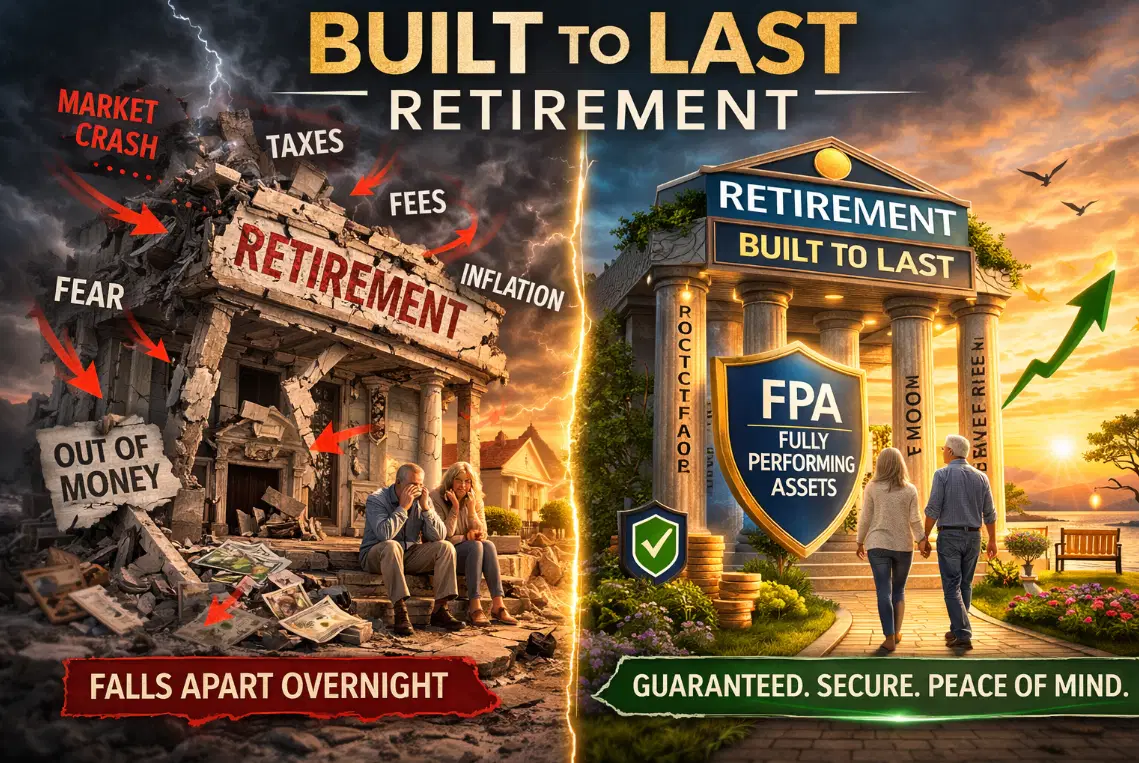
Modern financial architecture has moved toward Fully Performing Assets (FPA). Think of an FPA as the "Smartphone of Finance." Just as your phone consolidated your camera, GPS, computer, and phone into one device, an FPA consolidates 5–15 pillars of value: including growth, locked-in protection, tax-free income, and long-term care: into a single, engineered vehicle.
The Volatility Tax and Your 'Margin Audit™'
The biggest threat to your retirement isn't a lack of "opportunity": it's the presence of leaks. Most portfolios are riddled with hidden costs:
The Volatility Tax: The cost of recovering from market dips.
The Fee Tax: The 1–2% you pay for "active management" that usually underperforms the index.
The Uncertainty Tax: The mental energy spent worrying if the "Magic Number" on your statement will actually be there when you need to withdraw it.
In an engineering audit, we don't look at "best-case scenarios." We look at stress points. We perform a Volatility Recovery Analysis. We ask: If the market drops 20% tomorrow, how many years of your life just got traded away to get back to where you are right now?
For many, the answer is 3 to 5 years. That is too high a price to pay for "participation."
Uncapped Gains and Expanded Market Participation (EMP)
When we talk about moving away from Wall Street risk, many people assume that means settling for 1% returns at a local bank. This is the "False Choice" Wall Street wants you to believe in: either gamble with us or rot in a savings account.
Through Expanded Market Participation (EMP), we use institutional-grade banking architecture to provide a different path. We use vehicles that offer a 0% Floor (meaning you never lose a dime to market volatility) combined with Uncapped Gains.
Imagine a scenario where the market goes up 10%. With an EMP multiplier of 110% to 200%, your actual gain could be 11% to 20%, all while maintaining a contractual guarantee that if the market drops 30%, your account stays at 0% change.
You keep the gains; you outsource the losses. That isn't "luck." That is Engineered Performance.

The Million Dollar Hour™: Finding Your Real Numbers
The reason most retirement plans fail isn't a lack of effort; it's a lack of Truth.
Wall Street thrives on hidden complexity. They want you to believe that retirement is so complicated you must pay them a "Participation Fee" forever just to stay in the game.
We take a different approach. We believe in Awareness & Unlearning. Before you can build a stable future, you have to unlearn the "Average Return" myths that have been hard-coded into your brain.
We offer a professional service called the Million Dollar Hour™ Forecast. This isn't a "free consultation" where a salesman tries to pivot you into a product. It is a $995 Engineering and Margin Audit.
During this hour, we subject your current plan to a 7-Question Stress Test. We look at:
Compounding Efficiency: Where is the Volatility Tax eating your growth?
Sequence of Return Margin: How much market trauma can your plan actually sustain?
The Truth Test: Comparing your current "Rolodex" strategy against a modern "Multi-Pillar" FPA.

We look for the "Gaps." We look at the cash falling into the void of unrecovered losses and we show you exactly how to close it.
Peace is the Path, Wisdom is the Way
If you are a Quiet Builder, you aren't looking for a "home run" or a "hot tip." You are looking for Certainty. You want to know that the work you’ve done is protected, and the future you’ve envisioned is mathematically inevitable.
Wealth isn't built on macro headlines; it’s built on micro margins. It’s built by making the decision to move from a "False Model" driven by greed and fear into an engineered system based on physics and architecture.
Stop settling for "Average." Your retirement shouldn't be a game of "Wait and See." It should be a matter of Your Money, Your Rules, In Your Time, On Your Street.
Ready for clarity instead of confusion?
The Million Dollar Hour™ is your educational, one-on-one retirement review that reveals where your plan leads : not just where it’s been.
👉 Schedule your session today.
You can keep participating… Or you can finally see the outcome. The Million Dollar Hour™ shows you exactly:
✔ Where you are ✔ Where you’re going ✔ How to fix the gaps 👉 Book your session now
Check out the Retirement Blueprint
Concerned about market losses, taxes, or income reliability?
Take the 7 Question Retirement Stress Test →