
Retirement Strategies That Maximize Income, Eliminate Risk, and Help Ensure You Never Run Out of Money How to Achieve The Retirement Future Everyone Seeks
Most retirement plans are built on assumptions that no longer hold up—market averages, predictable tax rates, and the belief that time will always recover losses. But as you approach or enter retirement, the rules change. What worked during your accumulation years can become a liability during the withdrawal phase.
This blog is designed to help you rethink traditional strategies and discover a more engineered approach to retirement income—one focused on certainty, efficiency, and control.
Here, you’ll learn how to reduce or eliminate the biggest threats to your financial future, including market losses, rising taxes, hidden fees, and the silent erosion caused by lost time. We break down complex financial concepts into clear, actionable insights so you can make better decisions about your 401(k), IRA, and retirement income strategy.
You’ll also discover why many conventional approaches—like relying on average returns or the 4% rule—can expose you to unnecessary risk, especially when withdrawals begin. Instead, we explore strategies designed to protect your principal, improve compounding efficiency, and create predictable income streams that last.
Our focus is on helping you transition from “assets at risk” to a more stable and structured approach using fully performing assets—where growth, income, and protection work together instead of against each other.
Whether you’re still working or already retired, the goal is simple:
help you keep more of what you earn, generate more reliable income, and build a plan that doesn’t depend on hope, timing, or market luck.
If you’ve ever wondered:
* How to create tax-efficient retirement income
* How to avoid sequence of returns risk
* How to reduce fees and increase net returns
* How to design income that doesn’t run out
—you’re in the right place.
Explore the articles below and start building a retirement strategy based on engineering, not guesswork.

Why Brokers Sell Moods vs. Engineered Retirement Results
The Singer’s Drug: Why Your Broker Sells Moods, Not Retirement Results
One of the fastest ways to uncover hidden risk is to take our 7 Question Retirement Stress Test.
![[HERO] The Singer’s Drug: Why Your Broker Sells Moods, Not Retirement Results](https://cdn.marblism.com/OgarPTRYYtw.webp "[HERO] The Singer’s Drug: Why Your Broker Sells Moods, Not Retirement Results")
Start here: See what your retirement actually looks like → 👉 Book Your Million Dollar Hour™
The Bull Market Ballad: Is Your Broker Singing You to Financial Sleep?
We’ve all seen the performance. Your broker sits across the desk, a glossy report in hand, pointing at the upward-sloping green lines. He’s leaning into the mic, crooning about "long-term averages" and "staying the course."
It’s a catchy tune. It’s the "Bull Market Hit."
In the financial world, Wall Street brokers act like celebrity singers. They sell a "drug of the mind": the emotional high that comes with rising statement balances. When the market is up, the mood is electric. You feel wealthy, you feel smart, and you feel safe.
But there’s another chemical in the room that almost nobody talks about: oxytocin. It’s often called the "trust hormone." It’s what helps people bond, relax, and feel safe with familiar voices. In the broker relationship, that emotional bond can become what we call the Oxytocin Trap. The relationship feels so reassuring that it overrides the actual numbers. Clients stay emotionally attached to risky, underperforming plans because the bond feels good, even when the math is bad.
That’s the real trick. The broker isn’t just selling returns. He’s selling reassurance, familiarity, and social bonding. And once that bond is formed, many people stop asking the hard question: "What happens if I take a 30% hit at the wrong time?" That is where The Math of Recovery gets ignored in favor of trust, habit, and hope.
But here’s the problem: The singer doesn't have a second act for when the lights go out. They don’t sing the "Bear Market Blues," and they certainly don’t offer refunds when the music stops and your retirement savings take a 30% haircut.
At Your Street Wealth, we believe retirement isn't a concert: it’s a structural requirement. You don't need a mood; you need Engineered Performance.
The Addiction to "Participation"
Most people are taught to "participate" in the market. Participation is just a polite word for gambling with your future. When you participate, you are at the mercy of the "Singer’s" playlist. If the market drops, your broker tells you to "wait it out."
But the math of retirement doesn't care about your patience. It cares about Sequence of Returns Risk (SORR).
If you are 55 or older, a major market downturn isn't just a "bad year": it’s a structural failure. If you lose 30% of your portfolio today, you don't just need 30% to get back to even. You need a 42.8% gain just to see the surface again. That is the Math of Recovery, and it is the silent killer of retirement dreams.
Brokers sell the "mood" of the 10% average return, but they hide the "leakage" of fees, taxes, and volatility. They operate on a False Model driven by fear and greed. When the Greed/Fear meter is high, they push you into more risk. When fear hits, they have no engineering to stop the bleed.

From Moods to Engineering: The SUCCESS Framework
If you want to stop being an audience member and start being the Architect of your own wealth, you need a rules-based system. We use the SUCCESS acronym to move from emotional "participation" to mathematical certainty:
S – Strategy: Is your plan designed to produce a specific outcome, or are you just hoping the market stays up?
U – Underlying Architecture: Are you using "Single-Pillar" assets (like just stocks or just real estate) or "Multi-Pillar" assets that provide growth, protection, and tax-free income simultaneously?
C – Control: Do you own the rules of your money, or does the government and Wall Street?
C – Constraints: Understanding what you can't do is as important as what you can.
E – Evidence: We don't rely on "opinions." We rely on institutional-grade Asset Liability Management (ALM).
S – Success: Defining success as a guaranteed lifetime income, not just a "big number" on a screen.
S – Serenity: The end goal. Knowing the check is coming regardless of who is in the White House or what the S&P 500 did today.

The FIAAR Strategy: Taking the Chips off the Table
Think of the market like a high-stakes game in Vegas. When the "Singer" is on stage and the "Bull Market Hits" are playing, everyone is winning. The smart player knows that the house eventually wants those winnings back.
The FIAAR Strategy is about being smart enough to take your growth off the table before the house takes it.
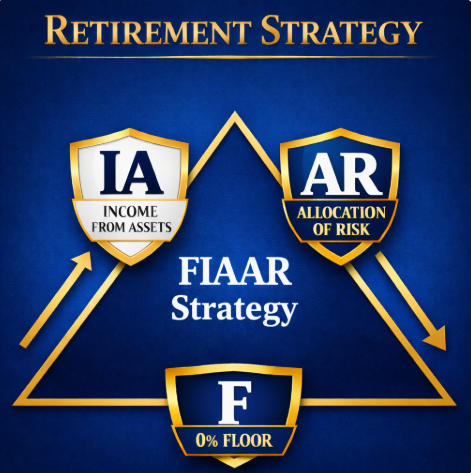
This isn't about "getting out" of the market; it's about Preserving, Protecting, and Prolonging your wealth.
Preserving: Locking in the gains you’ve already made.
Protecting: Implementing a 0% Floor. This means when the market drops 20%, your statement shows 0% loss. You keep your principal and your previous gains.
Prolonging: Creating an income stream that you cannot outlive.
In Wall Street’s world, you are "spinning sharp knives" with interest-rate ripples and market volatility. In our world, we use Engineered Performance to ensure your floor is solid.
The Smartphone of Finance: Fully Performing Assets (FPA)
Most investors are still carrying around a "Rolodex in a SpaceX world." They have a bank account for cash, a brokerage account for stocks, and maybe some real estate. These are Single-Pillar traditional assets. They are high-risk, high-fee, and high-maintenance.
Imagine if you still had to carry a pager, a camera, a GPS, and a phone. That’s how most people manage their retirement.
We utilize Fully Performing Assets (FPA). Think of FPA as the "smartphone" of finance. It’s a multi-pillar vehicle that consolidates 5–15 pillars of value: such as growth, protection, and tax-advantaged income: into one engineered structure.
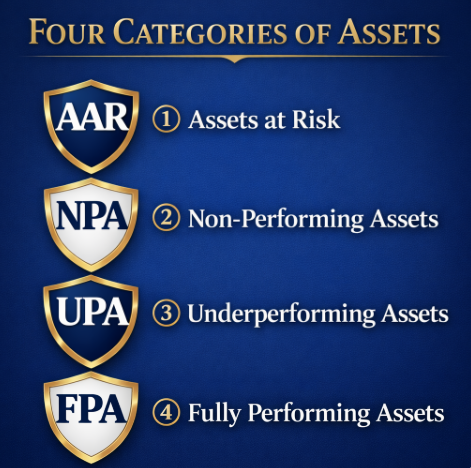
When we conduct a Margin Audit™, we look at your current holdings and categorize them:
Assets at Risk (AAR): These are your "Teens": high energy but high trouble. As you age, you need fewer of these.
Non-Performing Assets (NPA): Money sitting idle or losing to inflation.
Underperforming Assets (UPA): Assets with hidden fees or "leaks."
Fully Performing Assets (FPA): The foundation of a secure retirement.
By moving assets from AAR and UPA into FPA, we can often provide Uncapped Gains (UCG) and Expanded Market Participation (EMP).
Brokers might tell you that "indexed products have low caps." That’s the old song. Modern engineering allows for EMP multipliers of 110% to 200%. If the market gains 10%, an EMP-enabled FPA could see an 11% to 20% gain: with a guaranteed 0% floor if the market crashes the next day.
How Much Do I Really Need to Retire?
The most common question we get is, "How much do I need to retire?"
The "Singer" will give you a generic number: usually $1 million or $2 million: based on the "4% Rule." But that rule was written in a different era. Today, with sequence of returns risk and rising taxes, that number is a guess at best.
You can estimate your income needs, but you cannot predict future portfolio value when losses and leaks are uncontrollable. Wall Street wants you to focus on the "Accumulation" number. We focus on the Distribution Architecture.
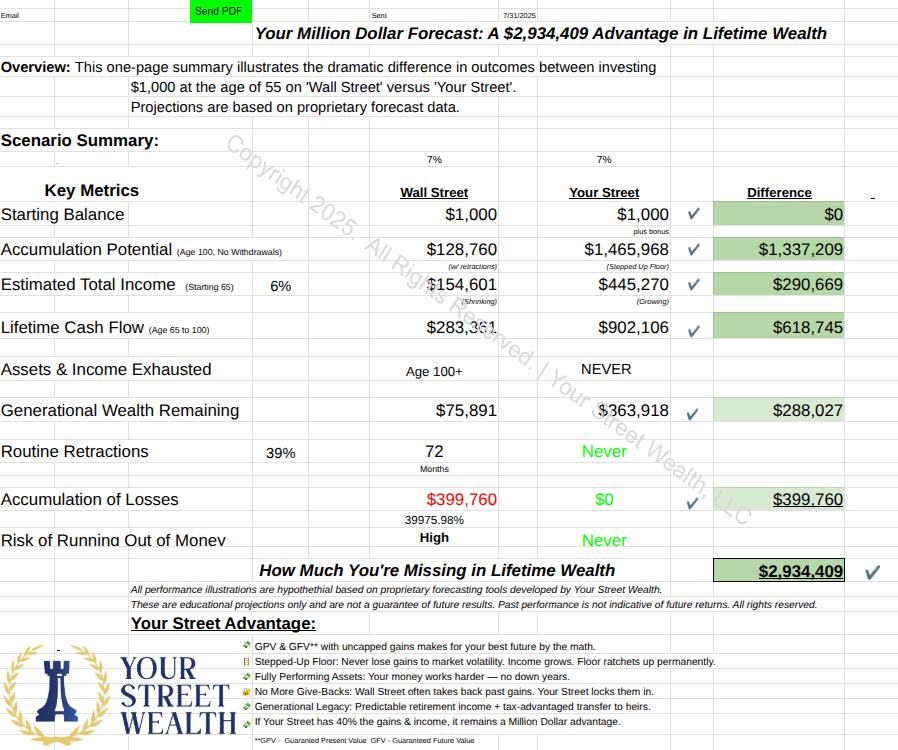
As shown in our comparison audits, the difference between "Participating" in Wall Street's mood and "Engineering" your performance on Your Street can be millions of dollars in lifetime wealth. We don't just want you to have a "big pile of money"; we want you to have guaranteed cash flow that isn't dependent on market conditions.
Stop Listening to the Singer
If you are a "Quiet Builder": someone who has worked hard, saved well, but feels a sense of unease about the current financial landscape: it’s time to change the channel.
The "Singer’s Drug" of emotional highs is addictive, but it's not a strategy. Real retirement planning isn't about chasing the next macro headline; it's about the micro-margins of your own balance sheet. It’s about moving from a "False Model" to Institutional-Grade Engineering.
You wouldn't build a house based on a "feeling." You shouldn't build a retirement that way either.
Peace is the path, wisdom is the way. It’s time to move your money to a street where the rules favor you. Your Money, Your Rules, In Your Time, On Your Street.
Ready for clarity instead of confusion?
The Million Dollar Hour™ is your educational, one-on-one retirement review that reveals where your plan leads : not just where it’s been.
👉 Schedule your session today.
You can keep participating… Or you can finally see the outcome. The Million Dollar Hour™ shows you exactly:
✔ Where you are ✔ Where you’re going ✔ How to fix the gaps 👉 Book your session now
Check out the Retirement Blueprint
Concerned about market losses, taxes, or income reliability?