
Retirement Strategies That Maximize Income, Eliminate Risk, and Help Ensure You Never Run Out of Money How to Achieve The Retirement Future Everyone Seeks
Most retirement plans are built on assumptions that no longer hold up—market averages, predictable tax rates, and the belief that time will always recover losses. But as you approach or enter retirement, the rules change. What worked during your accumulation years can become a liability during the withdrawal phase.
This blog is designed to help you rethink traditional strategies and discover a more engineered approach to retirement income—one focused on certainty, efficiency, and control.
Here, you’ll learn how to reduce or eliminate the biggest threats to your financial future, including market losses, rising taxes, hidden fees, and the silent erosion caused by lost time. We break down complex financial concepts into clear, actionable insights so you can make better decisions about your 401(k), IRA, and retirement income strategy.
You’ll also discover why many conventional approaches—like relying on average returns or the 4% rule—can expose you to unnecessary risk, especially when withdrawals begin. Instead, we explore strategies designed to protect your principal, improve compounding efficiency, and create predictable income streams that last.
Our focus is on helping you transition from “assets at risk” to a more stable and structured approach using fully performing assets—where growth, income, and protection work together instead of against each other.
Whether you’re still working or already retired, the goal is simple:
help you keep more of what you earn, generate more reliable income, and build a plan that doesn’t depend on hope, timing, or market luck.
If you’ve ever wondered:
* How to create tax-efficient retirement income
* How to avoid sequence of returns risk
* How to reduce fees and increase net returns
* How to design income that doesn’t run out
—you’re in the right place.
Explore the articles below and start building a retirement strategy based on engineering, not guesswork.

Test Your Retirement Plan Before You Need It
Nobody Puts Money In to Lose Money: The Test the Herd Never Runs

The Retirement Test the Herd Never Runs
Nobody puts money in to lose money.
I have never met anyone who opened an account, funded a plan, or invested a lifetime of savings with the intention of ending up with less.
My truth is simple: No one ever puts money in to lose money. But you must test it to see.
That changes the conversation.
If losses were never the goal, then the loss was not a choice. It was an untested assumption. That is not a moral failure. It is a gap between what someone expected their architecture to do and what it actually did.
The remedy is not another warning. The remedy is a test.
If you are continuing from Why 94% of Retirement Plans Fail and How to Fix Yours, carry that question forward:
What did the plan actually do, not what was it supposed to do?
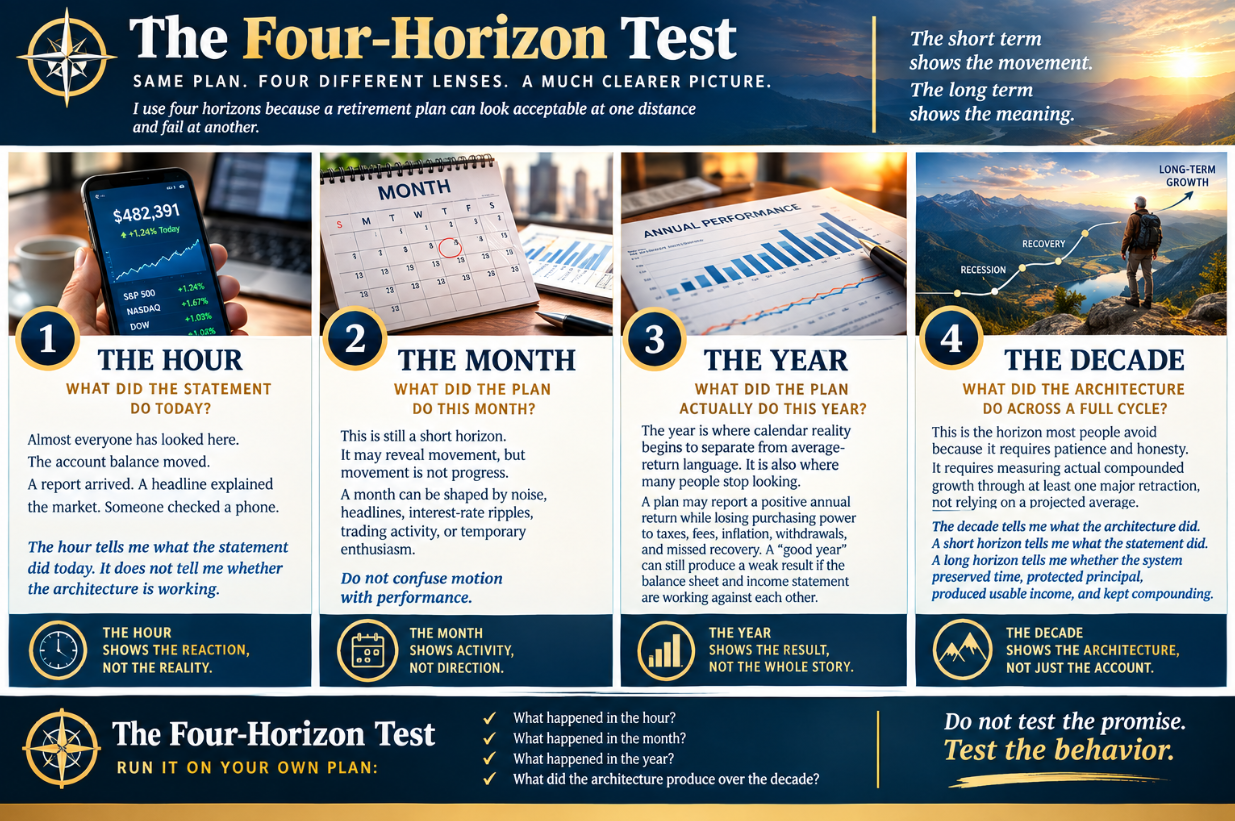
The Four-Horizon Test
I use four horizons because a retirement plan can look acceptable at one distance and fail at another.
1. The Hour
What did the statement do today?
Almost everyone has looked here. The account balance moved. A report arrived. A headline explained the market. Someone checked a phone.
The hour tells me what the statement did today. It does not tell me whether the architecture is working.
2. The Month
What did the plan do this month?
This is still a short horizon. It may reveal movement, but movement is not progress. A month can be shaped by noise, headlines, interest-rate ripples, trading activity, or temporary enthusiasm.
Do not confuse motion with performance.
3. The Year
What did the plan actually do this year?
The year is where calendar reality begins to separate from average-return language. It is also where many people stop looking.
A plan may report a positive annual return while losing purchasing power to taxes, fees, inflation, withdrawals, and missed recovery. A “good year” can still produce a weak result if the balance sheet and income statement are working against each other.
4. The Decade
What did the architecture do across a full cycle?
This is the horizon most people avoid because it requires patience and honesty. It requires measuring actual compounded growth through at least one major retraction, not relying on a projected average.
The decade tells me what the architecture did.
A short horizon tells me what the statement did. A long horizon tells me whether the system preserved time, protected principal, produced usable income, and kept compounding.
That is the Four-Horizon Test. Run it on your own plan:
What happened in the hour?
What happened in the month?
What happened in the year?
What did the architecture produce over the decade?
Do not test the promise. Test the behavior.
The Herd Does Not Prove Your Plan Works
People gain trust in Wall Street by following the herd.
I do not say that with contempt. I understand why it happens. If everyone around us is using the same language, buying the same products, and accepting the same volatility, that familiarity feels like evidence.
But the herd proves nothing. It only repeats.
Other people’s confidence is not evidence about your withdrawal schedule, your taxes, your time horizon, your income needs, or your family’s legacy goals. Their experience is not your forecast.
The only thing that converts belief into measurement is inspection.
That is why I use the process:
QUESTION → TEST → PROVE → DECIDE → ACT
The question identifies the assumption.
The test exposes the behavior.
The results prove what happened.
The evidence supports the decision.
The decision directs the action.
This is also the Retirement Testing Principle:
> You do not have to believe in an alternative strategy, or reject your current strategy, to test whether a different architecture produces better measurable outcomes.
Test first. Change your beliefs only when the evidence requires it.
The Math of Recovery Changes the Decade
The decade matters because losses do not behave like gains.
A 30% loss requires approximately a 42.9% gain to recover. That is not an opinion. It is the math of recovery.
If $100,000 falls by 30%, the balance becomes $70,000. A 30% gain on $70,000 produces only $91,000. The account needs roughly 42.9% growth from $70,000 to return to $100,000.
Now add withdrawals.
Sequence-of-returns risk explains why two portfolios with the same average return can produce very different outcomes. If losses arrive before or during withdrawals, you may sell more units at lower prices. Those units cannot participate in the recovery.
The average may look acceptable. The lived result may not be.
Time becomes the cost that cannot be refunded.
This is why I ask my clients to inspect the six Wealth Killers:
Market volatility
Sequence-of-returns risk
Fees
Taxes
Inflation
Poor income design
These forces can create Assets at Risk. Hidden liabilities where lost money and lost time accumulate into negative margin.
The Wall Street Cycle makes this more important. I test for recurring 10%–20% swings that may appear roughly every 18 months and major retractions that can average about 40% every five to seven years. Each major retraction can cost at least 3.3 years of forward progress.
The 5x Accumulated Loss Truth gives the problem another dimension: $100,000 in contributions can be associated with $500,000 in cumulative losses across repeated cycles, withdrawals, fees, and missed compounding. The point is not that every person experiences the same number. The point is that cumulative loss can become several times larger than the original contribution when time is repeatedly reset.
From Participation to Engineered Performance
The market can be a useful tool. But it is primarily engineered for institutions and the unknown 3% who succeed through some combination of skill and luck. It can become a destructive storm for individuals who participate in its maelstrom without testing the architecture.
High greed on the Greed/Fear meter can signal greater loss risk. High fear can signal lower loss risk. The emotional meter changes, but the individual still has to decide what behavior the plan must produce.
That is the difference between Participation vs. Engineered Performance.
Participation asks, “What might the market do?”
Engineering asks, “What must my plan do, and how will I know whether it did it?”
I call the first the Shiny Object: average annual returns, optimistic projections, and rouge numbers that make the result look clean by hiding the negatives.
The Dark Object is what the average leaves out: cumulative cycle losses, fees, taxes, sequence risk, time lost, and income that must be drawn from a shrinking balance.
It is double-digit opportunity standing on a foundation of reliability. The foundation question comes first.
That is why I use the Million Dollar Hour™ as an educational comparison laboratory. The purpose is to place the assumptions, behavior, recovery requirements, and income outcomes side by side so the investor can inspect what was previously invisible.
Bring your assumptions
> Bring your expected return. Bring your withdrawal need. Bring your time horizon. Bring the losses you believe you can tolerate. Then test what happens when the assumptions meet taxes, fees, withdrawals, inflation, and a major retraction.
Architecture Must Serve the Whole System
The Engineered Retirement Blueprint begins with three connected parts:
Balance Sheet: the source of funds
Income Statement: the use of funds
Margin: the battleground between positive and negative outcomes
A retirement plan is not successful because it produces activity. It is successful because it produces usable income while preserving the source of future income.
That requires the first principles of The 7 Disciplines of Retirement Wealth™. This article most directly serves:
Discipline 2, Protect Against Unnecessary Loss: Never risk what you cannot afford to lose.
Discipline 3, Protect Forward Progress: Never accept unnecessary step-backs.
Discipline 4, Protect Time: Money can be recovered. Time cannot.
It also follows the 9 Levels of Retirement Discovery™:
Outcome: What income and legacy must the plan produce?
Cost: What do taxes, fees, inflation, volatility, and lost time consume?
Opportunity: Which assets can be converted into Fully Performing Assets?
Barrier: Which inherited beliefs prevent better testing?
Truth: What was the actual compounded result, not the average?
Risk: Which losses can permanently destroy future income?
Principle: Is principal protected before performance is pursued?
Value: What is the lifetime usefulness and present value of the money?
Synergy: Do the income, growth, protection, tax, and legacy elements work together?
Traditional retirement planning can feel like a Rolodex in a SpaceX world: durable in its era, but not designed for the speed and technical demands of modern retirement.
The consolidation of technology changed phones, pagers, cameras, maps, and televisions into one smartphone. Financial architecture is moving through a similar shift. Banks, stocks, and real estate are often single-pillar assets. Fully Performing Assets can combine five to fifteen pillars, including growth, protection, income, long-term-care support, tax efficiency, and legacy design.
That is not a product-first argument. It is a systems argument.
Your Rules Are a Sequence
“Your Money. Your Rules. In Your Time. On Your Street.” is not a slogan. It is the order in which someone leaves the herd.
Your Money means ownership. Stop lending your outcome to someone else’s process.
Your Rules means defining the terms your plan must meet. Require clarity. Insist on evidence. Demand behavior that supports your future.
That is the RID framework:
Require the plan to state what it must accomplish.
Insist on testing across the four horizons.
Demand proof before accepting the outcome.
In Your Time means choosing the horizon that matters. The decade matters because retirement is not a one-year contest.
On Your Street means building an architecture of your own rather than taking a seat on someone else’s ride.
Preserve, Protect & Prolong. Remove leaks, drains, and unnecessary losses. Measure the outcome instead of admiring the activity.
I see a visible shift in the questions people bring into the room. More people are asking what their plans actually did. More people are testing assumptions before relying on them. More people are choosing rules for their money, in their time, to satisfy their future.
That observation is not a statistic. It is what I see.
The work is Complete Wealth Engineering: continuous learning, unlearning, testing, and improving the architecture as life changes. Stewardship requires that effort. You are responsible for learning what your money is doing and preventing avoidable consequences through wisdom.
Peace is the path, wisdom is the way.
So begin with the question. Run the test. Let your own results supply the decision.
What does your plan produce across the hour, the month, the year, and the decade: subject to the actual terms, limitations, costs, and claims-paying ability?
Educational disclaimer: This article is for general educational purposes only and is not personalized investment, tax, legal, or insurance advice. Financial outcomes depend on individual circumstances, contractual terms, fees, taxes, market conditions, and the financial strength and claims-paying ability of any relevant institution. Review your situation with qualified professionals before making financial decisions.
Ready for clarity instead of confusion?
The Million Dollar Hour™ is your educational, one-on-one retirement review that reveals where your plan leads, not just where it’s been.
👉 Schedule your session today.