
15-Pillar Retirement Heat Shield
The 15-Pillar Architecture: Why Your Retirement Needs More Than a Single Asset Pillar
One of the fastest ways to uncover hidden risk is to take our 7 Question Retirement Stress Test.
![[HERO] The 15-Pillar Architecture: Why Your Retirement Needs More Than a Single Asset Pillar](https://cdn.marblism.com/ZcewTXljOqF.webp "[HERO] The 15-Pillar Architecture: Why Your Retirement Needs More Than a Single Asset Pillar")
Start here: See what your retirement actually looks like → 👉 Book Your Million Dollar Hour™
Your Retirement Needs Multiple Coordinates
If you wanted to fly a plane from New York to Paris, you’d expect the pilot to use more than just a compass. To navigate the modern skies safely, a pilot relies on at least six coordinates: latitude, longitude, altitude, speed, heading, and time. And even that is just the start. The aircraft is not moving across a flat map. It is circumnavigating a sphere while the Earth rotates beneath it and hurtles through space at roughly 30,000 miles per hour. A true pilot also accounts for weather, air streams, and even the gravitational effects of the moon and sun. If you ignore those active variables, or worse, never even know they exist, you do not reach the right destination by accident. High-beam precision means accounting for the rotation and the orbit, not just the heading.
Yet, when it comes to the most important journey of your life: a 30-year retirement: Wall Street tells you that you only need one "pillar": the stock market.
They call it "diversification," but really, it’s just a collection of different flavored risks all tied to the same single pillar of market participation. At Your Street Wealth, we call this 1600s navigation. It’s like sailing west and just hoping you hit land before the scurvy sets in.
In a world that is faster, riskier, and more complex than ever, your retirement needs more than a single asset pillar. It needs a 15-pillar architecture designed to withstand reality, not just optimistic projections.
The "Single Pillar" Trap
Most people are taught to build their entire future on a single pillar: stocks and mutual funds. This is the "Participation" model. You give your money to the market, pay a fee to someone to watch it, and hope that by the time you need to spend it, the numbers on the screen are higher than when you started.
This worked okay in the 1980s when interest rates were high and the wind was at everyone's back. But today? Using the traditional Wall Street model is like using a Rolodex in a SpaceX world. It was a durable tool for its era, but it’s completely inadequate for the speed and technical demands of a modern retirement.
Wall Street thrives on "Participation." They want you in the game because they get paid whether you win or lose. They use hidden complexity to keep you addicted to the daily news cycle, the "hot" sectors, and the constant buying and selling. It’s a false architecture designed to extract value from you, rather than engineer performance for you.
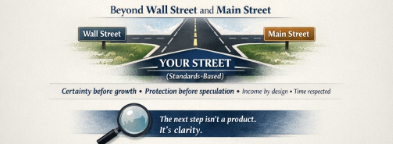
Architecture vs. Blind Investing
At Your Street Wealth, we don’t "participate" in the market. We engineer performance.
There’s a fundamental difference between an investor and an architect. An investor buys a bunch of bricks and hopes a house eventually forms. An architect creates a blueprint based on physics, load-bearing requirements, and the specific needs of the family living inside.
If you’re a "Quiet Builder": someone who has worked hard, saved well, and is now looking at the next 30 years with a bit of unease: you don't need another "opportunity." You need precision. You need a Margin Audit™ to see where your current plan is leaking. You need to understand the Math of Recovery: the brutal reality that a 30% loss requires a 42% gain just to get back to zero.
The 15-Pillar Architecture: The "Smartphone" of Finance
Think about your smartphone. Twenty years ago, if you wanted to do everything your phone does today, you’d need a pager, a digital camera, a GPS unit, a Walkman, a flashlight, a calendar, and a bulky laptop.
We call this the "Consolidation of Technology."
The Single Pillar financial model is outdated because it treats every financial need as a separate, often conflicting, product. You buy insurance for protection. You buy stocks for growth. You put money in a savings account for liquidity. You set up a trust for legacy.
Our approach uses Fully Performing Assets (FPA). An FPA is the "smartphone" of finance. It’s a multi-pillar asset vehicle that consolidates 5 to 15 pillars of value into one engineered structure. In retirement, those 15 pillars function like a Thermal Protection System : a coordinated heat shield designed for the hardest part of the mission.
That hardest part is not always accumulation. It’s re-entry : the decumulation years, when you’re actually drawing income and passing through the friction of taxes, fees, inflation, and market volatility. A rocket can survive launch and still fail on the way home if the heat shield is weak. Retirement works the same way. You can build a big account value, but without coordinated protection, the friction of real life can burn up the craft during splashdown.
That’s the difference between Participation vs. Engineered Performance. Participation says, “Just stay invested and hope the timing works out.” Engineering says, “Build the retirement craft to survive contact with reality.” The 15 pillars are not random features. They are the protective tiles, layers, and systems that help preserve time, income, and optionality when the pressure is highest.
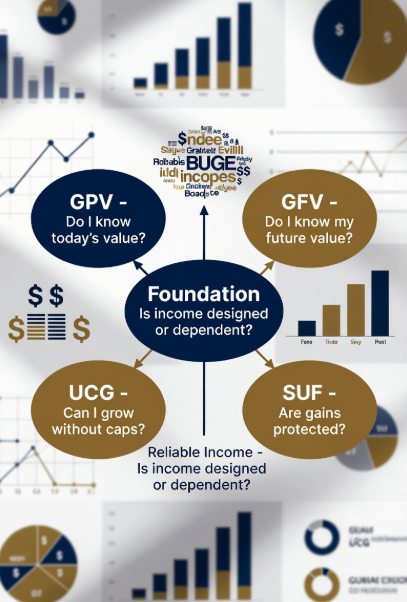
What are these 15 Pillars?
When we design a retirement architecture, we aren't just looking at "growth." We are coordinating up to 15 distinct functional pillars, including:
Principal Protection: A 0% floor so you never lose a dime to market volatility.
Uncapped Gains (UCG): The ability to capture the upside of the market without the downside.
Expanded Market Participation (EMP): Using multipliers (110%–200%) to outperform the index itself.
Guaranteed Lifetime Income: Income you cannot outlive, designed by choice, not left to chance.
Tax-Advantaged Growth: Keeping the IRS out of your compounding curve.
Tax-Free Distributions: Accessing your wealth without a "tax bomb" waiting in the future.
Liquidity and Accessibility: Having your money available when life happens.
Long-Term Care (LTC) Benefits: Protecting your estate from healthcare costs.
Legacy/Death Benefit: Ensuring your family is taken care of with maximum efficiency.
Risk-Offset: Mathematically neutralizing the impact of inflation and fees.
Volatility Recovery: Eliminating the "Math of Recovery" trap.
Sequence of Return Margin: Protecting your withdrawals during market downturns.
Asset Liability Management (ALM): Matching your assets to your specific future spending needs.
Compounding Efficiency: Removing the "leaks" of taxes and fees that kill wealth over time.
Clarity and Peace of Mind: The psychological pillar: knowing exactly where you stand.
Addressing the "Too Complex" Criticism
Sometimes people say, "Frank, 15 pillars sounds too complex. Why can't I just keep it simple with a 60/40 split?"
Here’s the problem: "simple" is one of Wall Street’s favorite traps. Not because retirement is actually simple, but because keeping people dumbed down makes them easier to manage, easier to sell, and easier to keep participating in a false model they never fully understand.
Frank’s metaphor is dead-on. If you were launching a spacecraft to the moon, you would not aim for where the moon is at launch. That would be a recipe for failure. You have to calculate where the moon will be when the spacecraft actually arrives. Retirement works the same way. A plan that looks "simple" today often ignores where your life, taxes, inflation, income needs, and market exposure will be when you actually need the money later.
That’s why rules-based architecture matters. The goal is not to make the conversation sound easy. The goal is to Preserve, Protect, and Prolong your wealth and your time. Preserve principal. Protect income. Prolong the usefulness of every dollar. That takes design, not slogans.
And this is exactly where the heat shield metaphor matters. During accumulation, a lot of bad designs can look fine on paper. During decumulation, the friction shows up fast. Taxes scrape away at distributions. Fees keep siphoning. Volatility hits at the exact moment withdrawals begin. That’s when a single-pillar plan starts heating up in all the wrong places.
So no, staying ignorant is not the way to live, even if that’s exactly what Wall Street wants. The 15-pillar architecture isn't complex for the sake of being complicated. It is the minimum architecture required for reality. It’s the difference between a tent and a skyscraper. Both provide shelter, but only one is engineered to survive a hurricane. Or, if we stay with the flight path metaphor, only one has the Thermal Protection System needed to make it through retirement re-entry without burning up on the way down.
The Math of Recovery: Why Pillars Matter
In a single-pillar market strategy, you are constantly fighting the Math of Recovery. If the market drops 50% (as it has done twice in the last 25 years), you don't just need a 50% gain to get back. You need a 100% gain.
If you are 60 years old, do you have the time to wait for a 100% gain just to get back to where you were yesterday?
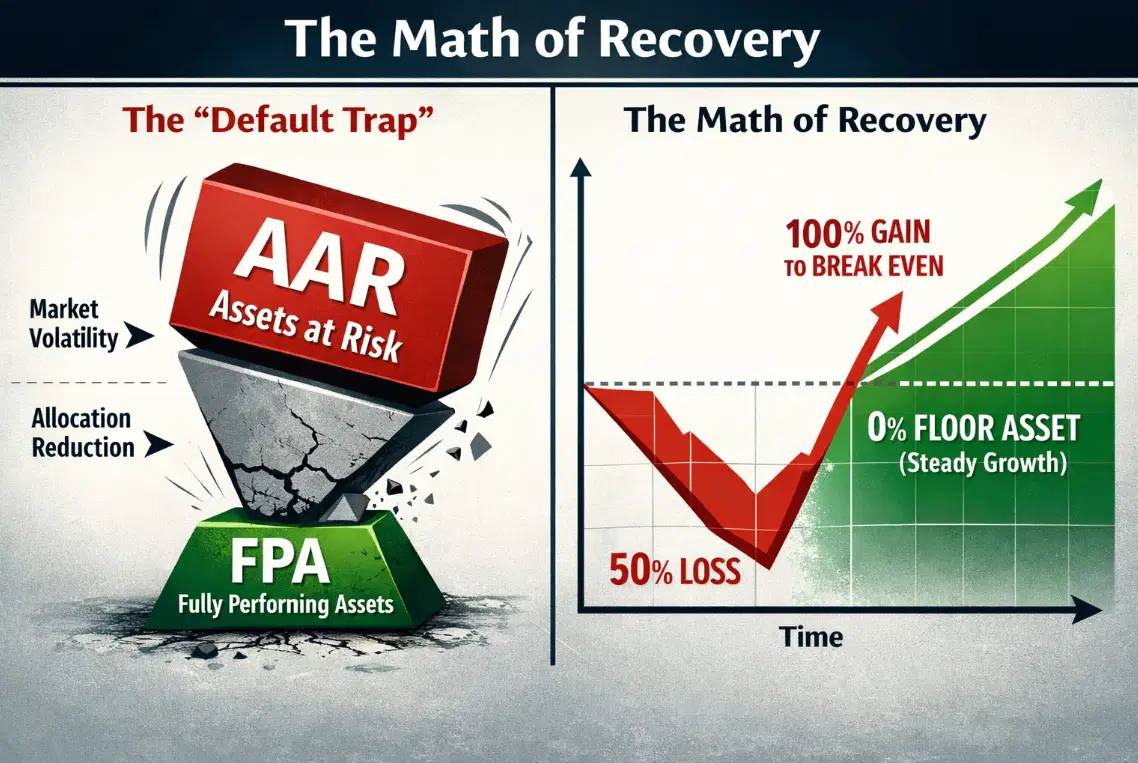
Now add decumulation to the equation. Losses don’t just hurt the account. They hit while distributions, taxes, and fees are already creating drag. That’s retirement re-entry friction. And without a real Thermal Protection System, the craft doesn’t just slow down : it can break apart mathematically.
By using FPAs with a 0% floor, we eliminate the need for recovery. When the market goes -30%, your account goes 0%. When the market goes +10%, your account might go +15% or +20% thanks to Expanded Market Participation.
That matters because the best heat shield in retirement is not guesswork. It’s engineered stability. It’s a coordinated multi-pillar design that reduces friction where it counts most : income, taxes, fees, and sequence risk.
We shift the conversation from "Participation" (gambling on headlines) to "Performance" (engineering margins). Wealth isn't built on macro headlines; it’s built on micro margins.
The Architect vs. The Participant
The transition from working for your money to your money working for you is the most critical pivot you will ever make. It requires unlearning the myths Wall Street has fed you for decades.
You have to decide: Are you a Participant or an Architect?
Participants follow the crowd. They chase "FREE" advice and end up paying for it in hidden fees, lost time, and unnecessary taxes. They are the "mice" chasing the cheese in a maze designed by the banks.
Architects: the Quiet Builders we work with: understand that wisdom is actionable. They value their time more than their money. They want a scrutinized, certain plan that removes the "hope" and replaces it with mathematical certainty.

Engineering Your Certainty
We use a process called the Million Dollar Hour™ Forecast. This isn't a "free consultation" where we try to sell you a product. It is a $995 institutional-grade engineering session. It is also a direct move in the opposite direction of Wall Street’s "ignorant by design" model.
While Wall Street wants you to stay in the dark with "simple" products, the Million Dollar Hour™ turns the lights on. It gives you the benefit of high-level engineering instead of low-level sales language. It is the choice for people who refuse to be dumbed down and would rather master the physics of their retirement than blindly participate in someone else’s system.
We conduct a Volatility Recovery Analysis and a Margin Audit™ of your current holdings. We look at your Assets at Risk (AAR) and your Non-Performing Assets (NPA) and show you exactly how to move them into the Foundation of Fully Performing Assets (FPA).
In 60 minutes, we provide the clarity that most people spend 30 years looking for. We translate the "spinning sharp knives" of interest-rate ripples and market volatility into a language of balance-sheet healing.
Peace is the Path, Wisdom is the Way
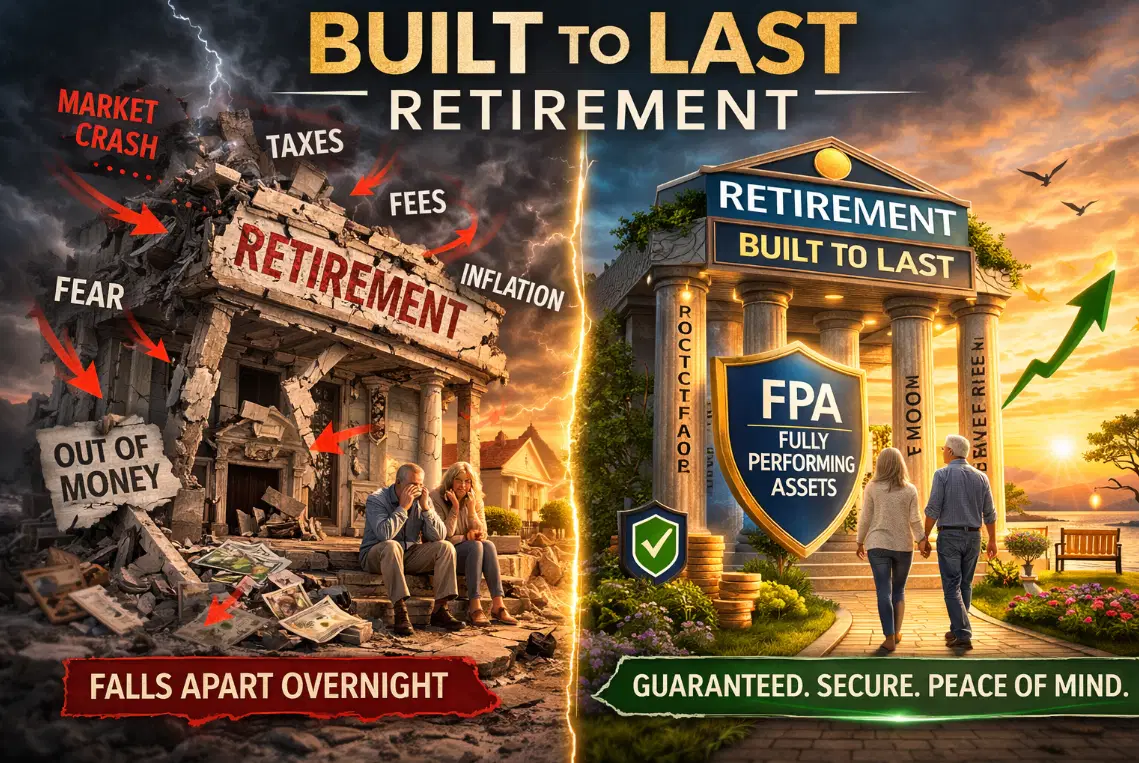
Retirement shouldn't be a source of fatigue. It should be the reward for a life of building. But you cannot find peace in a structure built on a single, shaky pillar.
Your retirement needs a coordinated architecture. It needs the protection of a 0% floor, the fuel of uncapped gains, and the security of designed income.
It’s time to move off of Wall Street’s "False Model" driven by greed and fear. It’s time to bring your wealth home.
Your Money, Your Rules, In Your Time, On Your Street.
Ready for clarity instead of confusion?
The Million Dollar Hour™ is your educational, one-on-one retirement review that reveals where your plan leads : not just where it’s been.
👉 Schedule your session today.
Concerned about market losses, taxes, or income reliability?
Take the 7 Question Retirement Stress Test →
You can keep participating… Or you can finally see the outcome. The Million Dollar Hour™ shows you exactly:
✔ Where you are ✔ Where you’re going ✔ How to fix the gaps 👉 Book your session now
Check out the Retirement Blueprint