
How Much Do I Need to Retire If My Plan Depends on My Paycheck?
How Much Do I Need to Retire If My Plan Depends on My Paycheck? (The Income Illusion Gap)
![[HERO] How Much Do I Need to Retire If My Plan Depends on My Paycheck? (The Income Illusion Gap)](https://cdn.marblism.com/srMbWumAPQs.webp "[HERO] How Much Do I Need to Retire If My Plan Depends on My Paycheck? (The Income Illusion Gap)")
Here's a question that keeps more people working longer than they'd like: How much do I need to retire?
Most people answer with a number. A big round one. Maybe $1 million. Maybe $2 million. Maybe "enough."
But here's the thing nobody tells you until it's almost too late: the number doesn't matter nearly as much as the income it produces.
You can have a seven-figure balance and still wake up every month wondering if you can afford to turn on the AC. You can have half that amount and sleep like a baby because you know exactly what's arriving, when, and from where.
The difference? One person has wealth. The other has income.
And Wall Street? Well, Wall St. Wally loves talking about the first one. He's not super excited about engineering the second.
The Income Dependent Profile
If you've spent 30+ years watching paychecks hit your account like clockwork, you're part of a massive club: the Income Dependent.
It's not an insult. It's just reality. Most of us build our lives around predictable earned income. Mortgage, car payment, groceries, insurance, maybe a vacation: it all flows from that direct deposit. Taxes get withheld automatically. Benefits arrive subsidized. You don't think about "creating cash flow." You just… spend what you make.
Then retirement day arrives.
And that beautiful, predictable paycheck? Gone.
Now you're staring at statements, wondering which account to pull from, how much is safe, whether this market dip means you should wait, and if taking $5,000 this month means you can't take $6,000 next year.
Welcome to the Income Illusion Gap: the brutal space between having money and having money show up when you need it.

The Problem Wall Street Won't Solve
Let's be blunt: Wall Street is built to accumulate your dollars, not distribute your income.
They're really good at helping you pile it up. Quarterly statements, percentage gains, compounding magic, hot sector picks. All designed to make the number go up.
But then you retire, and suddenly the game changes. Now you need the opposite: predictable cash flow that doesn't evaporate when the market has a bad year (or three).
And here's where it gets messy.
Most retirees assume they'll just "take what they need" from their accounts. Sounds simple, right?
Wrong.
Because bills care whether cash arrives this month: not whether your portfolio might recover by next year. If you're pulling money during a downturn, you're locking in losses. You're shrinking the base that's supposed to last 25+ years. And you're introducing a silent killer called sequence of returns risk (we'll get to that beast in another post).
The result? You end up with asset-rich, income-poor syndrome: a big balance that feels unsafe to touch.
The Math Wall Street Doesn't Show You
Here's the thing about turning wealth into income: it's not division. It's engineering.
Let's say you've saved $1 million. Congrats: that's no small feat. But how much income does that produce?
If you follow the old "4% rule," that's $40,000 a year. Before taxes. Before healthcare. Before inflation eats into it. Before the market decides to visit bear country for 18 months.
Now layer in reality:
Medicare premiums (and they go up as you age)
Supplemental insurance
Prescription costs
Property taxes that don't care if your portfolio tanked
The car that breaks
The roof that leaks
The kids/grandkids who need help
Suddenly, $40,000 doesn't feel like much. And worse: you're hoping the market cooperates every single year so you can keep pulling it.
That's not income. That's gambling with your grocery money.
What Engineered Income Actually Looks Like
So if "just withdraw what you need" doesn't work, what does?
Layered income.
Think of retirement income like a stool with multiple legs instead of a wobbly pogo stick. Each layer has a job:
Layer 1: The Foundation (Predictable & Guaranteed)
This covers your non-negotiables: housing, food, utilities, insurance. Social Security goes here. So does any pension. And if you've engineered it right, so does income from vehicles designed to produce cash flow, not just grow a balance.
Layer 2: Flexibility (Semi-Predictable)
This is for travel, hobbies, dining out, gifts. It can flex up or down depending on the year, but it's still structured: not panic-driven.
Layer 3: Growth (Inflation Fighter)
Some portion stays invested for long-term growth to combat inflation and protect purchasing power 10, 15, 20 years out.
Layer 4: Contingency (Healthcare & Oh-Crap Money)
Medical events. Long-term care. The thing you didn't see coming.
Each layer behaves differently. Each has a different risk profile. And together, they remove the daily anxiety of "Can I afford this?" because you already know which layer funds what.
This is what we mean when we say "income by design." It's not a product. It's not a hot stock tip. It's architecture: built before you need it, so it works when you do.
The Real Answer to "How Much Do I Need to Retire?"
So let's circle back to the original question: How much do I need to retire if my plan depends on my paycheck?
Short answer: More than you think: unless you stop depending on a paycheck model and start building an income model.
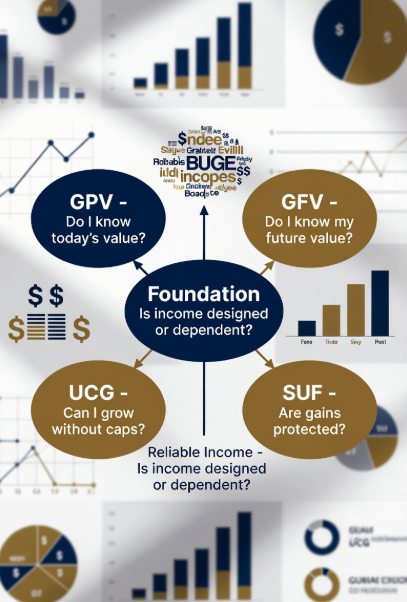
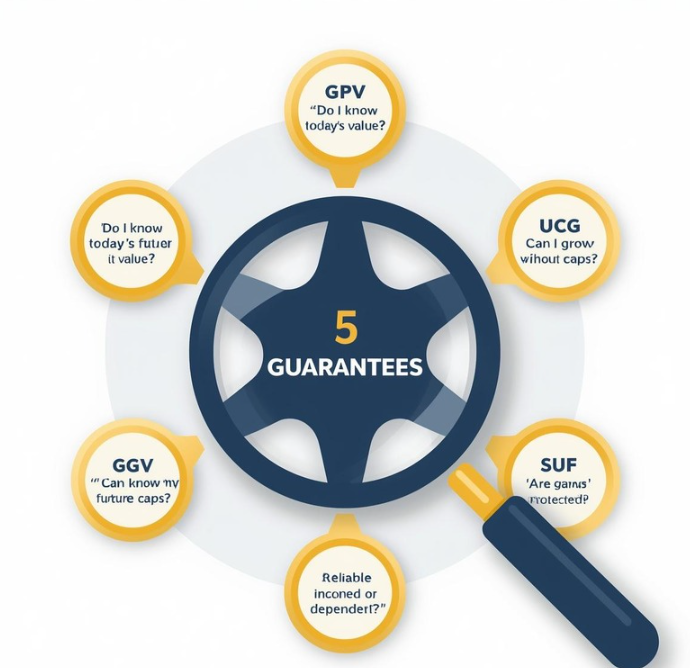
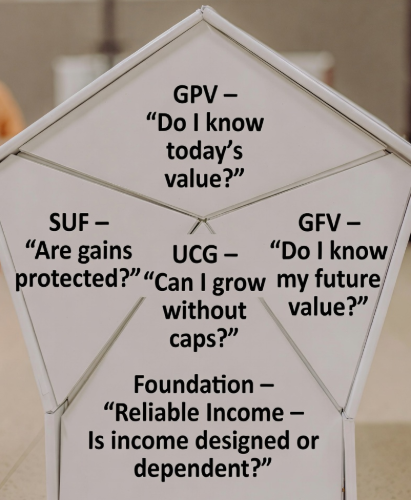
Long answer: It's not about hitting a magic number. It's about answering five questions with certainty before you retire:
What's my guaranteed present value (GPV)? What do I actually have today that I won't lose?
What's my guaranteed future value (GFV)? Where is this headed with certainty, not hope?
Do I have uncapped growth (UCG)? Can I still grow without risking what I've built?
Are my gains safe upon failure (SUF)? If the market crashes, am I protected?
Is my income designed or dependent? Do I have engineered cash flow, or am I winging it?
If you can't answer all five with confidence, you're not planning retirement: you're hoping for it.
And hope isn't a strategy. It's a gap.
Why This Matters More Than Your 401(k) Balance
Here's the uncomfortable truth: most people spend more time planning a two-week vacation than they do planning 30 years of retirement income.
They let Wall Street manage accumulation (which, to be fair, Wally's decent at). But then they hit retirement and realize no one ever built the distribution engine: the part that turns assets into reliable monthly income without the panic, the guesswork, or the sequence risk.
That's the Income Illusion Gap. And it's why so many retirees with "enough" money still feel broke.
The good news? It's fixable. But only if you address it before the paychecks stop.
Because once you're retired and pulling from a pile with no structure, you're flying blind. Every withdrawal feels like a gamble. Every market dip feels personal. And every dinner out feels like it's stealing from Future You.
That's no way to live the retirement you worked decades to earn.
What Happens in the Million Dollar Hour™
This is exactly what we unpack in the Million Dollar Hour™: a one-time, educational session that doesn't sell you anything: it just shows you where your current plan actually leads.
No fluff. No pitches. No "let me show you this hot fund."
Just clarity on whether your wealth is structured to produce income by design, or whether you're about to join the Income Dependent club with no paycheck and a whole lot of hope.
We map your five guarantees. We show you the gaps. And we let you decide what to do about it.
Because retirement's too long to spend it worried about running out.
Ready for clarity instead of confusion?
The Million Dollar Hour™ is your educational, one-on-one retirement review that reveals where your plan leads : not just where it's been.
👉 Schedule your session today.