
The Sommeroy Trap: Why You Can't Retire on an Island Where Time Stops
The Sommeroy Trap: Why You Can't Retire on an Island Where Time Stops
![[HERO] The Sommeroy Trap: Why You Can't Retire on an Island Where Time Stops](https://cdn.marblism.com/8Ar5hx6xgXT.webp "[HERO] The Sommeroy Trap: Why You Can't Retire on an Island Where Time Stops")
There's a tiny island in Norway called Sommeroy where residents literally tried to abolish time.
No clocks. No schedules. Just endless daylight in the summer and the freedom to live without the tyranny of tick-tock.
Sounds dreamy, right?
Here's the thing: Wall Street has been selling you the exact same fantasy for decades: only they call it "long-term investing" and "30-year averages." They want you to believe that when it comes to your retirement, time doesn't matter.
Cross the bridge into their marketing materials, and suddenly sequence of returns risk disappears. Market crashes become "just bumps in the road." A decade-long recovery? No big deal. After all, in 30 years, it all averages out.
But here's what they don't tell you: you can't actually live on Sommeroy.
The Bridge Goes Both Ways
The problem with the time-free zone isn't the marketing: it's that you eventually have to leave.
You might cross into Wall Street's version of Sommeroy at 45, convinced that time is irrelevant because you've got 20+ years until retirement. The charts look great. The projections are smooth. Everyone's smiling in the brochures.

But when you're 65 and ready to retire, you have to cross back into the real world. And in the real world:
The IRS still runs on a clock. Required minimum distributions don't care about your "long-term average." They want their cut at 73, whether your account is up or down.
Grocery stores don't accept 30-year averages. Your bills come monthly, not when the market decides to cooperate.
Your lifespan is ticking. A 10-year market recovery isn't just a number on a chart. It's a decade of your life. That's 520 weeks. 3,650 days. Time you will never, ever get back.
This is the Sommeroy Trap: Wall Street sells you a time-free retirement fantasy, but real life refuses to play along.
How Much Do You Need to Retire? (And When Does the Clock Start Mattering?)
If you've ever Googled "how much do I need to retire," you've probably seen the same advice everywhere: multiply your annual expenses by 25, follow the 4% rule, and hope the market cooperates.
But here's what those calculators don't tell you: when you retire matters just as much as how much you have.
Let's say you've saved $1 million and you're ready to retire in 2007. Congratulations! According to Wall Street's Sommeroy math, you're golden. The "long-term average" says you'll be fine.
Fast forward to 2009. The market just ate 37% of your portfolio. You're down to $630,000, and you've been withdrawing money the whole time to, you know, eat and pay bills.
"Don't worry," Wall Street says. "Time doesn't matter! It'll recover!"
Sure. It took about 13 years for the S&P 500 to fully recover and then some. But you weren't holding a frozen account: you were withdrawing from it during the crash. That's sequence of returns risk in action, and it's the reason people who retired in 2007 with $1 million ended up in very different financial positions than people who retired in 2012 with the same amount.
Wall Street wants you to believe you live in Sommeroy. But your retirement account? It lives in the real world, where timing is everything.

The Marketing vs. The Math
Here's how Wall Street keeps you in the time-free zone:
"Just look at the 30-year chart!"
Sure. But you're not investing for 30 years while retired. You're withdrawing money every single year. A bad first decade can wreck a retirement plan, even if the market eventually recovers.
"Stay the course!"
Easy to say when you're 35 with a paycheck. Not so easy when you're 68, watching your account balance drop while your RMDs keep climbing.
"You can't time the market!"
True. But you also can't ignore the market when you're living off it. Retirement income planning isn't about timing: it's about sequence. And if the sequence is bad, no amount of "long-term thinking" will bail you out.
The uncomfortable truth is this: Wall Street's business model depends on you believing time doesn't matter. Because if you actually understood sequence of returns risk, you'd start asking very different questions about guaranteed lifetime income and protection strategies: and those don't generate nearly as many management fees.
What Happens When You Leave Sommeroy
Let's say you finally cross back into reality. You're 65. You've got your nest egg. You're ready to start withdrawing.
And then the market drops 30%.
Here's what Wall Street tells you:
"Don't panic. This is temporary. Remember, time doesn't matter. Look at the 30-year average."
Here's what your bills tell you:
"Payment due: $3,200 this month. Also, inflation just added 6% to everything. Good luck."
This is the moment you realize you were never actually on Sommeroy. You were just visiting the gift shop.
The clock never stopped. It was always ticking. You just couldn't hear it over the marketing noise.
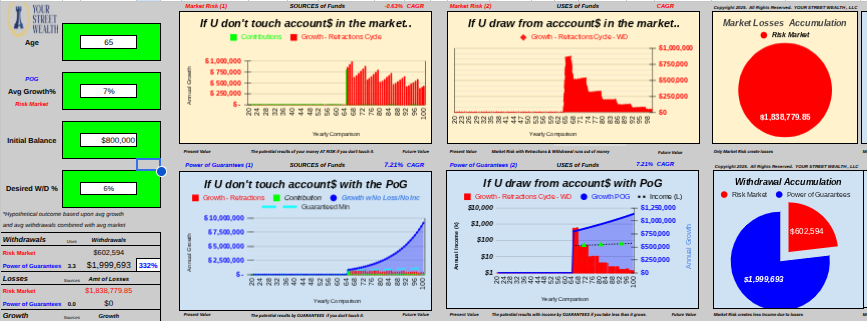
The Grown-Up Question: What If Time Actually Matters?
If you accept that time does matter: especially in retirement: then everything changes.
Instead of asking, "What's my long-term average?" you start asking:
What's guaranteed? Not projected. Not estimated. Guaranteed.
What happens if I retire into a bear market? Do I have a plan that doesn't depend on the market "eventually" recovering?
Can I outlive my money? Or do I have guaranteed lifetime income that pays regardless of what the market does?
What are the best retirement income strategies that don't require me to pray for good timing?
These are the questions Wall Street doesn't want you asking, because the answers usually involve things like annuities, bond ladders, and income floors: strategies that prioritize protection over growth and certainty over complexity.
In other words, strategies designed for people who understand that a decade of your life isn't just a blip on a chart.
The Architecture That Works in Real Time
The difference between Wall Street's Sommeroy fantasy and a real retirement plan comes down to architecture.
Wall Street's approach: throw money into a portfolio, hope the timing works out, and keep your fingers crossed that you don't retire during a crash.
The grown-up approach: build a plan that works in real time, not just on average.
That means:
Guaranteed income that covers your essential expenses, no matter what the market does
Liquidity for emergencies and opportunities
Tax planning that doesn't leave you scrambling when RMDs kick in
Sequence protection so a bad first decade doesn't wreck your entire retirement
This isn't complicated. It's just honest. And it's designed for people who live in the real world, where time matters and decades can't be wished away with "long-term thinking."
One Hour to Leave the Island
You don't need to spend years researching Wall Street's time-free fairy tales. You need one honest hour to see where your current plan actually leads: not where the brochures say it might go.
That's the Million Dollar Hour™. No sales pitch. No products pushed. Just a clear-eyed look at your retirement math, your sequence risk, and whether your plan works in real time or just on Wall Street's island.
Because here's the truth: Sommeroy is a beautiful place to visit. But you can't retire there.
The clock is ticking. It always has been. The only question is whether your plan knows it.
Ready for clarity instead of confusion?
The Million Dollar Hour™ is your educational, one-on-one retirement review that reveals where your plan leads : not just where it's been.
👉 Schedule your session today.
Keywords
how much do i need to retire, retirement income calculator, sequence of returns risk, retirement income planning, guaranteed retirement income, guaranteed lifetime income, annuities pros and cons retirement, best retirement income strategies, retirement plan review, protect retirement savings from market crash