
The Diversification Mustache: Why Wall Street's Favorite Strategy is a Disguise for Ignorance
The Diversification Mustache: Why Wall Street's Favorite Strategy is a Disguise for Ignorance
![[HERO] The Diversification Mustache: Why Wall Street's Favorable Strategy is a Disguise for Ignorance](https://cdn.marblism.com/CtW9Ju9qCEw.webp "[HERO] The Diversification Mustache: Why Wall Street's Favorable Strategy is a Disguise for Ignorance")
Let's talk about Wall Street's favorite word: diversification.
It sounds smart. It sounds safe. It sounds like the kind of thing a guy in a suit tells you right before he shuffles your money into eight different mutual funds and calls it a "strategy."
But here's the truth: Wall Street’s version of diversification is just another form of a gamble. It’s a fancier way of saying, “We’re going to spread bets around and see what comes up.”
If you’re 30 and you pick the right alternatives, it might work out… and it might not. To their credit, Wall Street is truthful about one thing: there are no guarantees on Wall Street.
But there are guarantees on Your Street.
Wall Street diversification is like shaking a container full of outcomes and dumping them on the table to see which ones you get. How does anyone get comfortable with that?
And the worst part? You've been sold this mustache as if it's a full beard.
The Company-Level Shell Game
Wall Street loves to tout diversification, but let's be clear about what they're actually diversifying: companies.
They'll put your money in 10 stocks, 15 mutual funds, a handful of bonds, and tell you you're "diversified." But here's the catch, all of those assets carry the same level of risk.
Stocks? Risky.
Bonds? Still tied to the market.
Mutual funds? Just a basket of stocks with a management fee slapped on top.
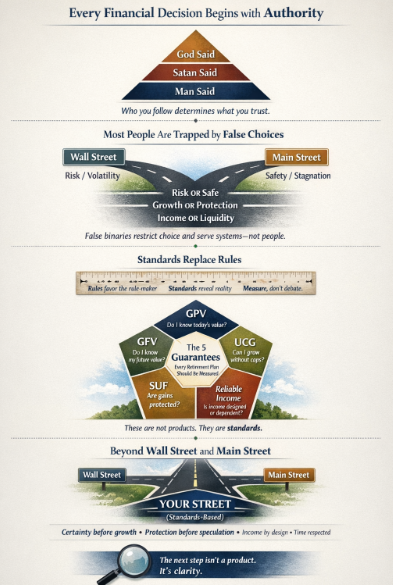
You're not diversified. You're just spread thin across the same risk profile. It's like putting all your eggs in different baskets, but all the baskets are on the same boat, and the boat is the Titanic.
The thing Wall Street conveniently ignores? The percentage of risk YOU are carrying at YOUR age.
A 30-year-old can take a hit and recover. A 65-year-old? Not so much. But Wall Street treats them both the same way, because it's easier to sell the same product to everyone than to actually build a retirement plan review that considers where you are in life.
The Math Wall Street Doesn't Want You to See
Here's a question I'd bet you $.05 nobody, not even your broker, can answer:
What are the 4 Rules of Company Stock Selection?
Go ahead. Call your advisor. I'll wait.
Chances are, they don't know. And that's because brokers don't pick stocks based on math or science. They pick based on:
What they're told to push by the home office
What's "hot" this month
What went up last year (and will probably go down this year)
There's no strategy. There's no science. There's just a sales pitch wrapped in jargon.
This is why diversification is a mustache, a fake disguise meant to make you feel like you're protected when you're really just exposed in a dozen different directions.
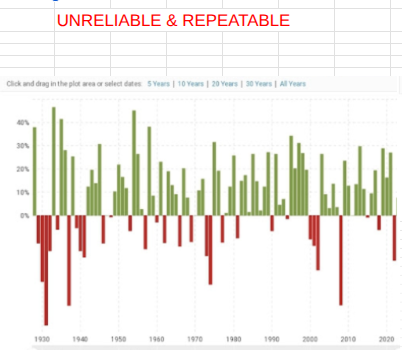
Look at that chart. Those red bars? Those are years your "diversified portfolio" went backward. And every time that happens, you're not just losing money, you're losing time. Time you'll never get back. Time that compounds against you instead of for you.
The Rule of 100: The Strategy Wall Street Ignores
So if diversification is a disguise, what's the real strategy?
It's called Allocation Strategy, and it's based on something Wall Street refuses to use: the Rule of 100.
Here’s the key clarification: the Rule of 100 is only “necessary” if you insist on keeping your money in Assets At Risk (AAR) on Wall Street — where red bars (losses) are part of the deal.
Here's how it works:
Subtract your age from 100. That's the percentage of your portfolio that should stay in AAR (risk). The rest? In Fully-Performing Assets (FPA).
Age 40: 60% risk to 40% Fully-performing
Age 65: 35% Risk, 65% Fully-Performing
Age 75: 25% risk, 75% Fully-Performing.
This is math. This is science. This is how you stop letting a market crash steal your time using a Stepped Up Floor (SUF).
Fully-Performing Assets don’t “give up growth.” They’re built for green bars up (growth) with no red bars down (losses) — which means your growth can compound because there are no market losses to recover from.
That’s the essence of Fully Performing Assets: the opportunity for 30%+ growth (or more) without limit, with a Stepped Up Floor locking in progress along the way. Who wouldn’t want Wall Street returns with a Stepped Up Floor?
Now here’s the contrast Wall Street doesn’t want you to see:
In the Million Dollar Hour™ (MDH), we show you how Fully Performing Assets (FPA) can outperform AAR over 20, 30, or 40 years for one simple reason — no red bars in the mix. No losses means no “recovery years,” which means compounding doesn’t get interrupted.
And when growth is already floor-protected, you don’t need a separate “protection” strategy… because the protection is built into the way the asset performs.
Why You Need Protection From… You
Here’s the part nobody likes to admit: a lot of retirement damage doesn’t come from the market itself — it comes from what people do during a market tsunami.
When the market drops 10–20% every 18 months (or around 40% every 6 years on average), panic is predictable. People freeze. People sell. People “go to cash.” And then they miss the rebound… which is how a temporary drop turns into permanent loss of time and wealth.
That’s one reason the Rule of 100 can act like a guardrail. If you’re going to keep money in Assets At Risk (AAR), you need a rules-based way to limit how much of your future you’re leaving exposed to the next wave.
And let’s talk about the lure Wall Street uses to keep you in that wave: “tax-deferred.”
Sure — AAR accounts can be tax-deferred. But Fully Performing Assets (FPA) can be tax-deferred too, and they can do it with no annual contribution limits.
So the question becomes pretty simple:
Why risk your retirement in a tsunami for a benefit you can get somewhere else… without the risk?
But Wall Street hates this. Why? Because it means pulling money out of AAR and into strategies they can't charge trading fees on, can't churn, and can't use to generate commissions.
So instead, they keep you "diversified" across a dozen funds, all carrying the same risk, all vulnerable to the same crashes, all feeding the same fee machine.
What Allocation Strategy Actually Looks Like
Real allocation strategy isn't about spreading your money across a bunch of similar assets. It's about matching your risk to your timeline.
Here's what that looks like in practice:
Growth assets (stocks, equity funds) → For money you won't need for 10+ years
Protected assets (fixed indexed annuities, bonds with guarantees) → For money you'll need in 5-10 years
Guaranteed income vehicles → For money you need now and for the rest of your life
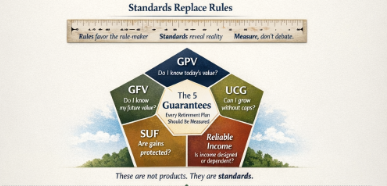
This is how you build best retirement income strategies that actually work. Not by hoping the market cooperates. Not by crossing your fingers and checking your balance every month. But by engineering a plan where you know today's value, you know future value, and your gains are protected.
That's allocation. That's strategy. That's the opposite of the diversification mustache Wall Street is trying to sell you.
The Opposite Side of the Coin
Allocation Strategy is the opposite side of the coin from Wall Street diversification.
One is designed to protect you. The other is designed to protect them.
One is based on your age, your timeline, and your need for certainty. The other is based on what's trending, what's easy to sell, and what generates the most fees.
One uses the Rule of 100 to align risk with reality. The other ignores it completely and hopes you never notice.

This is the difference between Wall Street, Main Street, and Your Street.
Wall Street = Risk disguised as diversification
Main Street = Safety disguised as savings accounts that lose to inflation
Your Street = Standards-based retirement income planning that guarantees growth, protects what you've earned, and delivers income you can't outlive
The Mustache Comes Off
Even if you’re 30, losing money is never the goal.
A red-bar year doesn’t just “hurt for a bit” and then magically disappear. It steals what you can’t replace: time and compounding. And even if you have 30 years to “recover,” you’re still behind where you would’ve been if that loss never happened in the first place.
That’s the quiet truth Wall Street doesn’t advertise: recovery isn’t winning — it’s catching up.
And that’s why the Your Street way is so different: why spend decades recovering from red bars when you could be compounding from day one?
Real retirement planning starts when you stop spreading money around and start allocating it with purpose.
That's what we do in the Million Dollar Hour™. We don't sell you diversification. We show you allocation. We don't guess at your future. We measure it. We don't hope your plan works. We guarantee it.
Keywords
retirement plan review, protect retirement savings from market crash, rule of 100 retirement, diversification vs allocation, sequence of returns risk, fully performing assets, assets at risk, guaranteed retirement income, how much do i need to retire, retirement risk management, wall street myths, market volatility protection, compounding wealth, tax deferred retirement growth.
Ready for clarity instead of confusion?
The Million Dollar Hour™ is your educational, one-on-one retirement review that reveals where your plan leads : not just where it's been.
👉 Schedule your session today.