
Best Retirement Income Strategies Here are 10 To Know Before
Looking For the Best Retirement Income Strategies? Here Are 10 Things You Should Know Before You Risk It All on Wall Street
![[HERO] Looking For the Best Retirement Income Strategies? Here Are 10 Things You Should Know Before You Risk It All on Wall Street](https://cdn.marblism.com/-W9SQVllpzY.webp "[HERO] Looking For the Best Retirement Income Strategies? Here Are 10 Things You Should Know Before You Risk It All on Wall Street")
If you’ve spent the last twenty years contributing to a 401(k) or a brokerage account, you’ve likely been conditioned. Like Pavlov’s dog, you’ve been trained to salivate at the sound of the "Average Return" bell. Wall Street rings that bell, tells you the market "always goes up in the long run," and you continue to pour your hard-earned capital into a system where they win with 100% certainty, while you’re left with a 3% chance of actual success.
Most people aren't planning their retirement; they are participating in a "School of Average" trap. They are waiting for the bell to ring so they can finally stop working, without realizing their financial engine is missing half its parts.
At Your Street Wealth, we don't do "average." We do engineering. If you’re a "Quiet Builder": someone who has worked hard, saved well, and is now feeling that nagging sense of unease about the future: this is for you.
Here are the 10 things you must understand before you risk another dime on Wall Street’s false models.
1. The Pavlovian Routine: Who is the System Built For?
Wall Street operates on a cycle of fear and greed. They’ve conditioned the public to follow a routine: buy, hold, hope, and pay fees regardless of performance. This routine provides Wall Street firms with absolute certainty of profit.
Think about it: whether the market goes up 20% or down 20%, their fees stay remarkably consistent. You take 100% of the risk, and they take a guaranteed cut of your principal. In our engineering view, that’s a design flaw. A plan that provides certainty for the provider but only "hope" for the customer isn't a strategy; it's a transfer of wealth.
2. The 3% Statistic: The Ugly Truth of Market Reliance
The industry loves to highlight the "winners," but the data tells a different story. Statistically, only about 2–3% of people find true, lasting success for retirement by relying solely on the stock market.
Why is the failure rate so high? Because the market is a "Participation" model, not a "Performance" model. Most retirees find themselves in a "Sequence of Returns" death spiral where a single bad year early in retirement destroys the longevity of their entire portfolio.
3. The 5x Loss: The Massive Cost of "Lost Gains"
Most investors focus on their contributions. They think, "I put in $500,000, and now I have $1,000,000. I’m winning!"
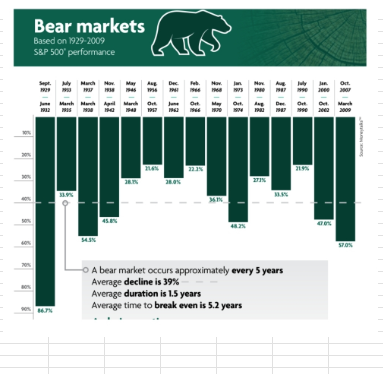
What they fail to see is the Volatility Recovery Analysis. Because of market downturns and the "Math of Recovery," the average investor loses about 5x their total contributions to lost gains and market volatility over their lifetime. When the market drops 30%, you don’t just need 30% to get back to even: you need 42.8%. That gap is lost time, lost compounding, and lost life. On Your Street, we focus on Compounding Efficiency, ensuring your money never has to work twice as hard just to get back to where it started.
4. Sequence of Returns: The Portfolio Killer
In the "School of Average," they tell you the order of returns doesn't matter. They are wrong.
If your portfolio goes up then down right before or during retirement, you might be okay. But if it goes down then up, it’s a death sentence for your income. Why? Because you are forced to sell shares at a loss to create your monthly check. This is what we call a "broken engine." You cannot recover from volatility when you are also subtracting income.
5. Assets at Risk (AAR) vs. Fully Performing Assets (FPA)
We categorize wealth using an Asset Pyramid. Most people have their entire retirement sitting in Assets at Risk (AAR): stocks, mutual funds, and variable instruments where the floor is zero.
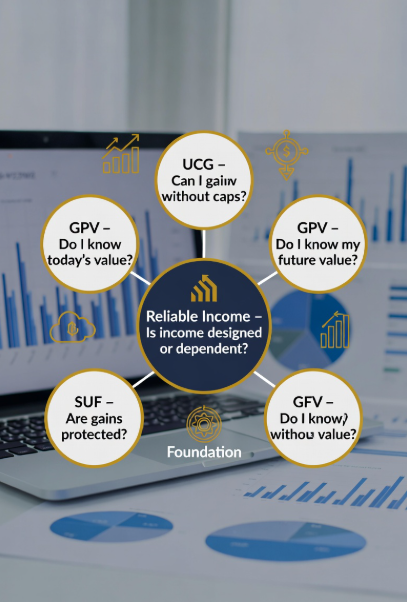
On Your Street, we transition "Quiet Builders" toward Fully Performing Assets (FPA). An FPA is the "foundation" of your pyramid. It offers a contractual floor of 0% (meaning you never lose a dime to market drops) while maintaining Uncapped Growth (UCG) potential. Why play a game of -30% to +30% when you could play a game of 0% to +30%?
6. The "Smartphone" of Finance: Multi-Pillar Strategy
Traditional financial products (like a basic savings account or a single stock) are "single-pillar" assets. They do one thing. It’s like carrying a pager, a calculator, and a paper map in your pocket.
Modern financial engineering uses the "Consolidation of Technology" analogy. A Fully Performing Asset is like a smartphone; it consolidates 5 to 15 pillars of value: growth, protection, tax-free income, and long-term care benefits: into one vehicle. Using a Rolodex-era strategy in a SpaceX world is how you end up financially fatigued.
7. Participation vs. Engineered Performance
Wall Street invites you to "participate" in the market. Participation is just a polite word for gambling on macro headlines.
We prefer Engineered Performance. This is rooted in Asset Liability Management (ALM): the same principles used by major banks and institutions to ensure they have the cash they need, exactly when they need it. We don't care what the headlines say; we care what the math says. Performance is designed; participation is hoped for.
8. The "Million Dollar Hour" Approach
Most financial reviews are just a "Participation Audit": a look back at how much you lost or gained based on luck.
We offer a Margin Audit™ through our Million Dollar Hour™ Forecast. This is a forensic analysis of your retirement plan. We don't look at "averages." We look at the micro margins: fees, taxes, and volatility drains. This $995 engineering session isn't for "free-cheese" seekers; it’s for the Architect who wants to see exactly where their current plan leads: and how to fix the leaks before they become floods.
9. Expanded Market Participation (EMP)
One of the biggest myths is that safe money can't grow. The "School of Average" will tell you that if you want safety, you have to accept 3% returns.
That’s outdated thinking. Through Expanded Market Participation (EMP), we can often engineer a 110% to 200% multiplier on market gains. If the market index goes up 10%, your actual gain could be 11% or even 20%, all while maintaining a 0% floor. We aren't just looking for growth; we are looking for Compounding Efficiency.
10. Moving from Wall Street to "Your Street"
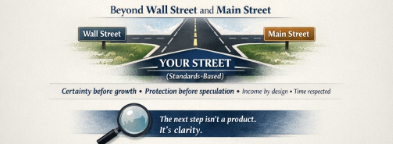
Wall Street is a "False Model" driven by the noise of the crowd. Your Street is built on certainty, clarity, and rules-based planning.
When you move to Your Street, you stop asking "What did the market do today?" and start knowing "How much income is guaranteed for the rest of my life?" Peace is the path, and wisdom is the way.
The Engineering of Certainty
Retirement shouldn't be a game of "wait and see." It shouldn't be a Pavlovian response to a ticker tape. It should be a designed outcome.
If you’re tired of the "spinning sharp knives" of interest-rate ripples and the "School of Average" rhetoric, it’s time to look at the architecture of your wealth. You can estimate your income needs all you want, but you cannot predict your future portfolio value when your losses and leaks are uncontrollable.
It’s time to move from a plan based on participation to a plan based on performance.
Your Money, Your Rules, In Your Time, On Your Street.
Ready for clarity instead of confusion?
The Million Dollar Hour™ is your educational, one-on-one retirement review that reveals where your plan leads : not just where it’s been.
👉 Schedule your session today.
You can keep participating… Or you can finally see the outcome. The Million Dollar Hour™ shows you exactly:
✔ Where you are ✔ Where you’re going ✔ How to fix the gaps 👉 Book your session now
Check out the Retirement Blueprint