
Market Returns vs Retirement Income
The Outcome Delusion: Why Your Retirement Process is Already Broken
Market Performance Is Not Retirement Income
One of the fastest ways to uncover hidden risk is to take our 7 Question Retirement Stress Test.
![[HERO] The Outcome Delusion: Why Your Retirement Process is Already Broken](https://cdn.marblism.com/jJtH--2Kc7Q.webp "[HERO] The Outcome Delusion: Why Your Retirement Process is Already Broken")
Start here: See what your retirement actually looks like → 👉 Book Your Million Dollar Hour™
The Law of the Process
There is an immutable law in engineering, architecture, and finance that most people choose to ignore: You can never achieve an outcome that is greater than the process allows.
If you build a bridge using toothpicks and Elmer’s glue, it doesn’t matter how much you "believe" it will hold a semi-truck. The process dictates the failure. If you try to bake a cake with salt instead of sugar, no amount of positive thinking will make it sweet.
Yet, when it comes to retirement income planning, millions of "Quiet Builders": successful people who have worked hard and saved diligently: are operating under a process designed for mediocrity or, worse, total collapse. They are chasing a Ferrari-level outcome using a lawnmower engine process.
At Your Street Wealth, we call this the Outcome Delusion. It’s the false belief that you can achieve financial peace and guaranteed retirement income using a Wall Street system built on "participation" rather than "engineered performance."
The Mathematical Canard: Why “Good Market Performance” Still Fails at Income
Wall Street has spent decades training people to confuse market performance with retirement success. Every time the "average return" bell rings, people assume the outcome is handled. If the statement says 7% or 10% average returns over time, the brain quietly translates that into, "I should be fine."
That translation is false.
A portfolio can show respectable performance on paper and still fail at the one job retirement actually requires: producing reliable income without forcing you to sell assets at the wrong time. That is the heart of the Outcome Delusion.
This is why we use the framework Participation vs. Engineered Performance. Participation means your outcome is still hostage to timing, volatility, fees, taxes, and withdrawals. Engineered Performance means the process is designed around the result you actually need: usable income, protected principal, and a path you can measure.
The "School of Average" ignores Volatility Recovery Analysis. It ignores sequence risk. It ignores the fact that losses and withdrawals happening together are not a minor inconvenience; they are a structural failure.
Here is the simple math:
If $1,000,000 drops 30%, it becomes $700,000.
To recover from $700,000 back to $1,000,000, you do not need 30%.
You need 42.86%.
Now add income. If that same retiree withdraws $60,000 during the decline, the account drops to $640,000. To get from $640,000 back to $1,000,000, the required gain is 56.25%.
That is the disconnect between market performance and actual income.
The statement may eventually recover. The retiree’s timeline may not.
This is The Math of Recovery: losses create a larger percentage hurdle on the way back up, and income withdrawals make that hurdle even steeper. So when someone says, "The market averages 8%," the real question is not, "What is the average?" The real question is, "What return is required after losses, while I am taking income, after fees and taxes, and by what date?"
That is where most retirement plans break.
Most people still build projections by multiplying a balance by 7% or 10% and calling it a plan. But retirement is not an accumulation fantasy. It is a distribution engineering problem. You can estimate your income need with reasonable precision. You cannot predict future portfolio value when market losses, fees, and taxes remain uncontrollable.
Historically, the market sees a 10-20% retraction with regularity, and a major retraction can arrive right when income begins. If your process depends on smooth markets to work, then your process is not a plan. It is a hope strategy wearing a spreadsheet.
The Charade We Tell Our Families
Perhaps the most painful part of the Outcome Delusion is the social cost. We see it every day: successful parents who live in a dream world of "projected riches," denying the truth of their situation even to their own sons and daughters.
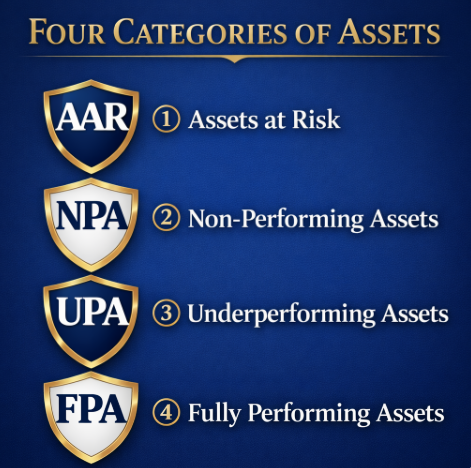
They stay in the "Assets at Risk" (AAR) category far too long, hoping the market will bail them out. They are "participating" in a system that doesn't care about their outcome. It’s a game of "some, a little, or none."
Some: You might end up with enough to get by.
A little: You might end up with just what you contributed (losing all that time/compounding).
None: You might outlive your money entirely.
The tragedy is that many people don't realize their process is broken until it’s too late to fix the engine. They spend their "red zone" years (ages 45–75) in a state of financial fatigue, sensing something is wrong but not knowing how to audit the margin.
If this concerns you, you’re not alone. Most people have never actually seen what their money is doing — or where it leads. 👉 In the Million Dollar Hour™, we map your exact outcome:
• Today’s value • Future income • Hidden risks • What it should be doing instead Book your session here →
Stress Testing the Process: The Margin Audit™
If you want a different outcome, you need a different process. You cannot guess your way to certainty. You must stress test the process with a real Margin Audit™.
A true retirement plan review does not stop at last year’s return. It tests whether the plan can convert assets into income under pressure. It asks:
What happens to my income if a 20% or 39% retraction hits the year I retire?
How many years of compounding are lost while the account tries to heal?
Is my income designed, or is it dependent on market mood swings?
Am I losing more to The Math of Recovery than I am gaining in the up years?
What is my actual compounded growth after volatility, fees, taxes, and withdrawals?
That last question matters most. Average return is marketing math. Actual income capacity is retirement math.
This is where we move from Participation to Engineered Performance. Participation says, "Stay invested and hope the averages show up." Engineered Performance says, "Measure the failure points, remove unnecessary risk, and design around the income target."
At Your Street Wealth, this is exactly what the Million Dollar Hour™ Forecast is built to do. In one 60-minute session, we review your current strategy, calculate the compounded growth you have actually earned versus what you think you earned, identify years lost to Wall Street risk, and map out a more precise path to safer accumulation and reliable lifetime income. It is a paid, high-clarity engineering review for people who want answers, not motivation.
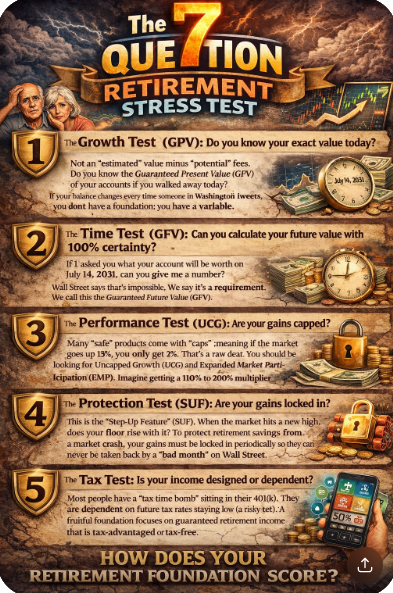
If market losses concern you, use the 7 Question Retirement Stress Test to evaluate your current plan.
The Choice of Three Streets
In the world of retirement, you are essentially choosing to live on one of three streets. Your outcome is dictated by the address you choose.
1. Main Street (The Rolodex in a SpaceX World)
This is the world of traditional banking and basic savings. It’s safe-ish, but stagnant. You’ll likely end up with a little more than you contributed, but inflation and taxes will eat the "growth" for lunch. It’s an outdated model: like trying to run a global business using a Rolodex. It was durable in the 1980s, but it's inadequate for the speed of today’s world.
2. Wall Street (The Casino of False Hopes)
This is where 97% of people reside. It’s a "False Model" driven by the Greed/Fear meter. When greed is high, you risk it all for "more." When fear hits, you panic and lock in losses. It’s a single-pillar model where you are constantly spinning sharp knives, hoping you don't get cut by interest rate ripples or sequence of returns risk. You could have "some, a little, or none."
3. Your Street (The Engineered Certainty)
This is the street we build at Your Street Wealth. It’s based on institutional-grade Asset Liability Management (ALM). Instead of "single-use" financial products, we use Fully Performing Assets (FPA).
Think of FPA as the "smartphone" of finance. Just as your phone consolidated your pager, camera, map, and computer into one device, an FPA consolidates 5–15 "pillars" of value: including growth, protection, and tax-free income: into one vehicle.
On Your Street, we focus on:
Uncapped Gains (UCG): Capturing market upside without the floor dropping out.
Expanded Market Participation (EMP): Using multipliers (110%–200%) to enhance performance without increasing risk.
Sequence of Return Margin: Engineering the plan so that a market drop doesn't break your retirement engine.
From Participation to Architecture
The "Quiet Builder" does not need more opportunity language. They need precision. They need to know whether the process can turn savings into income without breaking under pressure.
Wealth is not built on macro headlines. It is built on Compounding Efficiency and income design. That means stopping the leaks: fees, taxes, and the volatility tax, which is the hidden cost of having to recover from losses. This is why the disconnect between market performance and actual income is so dangerous. A portfolio may look productive during accumulation and still become fragile the moment distribution begins.
Here is the practical difference:
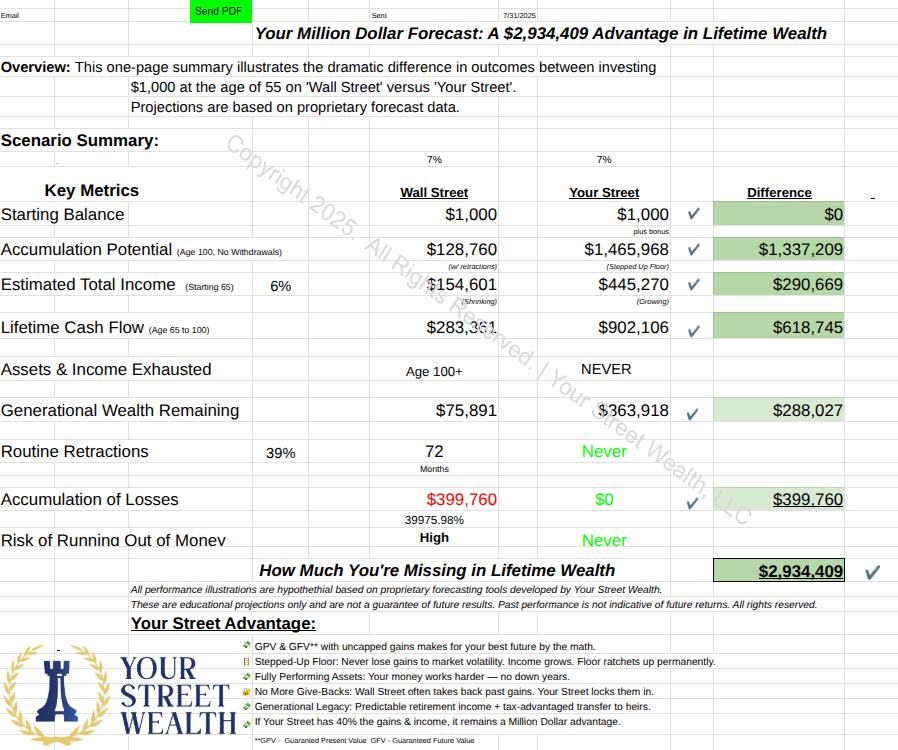
Wall Street often operates in a -30% to +30% range.
Engineered strategies aim for a 0% to +30% range.
That difference is not cosmetic. It changes the entire income equation.
In a loss-based system, your "average return" is not your lived experience because negative years damage the base that future growth must work from. In a 0% floor environment, the floor matters as much as the upside because it protects the compounding base. When you remove losing years, your average and your actual result move closer together. That is how architecture beats participation.
This is also where the Single Pillar vs. Multi-Pillar conversation matters. Banks, stocks, and real estate are usually single-pillar tools. Each does one main job, with its own risk, fee drag, or limitation. Fully Performing Assets (FPA), by contrast, are designed as multi-pillar tools that can combine 5-15 pillars of value in one vehicle, such as growth, protection, tax efficiency, income, and even long-term care features. In simple terms, single-pillar planning is a Rolodex in a SpaceX world. FPA is the smartphone of finance.
For readers who want to see the exact numbers in their own plan, this is where the Million Dollar Hour™ Forecast becomes valuable. It is not another free consultation. It is a $995 engineering session built to show how much time and income your current process may already be costing you, and whether a more stable, guaranteed path can produce a better retirement outcome.
Don't Wait Until the Engine Fails
The most dangerous thing you can do is deny the truth of your current process until it’s too late. Most people treat retirement like a destination: a "finish line." But retirement is a continuous stage that could last 30 or 40 years. You cannot afford to live in a "dream world" of bad math.
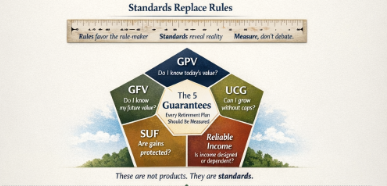
Every retirement plan should be measured against the Five Standards:
Do you know today’s value with 100% certainty?
Do you know the future value?
Are your gains protected?
Is your growth uncapped?
Is your income guaranteed and reliable?
If your current "process" can't answer "Yes" to all five, your outcome is at risk.
Peace is the path, wisdom is the way. It’s time to unlearn the myth that performance on a statement automatically becomes income in real life. It does not. Income has to be engineered.
You can keep participating in a False Model driven by fear and greed, or you can move toward a process designed around certainty, margin, and actual retirement cash flow.
Your Money. Your Rules. In Your Time. On Your Street.
Ready for clarity instead of confusion?
The Million Dollar Hour™ is your educational, one-on-one retirement review that reveals where your plan leads : not just where it’s been.
👉 Schedule your session today.
You can keep participating… Or you can finally see the outcome. The Million Dollar Hour™ shows you exactly:
✔ Where you are ✔ Where you’re going ✔ How to fix the gaps 👉 Book your session now
Check out the Retirement Blueprint
Concerned about market losses, taxes, or income reliability?
Take the 7 Question Retirement Stress Test →