
Protect Retirement Savings From Market Crash & Time Theft
The Theft of Time: Is Your Retirement Strategy Merely Consuming Your Life?
One of the fastest ways to uncover hidden risk is to take our 7 Question Retirement Stress Test.
![[HERO] The Theft of Time: Is Your Retirement Strategy Merely Consuming Your Life?](https://cdn.marblism.com/IGgtT-N61jG.webp "[HERO] The Theft of Time: Is Your Retirement Strategy Merely Consuming Your Life?")
Start here: See what your retirement actually looks like → 👉 Book Your Million Dollar Hour™
The Invisible Thief: Is Your Retirement Strategy Stealing Your Life One "Average" Return at a Time?
If you’ve spent any time in the corporate world, you know the soul-crushing weight of a meeting that should have been an email. You know the "small talk" that fills the first ten minutes of a call: pleasantries that act as a polite barrier to actually getting work done.
In business, we call this a "theft of time." It’s momentum-killing. It’s focus-stealing.
But here’s the thing most "Quiet Builders" don’t realize until it’s too late: Your retirement strategy is likely doing the exact same thing to your wealth.
Wall Street has turned retirement planning into a series of low-value conversations, repetitive busyness, and "small talk" metrics like average returns. While you’re busy checking your portfolio app every hour (the digital version of pacing the floor), the market is quietly stealing the one asset you can never buy back: Time.
At Your Street Wealth, we don’t just look at your money. We look at the efficiency of your time. If your money isn't compounding future results, it’s merely consuming your present life.
The 7 Forms of Time Theft in Your Retirement Plan
Just as small talk replaces meaningful action, certain habits in traditional retirement planning act as invisible thieves. Let’s look at how these seven forms of time theft apply to your portfolio.
1. Repetitive Busyness Without Progress
This is "motion without movement." In the stock market world, this looks like endlessly tweaking your asset allocation, rewriting your "buy list," or checking analytics every morning. If you are constantly managing your money, you aren't an investor; you’ve just given yourself a second, unpaid job. True architecture should grow and heal without you having to babysit it.
2. Decision Paralysis
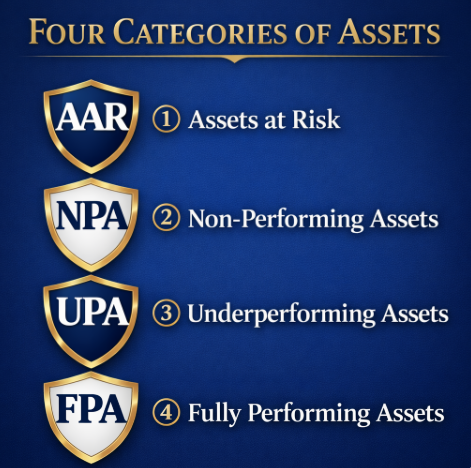
Are you waiting for "perfect clarity" before moving out of Assets at Risk (AAR)? Spending years researching ten different "options" when only two actually provide guarantees is a massive time tax. Perfection steals more time than mistakes. While you wait for the "perfect" time to exit the market, the market is preparing its next retraction.
3. Unresolved Resistance
This is the internal friction of switching from "Participation" (gambling on Wall Street) to "Performance" (Engineering). Often, what steals time is the fear of being seen making a move that contradicts the "status quo." This avoidance keeps you stuck in underperforming assets for decades.
4. Context Switching (The Volatility Tax)
Every time the market drops, you have to "switch contexts." You stop thinking about your legacy and start thinking about survival. You stop thinking about travel and start thinking about "The Math of Recovery." This cognitive cost is exhausting. Ten minutes of worry here and there becomes hours of lost strategic thinking over a lifetime.
5. Consuming Instead of Creating
Are you listening to one more podcast about "market trends"? Reading one more tutorial on "diversification"? When your intake of noise exceeds your output of certainty, you are a victim of hidden time theft. Knowledge is only power if it leads to a decision.
6. Low-Value Conversations
This is the "Small Talk" of finance. It’s your broker talking about "Average Returns" instead of "Actual Returns." It’s the conversation that avoids the hard truth: If you lose 30%, you need a 42.8% gain just to get back to zero. If your financial conversations don't include a Margin Audit™, they are stealing your time.
7. Recovery from Avoidable Mistakes
This is the big one. Poor systems steal future time. If you don’t have a plan that accounts for Sequence of Return Risk, you might spend the first ten years of your retirement just trying to fix what a two-year market crash broke.
If market losses concern you, use the 7 Question Retirement Stress Test to evaluate your current plan.
The Math of Recovery: Why Wall Street is a "Time Thief"
Traditional Wall Street methods are like a Rolodex in a SpaceX world. They worked for a different era, but they are inadequate for the speed and risk of modern planning.
When you "participate" in the market, you are spinning sharp knives. If the market takes a 30% dive, Wall Street tells you to "stay the course." But let's look at the math. A 30% loss on a million-dollar portfolio leaves you with $700,000. To get back to that million, you don't need a 30% gain. You need 42.8%.
How many years of your life does it take to manufacture a 42.8% gain? That is the "Time Tax."
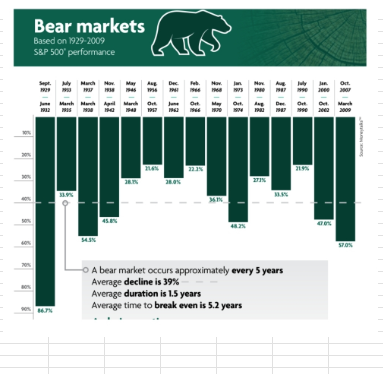
As the chart shows, bear markets aren't "if" events; they are "when" events. If your strategy requires you to wait five years just to break even, that is five years of your retirement stolen. You can't get those years back. You can't hike those mountains or visit those grandkids with the same energy five years later.
Participation vs. Engineered Performance
Most people are sold a "Single Pillar" model. They have a bank account (one pillar), some stocks (one pillar), or a piece of real estate (one pillar). These are single-use tools.
We view Fully Performing Assets (FPA) as the "smartphone" of finance. Just as your phone consolidated your camera, pager, and map into one device, an FPA consolidates 5 to 15 "pillars" of value into one vehicle.
The "Expansion of Pillars" Concept:
On Wall St, there is no Guaranteed Present Value (GPV) and no Guaranteed Future Value (GFV). There is only risk. But in an engineered environment:
You have a Guaranteed Future Value (The Floor).
You have Uncapped Gains (The Ceiling).
As the economy expands and the demand for capital grows, the "pillars" of your asset actually expand.
This triggers bonuses and increased growth potential. The more the world needs capital, the more your "Fortress" adds pillars to support you. This is never true on Wall Street: on Wall Street, high demand usually just leads to higher volatility and more theft of your time.
The Margin Audit™: Is Your Money Compounding or Consuming?
The fundamental question of the Million Dollar Hour™ is this: Is your activity compounding future results, or merely consuming present time?
We use a standards-based, personalized approach that prioritizes Certainty before Growth and Protection before Speculation. We move you from "Hope and Hazards" to "Guarantees and Growth."
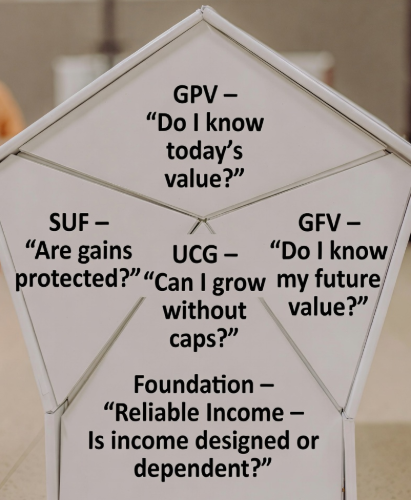
When we conduct a Million Dollar Hour™ Forecast, we aren't having a "small talk" conversation about your feelings. We are performing an institutional-grade engineering audit. We look for the "leaks": the taxes, the fees, and the volatility recovery time: that are quietly draining your clock.
Stop the Theft
Wealth is built on micro-margins, not macro-headlines. If you are tired of the "noise," the "small talk," and the "spinning knives" of traditional investing, it’s time to move to Your Street.
We don't chase "free cheese." We build architectural certainty for Quiet Builders who value their time as much as their money. We translate complex banking architecture into a clear, client-ready path.
Your Money, Your Rules, In Your Time, On Your Street.
Peace is the path, and wisdom is the way. Don't let your retirement strategy consume the very life it was meant to support.
Ready for clarity instead of confusion?
The Million Dollar Hour™ is your educational, one-on-one retirement review that reveals where your plan leads : not just where it’s been.
👉 Schedule your session today.
You can keep participating… Or you can finally see the outcome. The Million Dollar Hour™ shows you exactly:
✔ Where you are ✔ Where you’re going ✔ How to fix the gaps 👉 Book your session now
Check out the Retirement Blueprint
Concerned about market losses, taxes, or income reliability?
Take the 7 Question Retirement Stress Test →