
Protecting 401(k) From Market Losses
Protecting 401(k) From Market Losses
![[HERO] Protecting 401(k) From Market Losses](https://cdn.marblism.com/ljFZWdMatKO.webp "[HERO] Protecting 401(k) From Market Losses")
Start here: See what your retirement actually looks like → 👉 Book Your Million Dollar Hour™
You’ve spent thirty years as a "Quiet Builder." You’ve done the work, stayed in your lane, and ignored the noise. But as you look at your 401(k) statement today, that quiet confidence is being replaced by a nagging sense of "financial fatigue."
The market feels like a room full of spinning sharp knives. One wrong move: one poorly timed recession: and the wealth you’ve spent three decades compounding could be cut in half.
The industry tells you to "stay the course." They tell you that "participation" is the only way to grow. But here’s the truth: Participation is not a strategy; it’s a gamble.
In the modern economy, relying on traditional Wall Street methods to protect your retirement is like trying to use a Rolodex in a SpaceX world. It was a durable tool for its era, but it’s woefully inadequate for the speed, risk, and technical demands of the present.
If you want to protect your 401(k) from market losses, you have to stop "participating" and start "engineering."
The Illusion of Safety: Why Target Date Funds Fail
Most 401(k) plans default you into a "Target Date Fund" (TDF). On paper, it sounds sensible: as you get closer to retirement, the fund automatically shifts from more stocks to more bonds.
The problem is that allocation is not protection. A Target Date Fund may reduce volatility, but it does not remove loss. That matters because the biggest danger near retirement is not just a bad average return. It is Sequence of Returns risk.
What Sequence of Returns Risk Actually Means
Sequence of Returns risk is the danger that poor market returns happen in the wrong order: especially in the years right before retirement or the first years after income begins.
Same long-term average. Very different real-life result.
Here’s the simple version:
Investor A gets good returns early and bad returns later.
Investor B gets bad returns early and good returns later.
On paper, they may show the same average return.
In real life, Investor B can end up with far less money if losses happen when the account is largest or while withdrawals are starting.
That is why protecting a 401(k) is not just about chasing growth. It is about protecting timing. And timing risk is exactly where most Wall Street plans get wobbly.
The Single-Pillar Problem
A Target Date Fund is still a single-pillar solution. It allocates. That’s it. It does not guarantee principal. It does not eliminate drawdowns. It does not perform a personal Margin Audit™ on your retirement timing, income needs, fees, taxes, or recovery burden.
If the market drops 20% when you are five years from retirement, your plan may still be "working as designed." But if that loss delays retirement, reduces income, or forces withdrawals during a recovery period, then the design is not serving the person.
That’s the difference between Participation vs. Engineered Performance.
The Math of Recovery
Wall Street loves to quote averages. Retirees live in actual math.
If your portfolio drops:
10%, you need 11.1% to recover
20%, you need 25% to recover
30%, you need 42.9% to recover
40%, you need 66.7% to recover
50%, you need 100% to recover
This is The Math of Recovery. It is not opinion. It is arithmetic.
And here’s the part that stings: recovery takes time. If you are still contributing during your working years, you may be able to wait it out. But if retirement is close, or withdrawals have started, time becomes expensive. A loss is no longer just a paper decline. It can become a reduction in lifestyle, spending flexibility, and long-term income confidence.
That is why a 401(k) can feel safe for decades, then suddenly feel fragile right when you need it most.
If this concerns you, you’re not alone. Most people have never actually seen what their money is doing — or where it leads. 👉 In the Million Dollar Hour™, we map your exact outcome:
• Today’s value • Future income • Hidden risks • What it should be doing instead Book your session here →
From Assets at Risk (AAR) to Fully Performing Assets (FPA)
To protect your wealth, we have to move away from the "False Architecture" of Wall Street and toward the "Engineering of Certainty." This starts by understanding where your money actually lives in the Asset Pyramid.
NPA (Non-Performing Assets): Your cash and emergency funds. Necessary, but they don't grow.
AAR (Assets at Risk): This is where your 401(k) currently lives. It’s the "Teenager" phase of wealth: volatile, unpredictable, and prone to sudden retracting.
FPA (Fully Performing Assets): This is the "Foundation." These are the "Smartphones" of finance.
The Smartphone Analogy
Think about the technology you used in the 90s. You had a pager for messages, a camera for photos, a MapQuest printout for directions, and a Walkman for music. Today, all of those "single-use" tools have been consolidated into one smartphone.
Traditional retirement planning is still handing you a pager and a paper map. They give you a bank account for safety, a stock portfolio for growth, and an insurance policy for "just in case."
Fully Performing Assets (FPA) consolidate 5 to 15 "pillars" of value: including growth, protection, and tax-free income: into a single, engineered vehicle.

Description: A visual comparison showing outdated single-use financial tools (Rolodex, Pager) being replaced by a modern "Smartphone" representing Fully Performing Assets.
The Power of the 0% Floor
The cornerstone of Your Street Wealth’s philosophy is the 0% Floor.
In the Wall Street world, your outcomes often live in a range like -30% to +30%. In other words, you are exposed to full downside risk and then told to be patient afterward. That is participation.
On Your Street, the goal is different. Using institutional-grade banking architecture and rules-based design, we look for ways to shift the range toward 0% to +30%. That means losses from market downturns are removed from the equation while growth potential remains tied to market-linked performance rules.
That matters because the cleanest way to reduce Sequence of Returns risk is to reduce or eliminate the early loss that causes the damage in the first place.
When the market crashes, a 0% floor means the protected portion of your strategy does not go backward because of that market drop. No new hole. No fresh recovery mountain. No waiting for a 42% comeback just to get even after a 30% hit. That creates what we call Sequence of Return Margin: more room for retirement income decisions because fewer years are spent digging out.
Uncapped Gains (UCG) and Expanded Market Participation
Many brokers still describe these strategies as if they all come with tiny caps. That’s outdated shorthand.
In many modern designs, growth can be tied to Uncapped Gains (UCG) and improved through Expanded Market Participation (EMP). EMP is simply a multiplier on credited growth, often in the 110% to 200% range.
Simple example:
If the index gain used for crediting is 10%
And the EMP rate is 140%
The credited gain becomes 14%
That does not mean "free money." It means the contract rules can increase how much of the linked upside is credited, while still maintaining the principal protection features that matter for retirement timing.
This is where educational clarity matters. The conversation should not be "stocks good, safety bad" or "safety good, growth bad." The real question is: How much downside risk is acceptable when your retirement clock is no longer forgiving?
The Margin Audit™: Finding the Leaks
Most 401(k) plans are not broken in an obvious way. They are just full of small leaks that become expensive over time: fees, taxes, unmanaged volatility, and poor withdrawal timing. Think of it like flying with a tiny crack in the windshield. Nothing seems urgent until pressure changes.
That is why the first step is diagnosis, not guesswork.
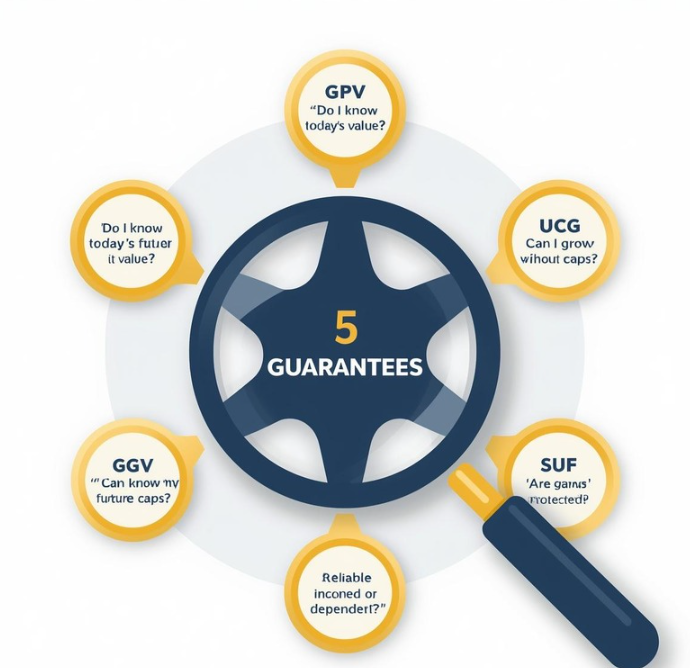
At Your Street Wealth, the Million Dollar Hour™ Forecast is the diagnostic session we use to measure current 401(k) vulnerability. This is where we apply The Margin Audit™ and a Volatility Recovery Analysis to your existing plan so you can see, in plain English, how exposed you may be to Sequence of Returns risk.
We look for:
The Volatility Tax: How much future growth could be lost to drawdowns and the recovery burden that follows?
The Timing Risk: What happens if a market decline shows up in the five years before retirement or the first years of income?
The Participation Fee: What are you paying Wall Street to keep you in the game while you still absorb the losses?
The Tax Drag: How much of the account do you really own after taxes?
The Knowledge Gap: Do you know your likely future value under stress, or only under ideal assumptions?
In short, the Million Dollar Hour™ Forecast helps answer the question most people never get a straight answer to:
If the market drops at the wrong time, what does that do to my retirement timeline and income?
Peace is the Path, Wisdom is the Way
If you are a "Quiet Builder," you are probably not looking for entertainment disguised as advice. You want a technical guide that is simple enough to trust and strong enough to hold.
Here is the educational version:
Identify what portion of your 401(k) is still exposed to loss.
Measure how much damage a 10%, 20%, or 30% decline would do if it happened near retirement.
Calculate The Math of Recovery for that loss.
Estimate how withdrawals would amplify the damage if income begins during a downturn.
Review whether a portion of assets should move from AAR to FPA to create more Sequence of Return Margin.
That is how protection planning should work. Not with hype. Not with predictions. With architecture.
Wall Street runs on a false model driven by fear and greed. High greed usually means higher risk of loss. High fear usually means lower risk of loss. Yet most people are encouraged to keep participating no matter what, as if timing does not matter and math is optional.
It does matter. A lot.
This is why we teach Participation vs. Engineered Performance. Participation says, "Stay in and hope." Engineered Performance says, "Measure the risk, protect the timeline, and design the outcome."
Peace is the path, wisdom is the way.
Your Next Move: The Million Dollar Hour™
You can estimate income needs. But you cannot reliably predict future portfolio value when losses and leaks are uncontrollable. That uncertainty is exactly why Sequence of Returns risk is so dangerous.
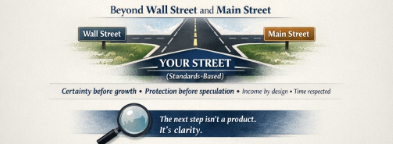
The alternative is clarity.
The Million Dollar Hour™ Forecast is a $995 professional retirement engineering session for high-intent readers who want to understand how vulnerable their current 401(k) really is. In one focused hour, we evaluate where your plan stands today, how market losses could affect the next phase of retirement, and whether your current design is built for participation or built for performance.
This is not a free chat. It is a paid diagnostic for people who want real numbers, real architecture, and a clear path forward.
In sixty minutes, we perform a Margin Audit™ and Volatility Recovery Analysis to show:
how much time may be lost after a market decline,
how much compounding efficiency may be leaking away,
and how a safer, rules-based path may help protect both wealth and retirement income.
If your current 401(k) is still acting like a Rolodex in a SpaceX world, this is where you find out what to do next.
Stop playing by Wall Street's rules. It's time for Your Money, Your Rules, In Your Time, On Your Street.
Ready for clarity instead of confusion?
The Million Dollar Hour™ is your educational, one-on-one retirement review that reveals where your plan leads — not just where it’s been.
👉 Schedule your session today.
You can keep participating… Or you can finally see the outcome. The Million Dollar Hour™ shows you exactly:
✔ Where you are ✔ Where you’re going ✔ How to fix the gaps 👉 Book your session now
Check out the Retirement Blueprint