
Q6 Reliability What Job Should Each Retirement Asset Do?
What Job Is Every Asset Supposed to Perform?

No hype. No universal guarantees. No promise that one strategy will fit every person.
Inspection does not manufacture safety. It does not guarantee an outcome. It determines which rules actually hold for this individual, under this law, with these terms, across this time horizon.
I only promise the truth. Nothing more.
Creative title alternative: Stop Collecting Products. Start Assigning Jobs.
SEO-safe title alternative: What Job Should Each Retirement Asset Do?
Question 6 of the Retirement Reliability & Repeatability Test™
Ask the question plainly:
> What job is every asset supposed to perform?
A product label does not assign a job.
“Stock.” “Bond.” “401(k).” “Annuity.” “Real estate.” “Cash.” These labels describe containers, categories, or instruments. They do not tell you whether an asset is supposed to produce Income, Growth, Protection, Liquidity, Preservation, Time, Peace, or Legacy.
Architecture begins when every resource has a defined purpose.
Read Retirement Architecture Before Products for the preceding foundation: the product is a tool, not automatically the plan.
Assign the Job Before Choosing the Tool
Begin with the outcome, not the label.
Ask:
Which assets must produce current Income?
Which assets must provide long-term Growth?
Which assets must provide Protection against unnecessary loss?
Which resources must remain Liquid?
Which assets must support Preservation?
Which design choices must protect future Time?
What evidence can create Peace?
Which resources are intended for Legacy?
No single asset should be assumed to perform every function. A stock may support Growth but may not provide dependable retirement Income. Cash may provide Liquidity but may not preserve purchasing power over decades. Real estate may provide income or appreciation, but it may also carry concentration, maintenance, tax, and liquidity costs.
A job must be tested against the actual terms, conditions, costs, risks, and timing.
The Asset-to-Job Test
Use this table as a starting point. It is not a universal allocation recommendation. It is a discipline for making every assignment visible.
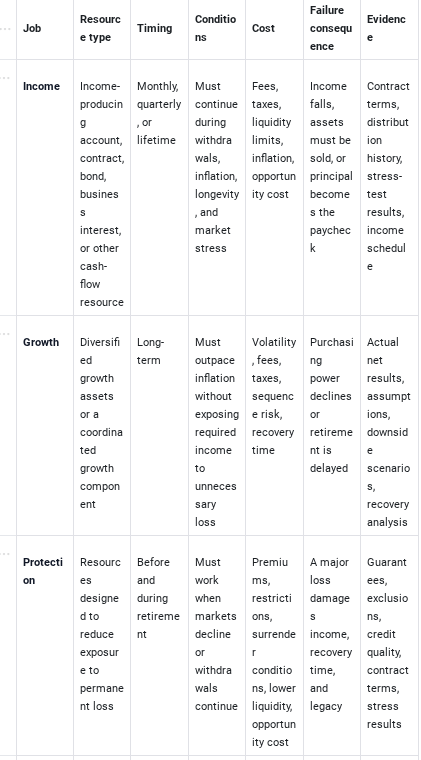
plus Liquidity, Preservation, Time, Peace & Legacy
The table exposes an important truth: some jobs belong to an asset, while others belong to the architecture surrounding the asset.
Time and Peace cannot be purchased from a label. They are outcomes of sound design, disciplined behavior, and repeated testing.
Single-Pillar Versus Coordinated Multi-Pillar Architecture
Traditional assets often perform a single primary job.
A bank account may provide Liquidity. A stock may provide Growth. Real estate may provide income, use, or appreciation. Each may be appropriate for a specific purpose. Each may also fail when asked to perform a job it was never designed to perform.
This is a single-pillar approach.
A coordinated multi-pillar architecture assigns multiple resources to complementary jobs. A Fully Performing Asset™ may coordinate several pillars: such as Growth, Protection, Income, tax coordination, long-term-care support, Liquidity, and Legacy: subject to actual terms, costs, limitations, and the issuing institution’s claims-paying ability.
Do not assume coordination merely because a product is marketed as comprehensive. Test the behavior.
The distinction resembles the Consolidation of Technology. Phones, cameras, maps, music players, and televisions once operated separately. A smartphone consolidated multiple functions into one coordinated device.
Retirement planning can still look like a Rolodex in a SpaceX world: a collection of durable tools without a coordinated operating system. The answer is not to reject every traditional asset. The answer is to assign each resource a job and test how the parts work together.

The Engineered Retirement Blueprint
Use the Engineered Retirement Blueprint to connect the jobs:
Balance Sheet = Source of Funds
Income Statement = Uses of Funds
Margin = The Battleground
The Balance Sheet shows what resources exist.
The Income Statement shows what life requires.
Margin shows what remains after taxes, fees, inflation, volatility, complexity, withdrawals, and poor income design apply pressure.
Those forces are the Six Wealth Killers:
Taxes
Fees
Market volatility
Inflation
Complexity
Poor income design
Together, they create Financial Gravity: the forces that pull lifetime usefulness out of money.
Apply PxRxT: Principal × Rate × Time. Protect the principal. Improve useful performance. Protect time.
A 30% loss requires approximately a 42.86% gain to recover. That is The Math of Recovery. It is not a market forecast. It is a reminder that a loss changes the job future growth must perform.
Activity Versus Outcome
Do not confuse financial activity with financial engineering.
A rouge appearance of diversification can still hide an undefined purpose.
Test behavior, not appearance.
Reliability asks: “Can it produce the required outcome?”
Repeatability asks: “Can it continue to produce that outcome across different conditions?”
Don’t test the promise. Test the behavior.
Stress-Test the Assignments
Use the Retirement Stress Lab to examine:
Market declines
Income interruptions
Inflation
Tax changes
Unexpected expenses
Longevity
Withdrawal timing
Legacy requirements
Use OOM™: Odds, Opinions, Models:
Odds: What is reasonably probable?
Opinions: Which assumptions are merely beliefs?
Models: What happens when the assumptions change?
Then use RID:
Require visible assumptions.
Insist on actual terms.
Demand evidence of the outcome.
The FBS Conjecture™ keeps the question testable: for this person, with these resources and objectives, which architecture produces the most reliable path toward the required future?
Do not treat the conjecture as a universal verdict. Test the actual individual architecture.
The Seven Disciplines and Nine Levels
This question most directly serves:
Discipline 1 — Protect the Principal: Is your retirement plan designed to preserve your wealth engine?
Discipline 2 — Protect Against Unnecessary Loss: How much of your retirement should be insulated from avoidable loss?
Discipline 3 — Protect Forward Progress: How many years could the current design lose during a downturn?
Discipline 4 — Protect Time: How much future income is lost when time is lost?
Discipline 5 — Increase Efficiency, Not Risk: Can the system produce more without greater exposure?
Discipline 6 — Upgrade Your Thinking: Are you solving retirement with yesterday’s thinking?
Discipline 7 — Preserve Every Victory: How much success is permanently protected?
Use the 9 Levels of Retirement Discovery™ to deepen the inspection:
Outcome: What income and legacy must the assets produce?
Cost: What do the Six Wealth Killers consume?
Opportunity: Which functions are missing?
Barrier: Which inherited beliefs limit better design?
Truth: What is actual performance rather than a projection?
Risk: What can permanently damage margin?
Principle: Is the wealth engine protected?
Value: What is the money’s lifetime usefulness?
Synergy: Do the parts work together?
This is stewardship. Learn what you have been given. Unlearn assumptions that no longer hold. Seek wisdom before consequences become expensive.
Three Streets, Three Questions
Use the Three Streets as a comparison framework:
Wall Street: What can the market produce?
Main Street: What does real life require?
Your Street: How should resources be engineered between the two?
Some Money, Same Time. Different Rules. On Your Street. Different Outcomes.
The Your Street standard is simple to state and difficult to fake:
Preserve, Protect & Prolong without avoidable leaks, drains, or losses.
The Retirement Wealth Gears: Pillars vs. Killers article explains how coordinated pillars can move a system forward while Wealth Killers create friction, heat, and energy loss.
Test the Architecture Before You Depend on It
A 401(k), bank account, brokerage account, property, or insurance contract may be useful. But the label does not answer the retirement question.
The real question remains:
> What is the maximum lifetime income your assets can produce while preserving the greatest amount of generational wealth?
The 401(k) Suitability Test applies the same discipline to a familiar retirement container: define the job, inspect the conditions, measure the cost, and test the outcome.
The Million Dollar Hour™ is an educational comparison laboratory for examining those questions against an individual’s assumptions, resources, timing, income requirements, and legacy priorities.
Bring Your Assumptions
> Bring your assumptions, account statements, income needs, tax concerns, benefit information, liquidity requirements, family priorities, and legacy goals. Test the destination before you trust the journey.
Your architecture should evolve as your life changes. That is the foundation of Complete Wealth Engineering™ and The Complete Wealth Engineering Journey™.
Learn continuously. Unlearn carefully. Test honestly.
Wealth Becomes More Than You Thought Possible explores the broader purpose of architecture: turning resources into Substance, Income, Time, Peace, and Legacy.
Why accept uncertainty without a defined upside when you can compare it with approaches that may offer contractual certainty and defined upside—subject to the actual terms, limitations, costs, and claims-paying ability?
Educational Disclaimer
This article is for educational purposes only. It is not individualized financial, tax, legal, insurance, retirement, or investment advice. No strategy or product is appropriate for every person, and no universal guarantees are made. Contractual guarantees, if any, depend on actual terms, limitations, costs, exclusions, liquidity provisions, surrender conditions, taxation, and the claims-paying ability of the issuing institution. Illustrations and examples are not forecasts or promises of future results. Consult qualified financial, tax, legal, insurance, and estate-planning professionals before making decisions. A retirement plan must be testable to be valid; a plan that cannot be tested is merely a promise.