
Q7 Reliable When Retirement Reality Differs From Projections
What Happens When Reality Differs From the Projection?

No hype. No universal guarantees. No promise that one strategy will fit every person.
Inspection does not manufacture safety. It does not guarantee an outcome. It determines which rules actually hold for this individual, under this law, with these terms, across this time horizon.
I only promise the truth. Nothing more.
Hook title alternative: The Projection Broke. What Does Your Retirement Do Next?
SEO-safe title alternative:
This is Question 7 of the Retirement Reliability & Repeatability Test™:
> What happens when reality differs from the projection?
Every retirement projection depends on assumptions. Returns, inflation, taxes, withdrawals, longevity, contributions, health, and timing all influence the result.
But a projection is a model, not the outcome.
The important question is not whether the model looks attractive under one set of assumptions. The important question is whether the retirement architecture has a measured response when reality refuses to cooperate.
Reliability asks: “Can it produce the required outcome?”
Repeatability asks whether it can continue producing an acceptable outcome across different conditions.
That distinction changes everything.
A retirement plan should not merely show you one path. It should show you what happens when the path bends, narrows, floods, or disappears.
Do Not Test the Promise. Test the Behavior.
A projection tells you what may happen if the assumptions hold.
A test examines what happens when they do not.
That is the difference between Participation vs. Engineered Performance:
Participation accepts the projection and hopes the conditions cooperate.
Engineered Performance tests the response before dependence begins.
Participation defends the plan when red flags appear.
Engineering redesigns the plan when evidence shows that the rules no longer work.
The proper sequence is:
QUESTION → TEST → PROVE → DECIDE → ACT
Ask the question. Stress the assumptions. Prove what the architecture can and cannot absorb. Decide based on evidence. Act before a manageable deviation becomes a permanent loss.
This is stewardship. Manage what you have been given. Learn continuously. Unlearn assumptions that no longer hold. Seek wisdom before consequences force the lesson.
What Can Cause the Projection to Fail?
Reality can differ from a projection in either direction. A plan may perform better than expected, creating additional flexibility. It may also perform worse, reducing income, margin, liquidity, and legacy capacity.
The Retirement Stress Lab should test at least these conditions:
Lower returns than projected
Higher inflation
A longer retirement
Rising taxes
Stopped contributions
Increased withdrawals
Market declines
Unexpected expenses
Health events
Delayed recovery after losses
The purpose is not to predict the future perfectly. No model can do that.
The purpose is to identify how much deviation the system can absorb, what breaks first, and which response should occur next.

Deviation-Response Table
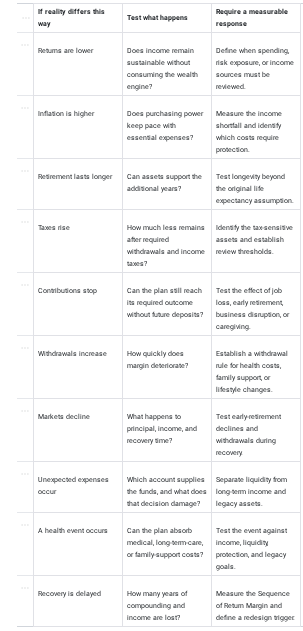
A table like this turns vague concern into a response rule.
Without a response rule, a projection is only a picture of what you hope will happen.
The Cost of a Delayed Response
A market decline does not have to permanently destroy a plan. But the combination of loss, withdrawals, fees, taxes, inflation, and delayed recovery can create lasting damage.
That is the Math of Recovery.
A 30% decline turns $100 into $70. Recovering from $70 to $100 requires approximately a 42.86% gain: not a 30% gain.
Now add withdrawals. Add taxes. Add inflation. Add fees. Add the years during which the account is rebuilding instead of compounding forward.
That is where Financial Gravity appears.
The Six Wealth Killers are:
Taxes
Fees
Market volatility
Inflation
Complexity
Poor income design
Not every force affects every plan equally. Test the interaction.
A polished projection may carry a rouge gloss of certainty, but appearance is not evidence. The Dark Object remains hidden until you measure the total cost of ownership, the recovery time, and the income consequences.
Use PxRxT: Principal × Rate × Time. Protect all three. Time cannot be refunded.
Activity Versus Outcome
Retirement planning can become crowded with activity: reviewing statements, changing allocations, reading headlines, adjusting contributions, and discussing average returns.
Activity is not the same as outcome.
Ask what the money must do.
Do not confuse account management with retirement engineering. A balance is part of the Balance Sheet, but it is not the entire retirement plan.
The Engineered Retirement Blueprint
The Engineered Retirement Blueprint organizes the test:
Balance Sheet = Source of Funds
Income Statement = Uses of Funds
Margin = The Battleground
The central question remains:
> What is the maximum lifetime income your assets can produce while preserving the greatest amount of generational wealth?
When reality changes, the Margin Audit™ asks whether the Source of Funds can still support the Uses of Funds while preserving the income-producing engine.
Test:
How much income is required?
Which assets provide that income?
Which assets provide growth?
Which assets provide protection?
Which assets provide liquidity?
Which assets support tax coordination and legacy?
What happens when one assumption fails?
This is where the FBS Conjecture™ applies:
> For this individual, with these resources, objectives, costs, risks, terms, and time horizon, which architecture produces the most reliable path toward the required future?
Do not begin with a product. Begin with the architecture.
Banks, stocks, and real estate may each perform legitimate single-pillar jobs. Fully Performing Assets™ are evaluated as multi-pillar structures that may coordinate growth, protection, income, liquidity, tax efficiency, long-term-care support, and legacy: subject to actual terms and limitations.
The test determines whether the parts actually work together.

OOM™, RID, and the Retirement Stress Lab
Use OOM™: Odds, Opinions, Models:
Odds: What is probable under the actual conditions?
Opinions: Which assumptions are beliefs rather than evidence?
Models: What happens when those assumptions are stressed?
Then use RID:
Require visible assumptions.
Insist on actual terms.
Demand a testable outcome.
Test the model through the Retirement Stress Lab:
Equity: What happens during a decline?
Income: Can essential income continue?
Time: How long does recovery require?
Inflation: Does purchasing power keep pace?
Taxes: What remains after tax obligations?
Events: What happens after an unexpected expense or health event?
Longevity: What happens if retirement lasts longer?
Legacy: What remains for family and future generations?
Then establish triggers.
For example:
Review the plan if essential income falls below the required amount.
Review the plan if withdrawals exceed the defined margin.
Review the plan if recovery takes longer than the tested range.
Review the plan if taxes or inflation reduce purchasing power beyond the modeled tolerance.
Redesign the plan if the architecture cannot preserve income without consuming principal.
A trigger creates a decision before emotion takes over.
The 7 Disciplines and 9 Levels
This article primarily serves:
Discipline 1 — Protect the Principal: Is your retirement plan designed to preserve your wealth engine?
Discipline 2 — Protect Against Unnecessary Loss: How much of your retirement should be insulated from avoidable loss?
Discipline 3 — Protect Forward Progress: How many years could the current strategy lose?
Discipline 4 — Protect Time: How much future income is lost when recovery consumes time?
Discipline 5 — Increase Efficiency, Not Risk: Can the outcome improve without increasing exposure?
Discipline 6 — Upgrade Your Thinking: Are you solving retirement with yesterday’s assumptions?
Discipline 7 — Preserve Every Victory: How much success is permanently protected?
Use the 9 Levels of Retirement Discovery™ to deepen the inspection:
Outcome: What must the assets produce?
Cost: What do taxes, fees, inflation, volatility, and delay consume?
Opportunity: Which guarantees or coordinated functions are missing?
Barrier: Which beliefs prevent a better response?
Truth: What is actual performance instead of an average?
Risk: What can permanently damage wealth and margin?
Principle: Is the income engine protected?
Value: What is the money’s lifetime usefulness?
Synergy: Do all parts respond together when conditions change?
This is also the foundation of Preserve, Protect & Prolong.
Preserve the principal. Protect forward progress. Prolong the usefulness of every dollar.
Bring Your Assumptions
> Bring your account statements, income needs, tax concerns, benefit information, liquidity requirements, family priorities, legacy goals, contribution history, withdrawal expectations, and the assumptions behind your current projection.
>
> Test the destination before you trust the journey.
The Million Dollar Hour™ serves here as an educational comparison laboratory for examining your numbers, assumptions, terms, time horizon, withdrawals, taxes, inflation, and legacy priorities under different conditions.
Use it to compare the Shiny Object: the projection: with the Dark Object: the costs, losses, delays, and hidden dependencies that appear when reality differs.
Some Money, Same Time. Different Rules. On Your Street. Different Outcomes.
Test the Response Before You Need It
A reliable retirement architecture does not require perfect predictions.
It requires visible assumptions, measurable thresholds, defined response rules, and the willingness to redesign when evidence says the current structure no longer works.
Read Test Your Retirement TCO Before It Is Too Late for the cost side of the inspection. Continue with Your Best Tomorrow: The Critical Retirement Test to examine why testing forward is wiser than defending the past. Then review Can Wealth Killers Be Disengaged and Retirement Architecture Before Products for the architecture beneath the response.
The Your Street retirement standard is testable. It is based on evidence, tests, and forecasts: not blind trust.
A retirement plan must be testable to be valid. A plan that cannot be tested is merely a promise.
Why accept uncertainty without a defined upside when you can compare it with approaches that may offer contractual certainty and defined upside—subject to the actual terms, limitations, costs, and claims-paying ability?
This article is for educational purposes only and is not individualized financial, tax, legal, insurance, or investment advice. No universal guarantees are made. Contractual guarantees, if any, are subject to actual terms, limitations, costs, exclusions, liquidity provisions, surrender conditions, and the claims-paying ability of the issuing institution. Illustrations are not forecasts or promises of future results. Consult qualified financial, tax, legal, insurance, and estate-planning professionals before making decisions.