
Recovery Timeline After Market Losses
The Math of Recovery Timeline
![[HERO] The Math of Recovery Timeline](https://cdn.marblism.com/94hjK0uq2On.webp "[HERO] The Math of Recovery Timeline")
Start here: See what your retirement actually looks like → 👉 Book Your Million Dollar Hour™
If you were an architect designing a high-rise, and you discovered a 30% structural deficit in the foundation, you wouldn't just "hope for the best" or "wait for the market to fix the concrete." You would recognize a catastrophic failure in the engineering.
Yet, in the world of traditional retirement planning: what we call "Wall Street Participation": investors are told to ignore structural deficits. They are told that "the market always goes up in the long run." While that might be true over a 100-year horizon, your retirement doesn't have 100 years. It has a specific, finite timeline.
The most dangerous math in finance isn’t addition or subtraction; it’s the Mathematics of Recovery. It is the hidden asymmetry that turns a "temporary" market dip into a permanent retirement delay.
The Asymmetry of Loss: Why 30% Does Not Equal 30%
Most "Quiet Builders": the engineers, architects, and business owners we work with: prefer precision. But Wall Street operates on "Average Returns," a metric so flawed it borders on professional malpractice.
If you lose 30% of your portfolio value in a market crash, logic might suggest you need a 30% gain to get back to even. But math isn't always logical; it's mathematical.
When you lose 30% of $1,000,000, you are left with $700,000. To get back to that original $1,000,000, you don't need a 30% gain ($210,000). You need a $300,000 gain.
$300,000 divided by your new $700,000 base is 42.85%.
Let that sink in. To recover from a 30% loss, your remaining money has to work 43% harder just to return to the starting line. You aren't even winning yet; you’re just paying back a "Volatility Tax" you never agreed to.
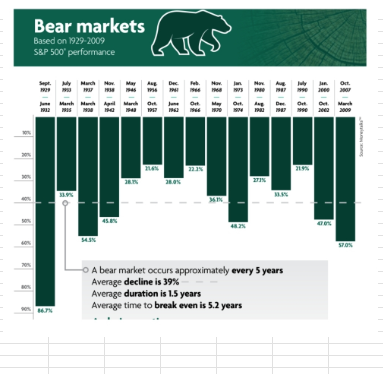
As this historical data illustrates, bear markets aren't anomalies; they are a recurring feature of a participation-based system. The average bear market loss of 39% requires a staggering 64% gain just to break even. On average, it takes 5.2 years just to get back to zero. For someone at age 62, a 5-year recovery isn't just a "dip": it’s the theft of their most active retirement years.
The "Volatility Recovery Analysis": Measuring the Damage
When we perform a Volatility Recovery Analysis during a Million Dollar Hour™ Forecast, we look at the structural integrity of your timeline with engineered precision. For retired engineers, this is not a pep talk. It is a recovery model.
Here is the technical breakdown behind The Math of Recovery:
If a $1,000,000 portfolio falls 30%, the value drops to $700,000. The portfolio is now short $300,000 from breakeven.
The Capital Gap: You need a 42.85% gain on the reduced base of $700,000 just to return to $1,000,000.
The Time Gap: If that reduced portfolio compounds at 6% annually with no withdrawals, the recovery timeline is about 6.1 years. At 5%, it is about 7.4 years. At 4%, it stretches to roughly 9.1 years.
The Income Gap: If you are taking withdrawals while the account is impaired, the timeline extends again because fewer dollars remain to do the recovery work.
The Sequence of Return Margin: Losses early in retirement are not just bad years. They are design failures. A negative sequence in the first 5 to 10 years can permanently lower lifetime income, even if average returns later look "fine" on paper.
Here is why time is NOT on YOUR SIDE:
A 10% loss needs an 11.1% recovery gain.
A 20% loss needs a 25% recovery gain.
A 30% loss needs a 42.85% recovery gain.
A 40% loss needs a 66.7% recovery gain.
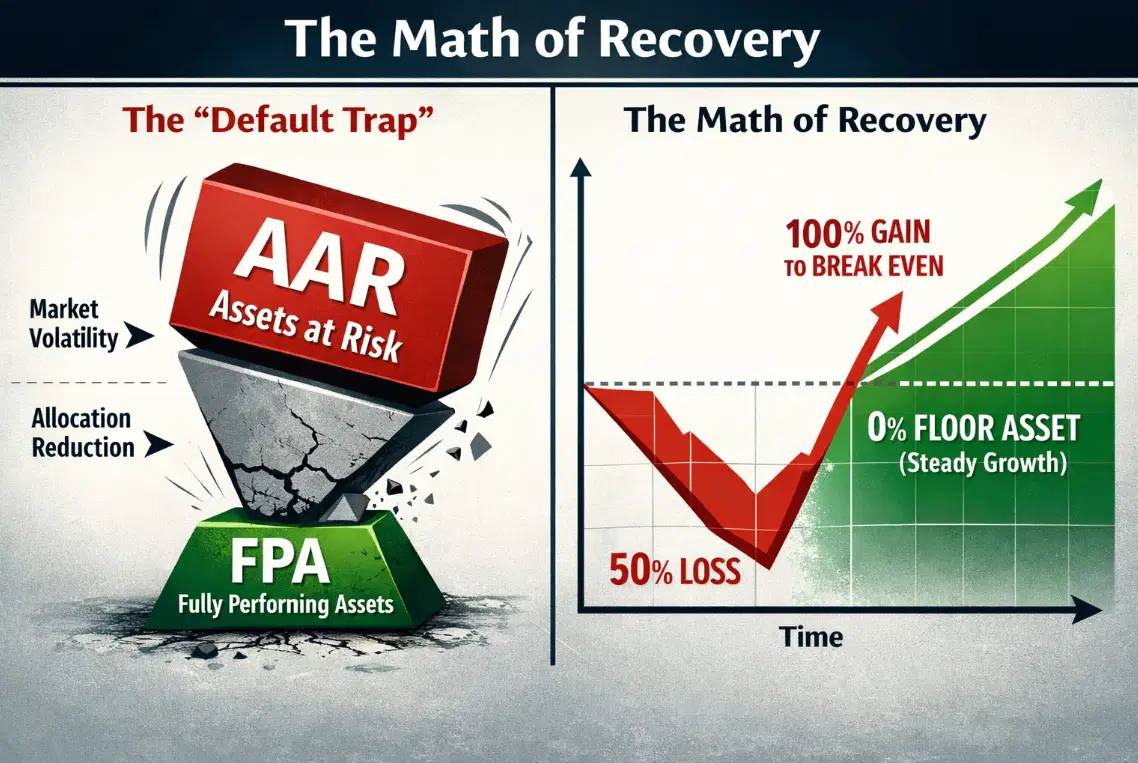
A 50% loss needs a 100% recovery gain.
That is why we call volatility delays Wealth Killers. They do not just hurt the account balance. They steal calendar years, delay income readiness, reduce Compounding Efficiency, and force your money to spend its best years digging out of a hole instead of building your future.
In the Million Dollar Hour™ Forecast, we identify these lost years directly. We calculate how long your current strategy needs to recover from past and future drawdowns, how much income capacity gets delayed, and where taxes, fees, and withdrawals widen the gap. That is the purpose of The Margin Audit™: to show you the exact years being lost inside a false Wall Street model driven by fear, greed, and average-return storytelling.
This is not theoretical. It is architectural. The larger the loss, the steeper the required climb. A 50% loss requires a 100% gain. That is not a strategy. That is a structural defect most advisors simply tell you to "ride out."
Participation vs. Engineered Performance
There is a fundamental difference between "Participation" and "Performance."
Participation is a Rolodex in a SpaceX world. It’s an outdated model where you give your money to a third party, pay them a fee regardless of outcomes, and hope that "the market" treats you well. It’s gambling disguised as a strategy.
Engineered Performance is based on Asset Liability Management (ALM). It’s about building a structure that doesn't rely on the "7% Lie" or the "Outcome Delusion." It’s about creating a floor.
In an engineered plan, we prioritize the 0% Floor Strategy. Why? Because if you never lose 30%, you never have to find a 43% gain just to break even. When you eliminate the "down" years, the "up" years: even if they are modest: compound with a level of Compounding Efficiency that Wall Street participation simply cannot match.
If this concerns you, you’re not alone. Most people have never actually seen what their money is doing — or where it leads. 👉 In the Million Dollar Hour™, we map your exact outcome:
• Today’s value • Future income • Hidden risks • What it should be doing instead Book your session here →
The Smartphone Analogy: The Consolidation of Technology
Think back to the year 2000. If you wanted to take a photo, listen to music, check your email, and make a phone call, you needed four different devices: a camera, a Discman, a laptop, and a Nokia brick.
Traditional finance still operates this way. You have your "Bank" (Single Pillar for liquidity), your "Brokerage" (Single Pillar for growth), and your "Insurance" (Single Pillar for protection). These are "single-use" tools that are often high-fee and high-risk.
Fully Performing Assets (FPA) represent the "Smartphone" of finance.
An FPA is a multi-pillar asset that consolidates 5 to 15 different pillars of value: growth, protection, tax-free access, and long-term care: into a single, engineered vehicle. Instead of spinning sharp knives (market volatility), an FPA utilizes an institutional-grade architecture that provides Uncapped Gains (UCG) and Expanded Market Participation (EMP), while maintaining a contractual floor of 0%.
The Margin Audit™: Finding the Leaks
Most Quiet Builders are losing money in ways they don't even see. These are the "micro margins" that destroy macro wealth. In our Margin Audit™, we look for three primary structural leaks:
The Volatility Leak: As we’ve discussed, the math of recovery is a massive drain on your time.
The Tax Leak: Traditional 401(k)s and IRAs are "Participation" plans with a lien held by the IRS. You are building a house on land you don't own.
The Fee Leak: Hidden management fees, expense ratios, and "participation costs" that extract value regardless of whether your portfolio is up or down.
When you audit these margins, you realize that your "Actual Return" is often a fraction of your "Average Return."

Suggested Image: A detailed infographic contrasting the "Actual Returns" of a volatile market vs. the "Engineered Returns" of a 0% floor strategy.
The Path of the Quiet Builder
We don't write for people chasing the latest "hot tip" or trying to "beat the market." We write for the Quiet Builders: the ones who have spent decades building a life, a career, or a business, and who now want the certainty that their wealth will be there when they need it.
They want a plan that is Engineered for Certainty, not a plan based on the "Greed/Fear Meter" of Wall Street.
When you shift from Assets at Risk (AAR) to Fully Performing Assets (FPA), you aren't just changing where your money sits. You are changing your relationship with time. You are closing the gap.

The Million Dollar Hour™: Your Engineering Review
You wouldn't start a multi-million dollar construction project without a scrutinized, professional blueprint. Your retirement deserves the same level of architectural precision.
The Million Dollar Hour™ Forecast is not a sales pitch; it is a $995 institutional-grade engineering session. It is a one-on-one Margin Audit™ designed to reveal exactly where your current plan leads.
We measure your Sequence of Return Margin, test your exposure to volatility, and map how many years a market loss can set you back. For Quiet Builders, especially retired engineers, this matters because retirement is not an infinite timeline. It is a finite design window. Every recovery year spent clawing back losses is a year your money is not compounding efficiently for income.
This is where the Forecast becomes different from Wall Street commentary. We do not just show what happened. We identify the lost years, the recovery drag, the wealth leaks, and whether your assets are actually engineered to perform or merely positioned to participate.
In 60 minutes, you can unlearn the myths of the false model and learn the fundamental financial architecture that provides peace and wisdom for life.
Your Money, Your Rules, In Your Time, On Your Street.
Peace is the path, wisdom is the way. Stop participating in the gamble and start engineering your outcome.
Ready for clarity instead of confusion?
The Million Dollar Hour™ is your educational, one-on-one retirement review that reveals where your plan leads — not just where it’s been.
👉 Schedule your session today.
You can keep participating… Or you can finally see the outcome. The Million Dollar Hour™ shows you exactly:
✔ Where you are ✔ Where you’re going ✔ How to fix the gaps 👉 Book your session now
Check out the Retirement Blueprint