
Retirement Blind Spots: Losses, Fees, Reality
The Net Benefit Blind Spot
One of the fastest ways to uncover hidden risk is to take our 7 Question Retirement Stress Test.
![[HERO] The Net Benefit Blind Spot](https://cdn.marblism.com/bGjjeuGEINY.webp "[HERO] The Net Benefit Blind Spot")
Start here: See what your retirement actually looks like → 👉 Book Your Million Dollar Hour™
Your Retirement Statement Is Leaving Out the Scary Part
Every month, thousands of "Quiet Builders": engineers, architects, and business owners who have spent decades doing the heavy lifting: open their retirement statements, see a number at the bottom, and still feel uneasy.
On paper, everything looks fine. The "Average Return" says 7% or 8%. The charts are green. The brochure smiles back at you. But your actual confidence level? Not invited to the meeting.
That disconnect is not paranoia. It is pattern recognition. It is your intuition noticing The Net Benefit Blind Spot: the part of traditional planning that focuses on what was promised, while ignoring what large losses and fees quietly subtract.
In institutional-grade engineering, we do not grade a system by the brochure. We grade it by real-world output after friction, stress, and failure points are accounted for. Retirement should be no different. Wall Street spotlights the gross number. We care about the net benefit: what you actually keep, what you can actually spend, and whether the structure still works after a bad year.
The Statement vs. Reality: The 7% Story Problem
Wall Street loves the word "Average" because it keeps the conversation comfortable and the math blurry.
Imagine you have $1,000,000. In Year One, the market drops 30%. You now have $700,000. In Year Two, the market gains 30%. The average return across those two years looks like 0%.
But your account is not back to $1,000,000. It is $910,000.
That missing $90,000 is not a rounding error. It is the cost of Participation vs. Engineered Performance. Participation says, "Stay in the game." Engineered Performance asks, "What did the game actually cost you?"

This is the first blind spot in traditional planning: large losses are treated like temporary weather, when in retirement they behave more like structural damage. During accumulation, volatility is frustrating. During distribution, it becomes a predator. If you are taking income from a portfolio while it is falling, you are not just losing dollars. You are damaging the Math of Recovery and shrinking your future income options at the same time.
The Math of Recovery: Why Time Is Your Most Expensive Asset
This is where traditional planning gets dangerously casual.
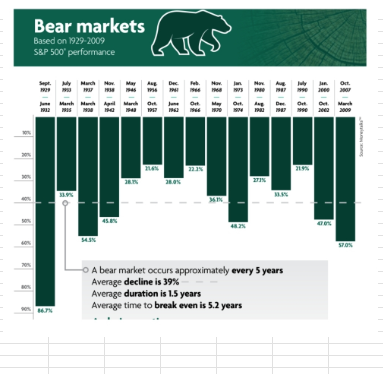
If you lose 30% of your portfolio, you do not need a 30% gain to recover. You need a 42.8% gain just to get back to even. Lose 50%, and now you need 100%.
That is The Math of Recovery. It is simple, brutal, and routinely ignored.
How long does it take to recover from a major hit? Sometimes years. Sometimes the better part of a decade. And for a 60-year-old Quiet Builder, that timeline is not theoretical. Those are your best years for travel, family, flexibility, and choice. Wall Street tends to treat recovery time like a footnote. It is not. It is the cost of being forced to relive the same financial year over and over until your balance finally catches back up.
The Three Wealth Killers (The Leaks)
The Net Benefit Blind Spot is usually built from three quiet leaks that traditional planning tends to minimize, bury, or explain away with a pie chart:
The Volatility Tax: Large losses hurt more than equal gains help. That is not opinion. That is arithmetic.
The Fee Friction: Internal expenses, fund fees, advisory fees, and product costs can quietly shave 2% to 3% a year off your compounding: whether you had a good year or a terrible one.
The Tax Time-Bomb: Many retirees are sitting on deferred tax balances they do not fully control. You may see $2 million on a statement, but that does not mean you get to keep $2 million.
When you subtract losses, fees, and taxes, the impressive headline return often becomes an unimpressive real-world result. This is the weakness of the Participation model. It asks you to tolerate hidden leakage and call it normal. It is a Rolodex in a SpaceX world: old, familiar, and not built for the technical demands of modern retirement.
If this concerns you, you’re not alone. Most people have never actually seen what their money is doing — or where it leads. 👉 In the Million Dollar Hour™, we map your exact outcome:
• Today’s value • Future income • Hidden risks • What it should be doing instead Book your session here →
From Participation to Engineered Performance
To fix the blind spot, we have to move from Participation vs. Engineered Performance.
Participation says: stay invested, hope it averages out, and try not to look during the bad parts.
Engineered Performance says: identify the failure points, reduce unnecessary risk, improve compounding efficiency, and build around guarantees.
That is how institutional-grade engineering works. We do not "hope" the structure holds. We audit the load paths, stress points, and hidden weaknesses first. At Your Street Wealth, we apply that same thinking through Asset Liability Management (ALM) and modern banking architecture.
We categorize every dollar into practical buckets:
NPA (Non-Performing Assets): Your "Infants." Emergency cash and reserves. Important, but not built for long-term growth.
AAR (Assets at Risk): Your "Teens." Stocks, mutual funds, and variable products exposed to market loss.
UPA (Underperforming Assets): Assets with too much drag, too little flexibility, or too much fee friction.
FPA (Fully Performing Assets): The "Foundation." Multi-pillar assets designed for growth, protection, and income working together.
The Smartphone Analogy: The Multi-Pillar Revolution
Think about old technology. You used to need a camera, a pager, a map, a music player, and a phone. Now one smartphone does the job of all of them.
Traditional financial products are still mostly single-pillar. A bank account gives safety, but weak growth. Stocks offer upside, but with downside. Real estate can build equity, but often with illiquidity, fees, and management drag.
Fully Performing Assets (FPA) are the smartphone of finance. They can consolidate 5 to 15 pillars of value into one vehicle, including:
0% Floors: A market loss does not become your loss.
Uncapped Gains (UCG): Growth tied to market performance without direct market loss.
Expanded Market Participation (EMP): Participation multipliers that can turn a 10% UCG into an 11% to 20% gain, depending on the structure.
Tax-Advantaged or Tax-Free Income: More control over what you actually keep.
Contractual Guarantees: A+ strength and rule-based planning instead of hoping markets behave.
That is the difference between single-pillar products and engineered multi-pillar design. One asks you to juggle risk. The other is built to reduce blind spots.

(Suggested Visual: A comparison between a pile of old electronics and a modern smartphone, labeled "Single-Pillar vs. Multi-Pillar Assets")
The Margin Audit™: Finding the Hidden Leakage
This is where the engineer's audit begins.
The Margin Audit™ is not about chasing more activity. It is about finding the hidden drag inside the current design. Most advisors talk about asset allocation, which often means moving percentages around and hoping the next downturn is polite.
We focus on Architecture.
We review your current plan and ask:
Where are the large-loss exposure points?
How much are fees reducing compounding efficiency?
What is your Sequence of Return Margin?
How much recovery time is built into your current path?
What happens to income if the market falls at the wrong time?
That is the point of The Margin Audit™ and the Volatility Recovery Analysis. If we can reduce unnecessary losses and plug avoidable leaks, we do not need heroic returns. We need a better design.
By engineering a 0% floor, you remove one of retirement's biggest blind spots: the need to recover from major market damage in the first place. No 30% loss means no 42.8% climb just to get back to where you already were. Elegant math. Rare on Wall Street.
Peace is the Path, Wisdom is the Way
If you are a Quiet Builder, you do not need more noise, more headlines, or more addictive buy/sell theater disguised as advice. You need clarity. You need rules. You need a structure that protects both time and wealth.
Wall Street operates on a False Model driven by fear and greed. When greed is high, risk is usually being underpriced. When fear is high, risk is often lower than the headlines suggest. Either way, the system keeps you watching, reacting, and researching. Busy is not the same as secure.
Your Street Wealth is different. We act as the bridge between institutional-grade engineering and your kitchen table. We translate complexity into decisions. We help you find and fix the blind spots.
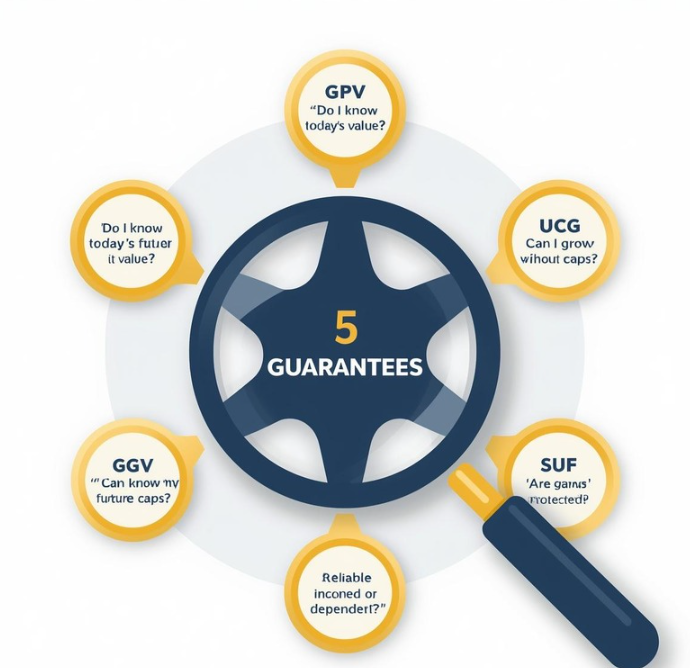
The Million Dollar Hour™ Forecast: The Engineer's Audit
The Net Benefit Blind Spot persists when you only look at statements and projections. Statements tell you where you have been. They do not tell you whether the design is sound.
The Million Dollar Hour™ Forecast is a $995 professional engineering session for high-intent readers who want the numbers audited, not sugar-coated. In sixty minutes, we use The Margin Audit™ and a Volatility Recovery Analysis to uncover the hidden weak points in traditional planning: large-loss exposure, fee drag, tax leakage, and false assumptions about future portfolio value.
You can estimate income needs.
You cannot accurately predict future portfolio value when losses, fees, and taxes remain uncontrollable.
That is why the goal is not better guessing. It is better architecture.
The Million Dollar Hour™ Forecast shows you how much time and wealth may be leaking out of your current plan and how to reposition toward a more stable, guaranteed retirement path rooted in modern banking architecture. Minimal drama. Maximum clarity.
Your Money, Your Rules, In Your Time, On Your Street.
Ready for clarity instead of confusion?
The Million Dollar Hour™ is your educational, one-on-one retirement review that reveals where your plan leads — not just where it’s been.
👉 Schedule your session today.
You can keep participating… Or you can finally see the outcome. The Million Dollar Hour™ shows you exactly:
✔ Where you are ✔ Where you’re going ✔ How to fix the gaps 👉 Book your session now
Check out the Retirement Blueprint
Concerned about market losses, taxes, or income reliability?
Take the 7 Question Retirement Stress Test →