
Testing Retirement Plan Reliability
Testing the Parts that Make It Happen

Don’t Test the Promise. Test the Parts.
My Truth Line
I do not need to predict the next mishap to test whether a retirement plan can survive it.
I need to name each part, define what that part must do, test it under pressure, and inspect the evidence before my future depends on it.
Nobody builds a rocket by hoping the engines, fuel system, guidance system, heat shield, and landing gear will work together. Engineers test each part separately. Then they test the interfaces between the parts. Then they test the entire vehicle under conditions that expose what can go wrong.
Retirement deserves the same discipline.
The question is not, “Did the plan produce a favorable result in the past?”
The question is, “Can the plan produce a reliable, repeatable, and reusable outcome when the conditions change?”
That is the difference between Participation vs. Engineered Performance.
A Rocket Is Not Proven by One Successful Flight
A successful launch proves that a vehicle completed one flight under one set of conditions. It does not prove that every part will perform again, under stress, with a different payload, a different temperature, or a different sequence of events.
Reliability comes from testing the architecture.
SpaceX describes this discipline through its work toward rapidly reusable vehicles and its “test like you fly” approach. The rocket is only an illustration here. I am not asking anyone to admire a company or compare a retirement plan to a spacecraft.
I am borrowing the standard:
Test each part individually.
Test each process individually.
Test the parts together.
Test the interfaces between parts.
Repeat the process.
Record the result.
Change the architecture when the evidence requires it.
A retirement plan that works only when markets rise is not reliable. A plan that produces income only when withdrawals occur in a favorable sequence is not repeatable. A plan that must be rebuilt after every major disruption is not reusable.
Reliability does not require a lucky outcome to be a good outcome.
Wall Street Tests Hope, Not Every Part
Many Wall Street tools create the appearance of testing without testing the parts that must hold.
A backtest tests the past. It does not test whether your future income survives a specific decline.
A projection tests an assumption. It does not prove that the assumption will remain true after taxes, fees, inflation, withdrawals, and sequence-of-returns risk.
An average return hides the order in which gains and losses occurred.
A risk-tolerance questionnaire tests how you feel about volatility. It does not test whether your balance sheet can withstand it.
A probability-of-success model can produce a reassuring number while leaving the most important question unanswered:
What happens if one specific part fails?
I classify these tools as OOM™: Odds, Opinions, and Models. They may be useful for discussion. They are not proof of a retirement outcome.
A rouge average return can make a plan look polished while leaving the actual machinery unexamined.
General Inspection Is Not Specific Testing
I have already used the Eye, Ear, Smell, Thumb, Microscope, and Time as inspection instruments.
These instruments are valuable because they help identify that something may be wrong.
But they are not the final proof.

The Eye notices appearance.
The Ear notices what has been said.
The Smell detects that something may be off.
The Thumb applies judgment and common sense.
The Microscope examines terms, sequence, costs, and behavior under stress.
Time reveals whether the result compounds, stalls, or moves backward.
General inspection produces suspicion. Specific testing produces evidence.
To test specifically, I must:
Name the part.
State the requirement.
Test the part on its own.
Show the individual result.
Test the interface with the other parts.
Decide whether action is warranted.
That distinction matters because a general statement such as “this strategy has historically performed well” does not tell me which part is carrying the result, or which part will fail first.
The Gap Between Suspicion and Evidence
There is a real gap between suspicion and evidence, and it has stood for centuries.
Never before have tests been available to resolve suspicion.
Everyone lives in suspicion — the wise — or in false hope that their future will end up better on Wall Street than on Your Street.
Your Street testing resolves the lingering suspicions, and it puts the opportunity to end false hope at Your Door, with Your Money, in Your Time, by Your Rules, on Your Street.
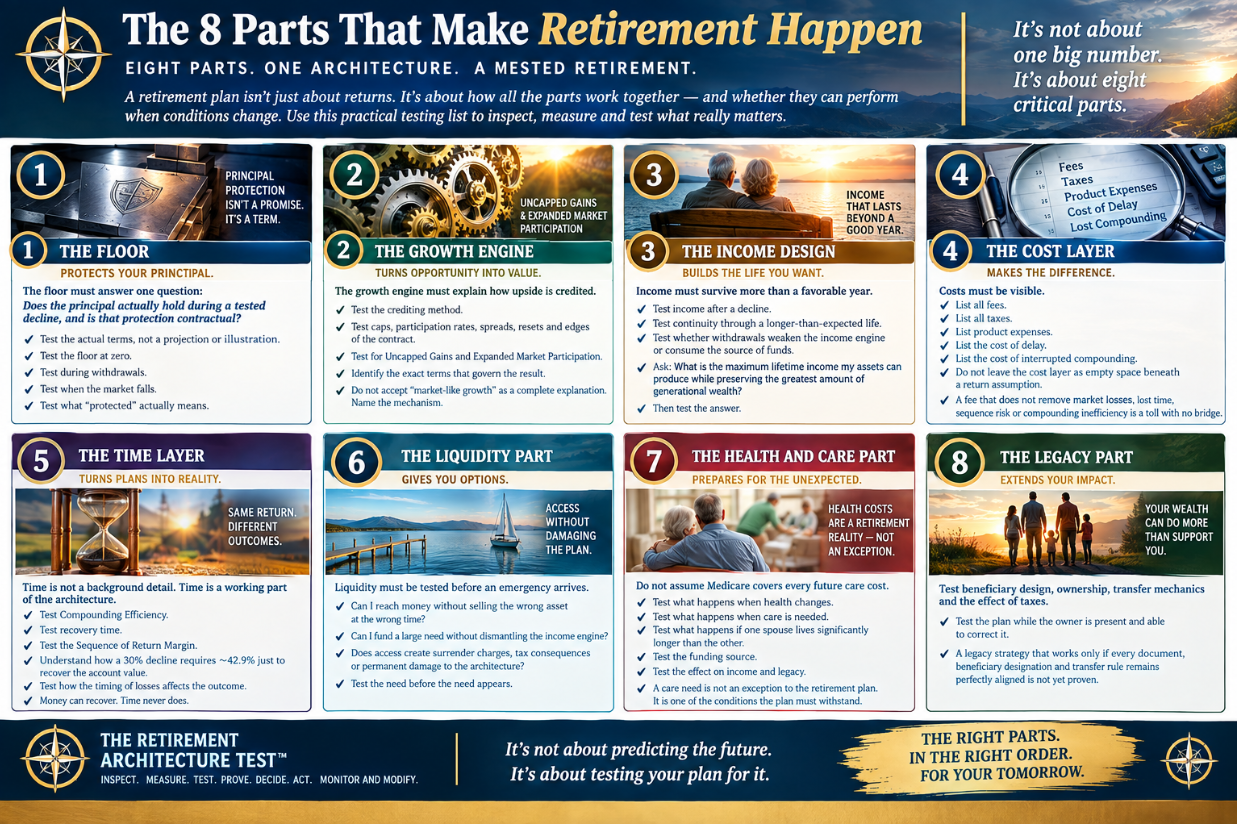
The Parts That Make Retirement Happen
I use the following parts as a practical testing list.
1. The Floor
The floor must answer one question:
Does the principal actually hold during a tested decline, and is that protection contractual?
The proof is found in the actual terms, not in a projection, illustration, or hopeful explanation.
Test the floor at zero. Test it during withdrawals. Test it when the market falls. Test what “protected” actually means.
2. The Growth Engine
The growth engine must explain how upside is credited.
Test the crediting method. Test caps, participation rates, spreads, resets, and the edges of the contract. Test whether the strategy uses Uncapped Gains and Expanded Market Participation, and identify the exact terms that govern the result.
Do not accept “market-like growth” as a complete explanation. Name the mechanism.
3. The Income Design
Income must survive more than a favorable year.
Test whether income holds after a decline. Test whether it continues through a longer-than-expected life. Test whether withdrawals weaken the income engine or consume the source of funds.
Ask the primary question:
What is the maximum lifetime income my assets can produce while preserving the greatest amount of generational wealth?
Then test the answer.
4. The Cost Layer
Costs must be visible.
List fees. List taxes. List product expenses. List the cost of delay. List the cost of interrupted compounding.
Do not leave the cost layer as empty space beneath a return assumption. A fee that does not remove market losses, lost time, sequence risk, or compounding inefficiency is a toll with no bridge.
5. The Time Layer
Time is not a background detail. Time is a working part of the architecture.
In a Your Street Wealth dashboard reading, a 30% decline requires approximately a 42.9% gain just to recover the account value. That recovery may take years, and withdrawals during recovery can lengthen it.
Test Compounding Efficiency. Test recovery time. Test the Sequence of Return Margin.
The same average return can produce different outcomes depending on when losses arrive. A loss at the beginning of retirement does not behave like the same loss near the end of a long accumulation period.
Money can recover. Time never does.
6. The Liquidity Part
Liquidity must be tested before an emergency arrives.
Can I reach money without selling the wrong asset at the wrong time? Can I fund a large need without dismantling the income engine? Does access create surrender charges, tax consequences, or permanent damage to the architecture?
Test the need before the need appears.
7. The Health and Care Part
Do not assume Medicare covers every future care cost.
Test what happens when health changes, care is needed, or one spouse lives significantly longer than the other. Test the funding source. Test the effect on income and legacy.
A care need is not an exception to the retirement plan. It is one of the conditions the plan must be designed to withstand.
8. The Legacy Part
Test beneficiary design, ownership, transfer mechanics, and the effect of taxes.
Test the plan while the owner is present and able to correct it. A legacy strategy that works only if every document, beneficiary designation, and transfer rule remains perfectly aligned is not yet proven.
Then Test the Interfaces
A part can pass its individual test and still fail when connected to another part.
Liquidity may conflict with guarantees. Income may conflict with legacy. Taxes may alter the apparent growth rate. Care costs may interrupt compounding. A withdrawal may change the behavior of the entire system.
That is why I use the Engineered Retirement Blueprint as the assembly drawing:
Balance Sheet = Source of Funds
Income Statement = Use of Funds
Margin = The Battleground
The parts must work together inside the margin.
I test the architecture across the Retirement Stress Lab dimensions: market decline, inflation, taxes, withdrawals, longevity, liquidity, care, legacy, and time. I do not test only the calm scenario. I test the conditions that reveal failure.

The Testing Sequence
I use five steps:
Question: What must this part do?
Test, What condition will expose its behavior?
Prove: What evidence demonstrates the result?
Decide: Is change warranted, or is no change warranted?
Act: What is the smallest architectural move that removes the exposure?
This is where RID™ (Require, Insist, Demand) becomes practical.
Require the part to be proven.
Insist that the proof be individual, not average.
Demand the evidence before the outcome depends on it.
The Retirement Testing Principle gives me permission to test without first rejecting what I already believe. I do not have to believe in an alternative strategy to test whether a different architecture produces a better measurable outcome.
Test the behavior. Then let the evidence inform the decision.
Reliability Comes Before Opportunity
It is double-digit opportunity standing on a foundation of reliability. The foundation question comes first.
That is also how I apply the 7 Disciplines of Retirement Wealth™.
This article primarily serves:
Discipline 1, Protect the Principal: Is the wealth engine preserved?
Discipline 2, Protect Against Unnecessary Loss: How much retirement wealth is exposed to avoidable loss?
Discipline 3, Protect Forward Progress: How many years could a setback remove?
Discipline 4, Protect Time: What future income disappears when recovery consumes years?
Discipline 5, Increase Efficiency, Not Risk: Can every dollar work harder without adding unnecessary exposure?
The 9 Levels of Retirement Discovery™ move the testing deeper: from outcome and cost to opportunity, barriers, truth, risk, principle, value, and synergy.
The FPA Pillars provide the “what”: growth, protection, income, liquidity, care, tax efficiency, and legacy. A single-pillar asset may perform one job. A Fully Performing Asset can coordinate five to fifteen pillars when the actual terms support that design.
My test is simple:
Do not test the promise. Test the behavior.
Bring Your Assumptions
> Bring your assumptions.
>
> Bring your statements.
>
> Bring your income need.
>
> Bring your fees, taxes, time horizon, and legacy goals.
>
> Bring the question you have avoided.
>
> I will not ask you to abandon your current strategy before testing it. I will ask whether its parts can produce a reliable, repeatable, and reusable outcome under the conditions your retirement may face.
The Million Dollar Hour™ is the educational comparison laboratory I use to examine those assumptions, test the parts, and compare the behavior of the current architecture against an engineered alternative.
Your Street Standard
Your Street is not a slogan. It is a testable standard built on evidence, tests, and forecasts.
Preserve the principal.
Protect the margin.
Prolong the compounding.
Remove leaks, drains, and unnecessary losses of time and money.
Your Money. Your Rules. In Your Time. On Your Street.
The future does not become reliable because I hope harder. It becomes more reliable when I test the parts that must make it happen, test the interfaces between them, and refuse to place my future on an unexamined assumption.
Can a retirement outcome be called reliable and repeatable when its guarantees are not tested: subject to the actual terms, limitations, costs, and claims-paying ability?
Educational disclaimer: This article is for educational purposes only and is not financial, investment, tax, legal, or insurance advice. No retirement strategy can eliminate every risk. Any guarantee depends on the specific contract, issuing organization, applicable limitations, costs, and claims-paying ability. Review all materials with qualified professionals before making financial decisions.