
The Ultimate Guide to Retirement Income Planning
The Ultimate Guide to Retirement Income Planning
One of the fastest ways to uncover hidden risk is to take our 7 Question Retirement Stress Test.
![[HERO] The Ultimate Guide to Retirement Income Planning](https://cdn.marblism.com/ZlqeM5JITCr.webp "[HERO] The Ultimate Guide to Retirement Income Planning")
Start here: See what your retirement actually looks like → 👉 Book Your Million Dollar Hour™
Why Your Retirement Strategy is a Rolodex in a SpaceX World
If you’ve spent the last thirty years focused on one thing: growing your "number": congratulations. You’ve successfully navigated the Accumulation Phase. You saved, you checked your 401(k) statements, and you hoped the line on the graph kept moving up and to the right.
But here’s the cold, hard truth: the rules of the game change the moment you stop contributing and start withdrawing.
Most people approach retirement like a Teenager. They’re full of hope, they "participate" in whatever the market gives them, and they cross their fingers that a crash doesn't happen on their watch. At Your Street Wealth, we prefer the Architect approach. Architects don’t build on hope; they build on blueprints, stress tests, and engineering.
If you’re a "Quiet Builder": someone who has worked hard, stayed out of the noise, and now feels a bit uneasy about the future: this guide is for you. We’re going to look at why traditional Wall Street advice is failing retirees and how to transition from "speculative participation" to "engineered performance."
The Silent Wealth Killer: Sequence of Returns Risk
When you are saving for retirement, the order in which your returns happen doesn't matter much. If the market drops 20% in your third year of working, you have decades to recover.
However, once you enter the Distribution Phase, the order of returns becomes everything. This is what we call Sequence of Returns Risk, and it is the "Silent Wealth Killer."
Imagine two retirees, both starting with $1 million and withdrawing $50,000 a year.
Retiree A sees a 10% market gain in year one.
Retiree B sees a 10% market loss in year one.
Even if their "average" return over 20 years is exactly the same, Retiree B is at a massive disadvantage. Why? Because Retiree B had to sell shares while they were down to fund their lifestyle. They effectively "locked in" those losses, leaving fewer "soldiers" in the field to participate in the eventual recovery.
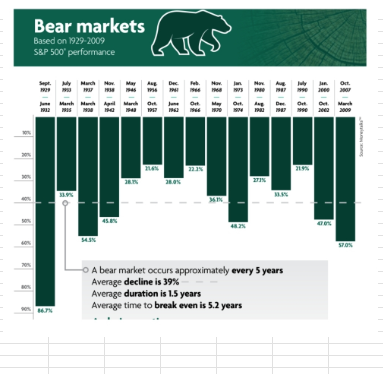
As the chart above shows, bear markets happen roughly every five years. If you hit one of those deep red zones in the first three to five years of your retirement, your plan could be mathematically broken before you’ve even finished your first "celebration" cruise.
The Disguises of Wall Street’s Future Promise
> "You know enough to think you are right about retirement, but don’t know enough to discover you are wrong."
That’s the trap for a lot of Quiet Builders. You’ve been responsible, disciplined, and smart enough to follow the traditional spreadsheet logic. You’ve seen the projections, trusted the averages, and assumed the math was giving you something solid. But retirement isn’t lived on a spreadsheet. It’s lived in real time, with real losses, real withdrawals, and real behavior pressure.
What is presented as opportunity is often a reframed limitation.
If you’re a Quiet Builder, this matters more than ever. The Teenager hears a polished phrase and assumes it means progress. The Architect hears the same phrase and asks, "What is this hiding?" That’s the real audit. Not just what Wall Street says, but what the language is covering up.
Here’s a simple audit of the most common belief disguises:
"Average returns" is often a disguise for uneven real-life results. Your account does not experience an average path. It lives through a sequence of gains and losses in real time.
"Stay invested" is often a disguise for absorbing losses you may not have time to recover from. That may work at 35. It hits differently at 65.
"Be patient" is often a disguise for lost time. And time is the one asset retirement gives you less of, not more.
"Long-term investing" is often a disguise for delayed accountability. If the plan breaks later, the language protected the promise today.
"Diversification" is often a disguise for owning several versions of market risk. More buckets doesn’t automatically mean more safety.
"Managed risk" is often a disguise for risk you still fully absorb. If you can still lose 20% to 30%, the pain is not managed. It’s just explained better.
"Liquidity" is often a disguise for easy access to assets that may be down when you need them most.
"Income planning" is often a disguise for withdrawing from an unpredictable base. You can estimate income needs, but you cannot predict future portfolio value when volatility, fees, and taxes are still in control.
"Freedom" is often a disguise for behavioral pressure. Most people don’t feel free when their statement drops and their retirement date gets shaky.
The Architect mindset is different. It doesn’t chase comforting language. It asks whether the structure protects time, margin, and control. That’s why Participation vs. Engineered Performance matters so much. Participation reacts. Architecture designs.
Risk, time, and control are reframed in language that feels safe, predictable, and averaged—while the real experience is uneven, delayed, and behaviorally constrained.
Wall Street’s Big Lie: The Myth of "Average Returns"
Wall Street loves to talk about "average returns." They’ll tell you the S&P 500 averages 8-10% over the long haul. But you don't spend averages; you spend dollars.
If you have $100 and you lose 50%, you have $50. To get back to $100, you need a 100% gain. Your "average" return over those two years would be 25% ((-50 + 100) / 2), but your actual profit is zero.
This is the Math of Recovery.
A 20% loss requires a 25% gain just to break even.
A 30% loss requires a 42% gain to break even.
A 50% loss requires a 100% gain to break even.
When you are withdrawing money for income, these math problems become unsolvable. You are fighting a war on two fronts: the market is taking your money, and you are taking your money. Most traditional portfolios simply aren't engineered to survive that kind of "Sequence of Return Margin" pressure.
The Margin Audit™: Moving Beyond Single-Pillar Assets
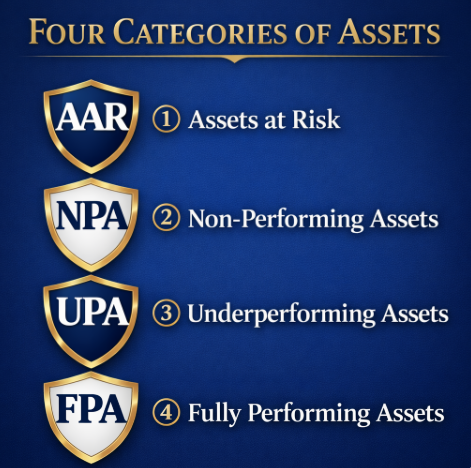
To understand why your current plan might be at risk, we need to look at the four categories of assets:
Assets at Risk (AAR): Stocks, mutual funds, and variable annuities. These are subject to market volatility.
Non-Performing Assets (NPA): Cash under the mattress or checking accounts that lose value to inflation.
Underperforming Assets (UPA): Low-yield bonds or CDs that don't keep up with the "leaks" of taxes and fees.
Fully Performing Assets (FPA): This is the foundation of an engineered retirement.
Traditional retirement planning relies on "Single-Pillar" assets. A bank account does one thing (storage). A stock does one thing (growth potential). Real estate does one thing (equity/rent).
Think of this like the technology of the 1980s. You had a pager, a camera, a calculator, and a telephone. They were all separate devices. Today, you have a smartphone: a single device that consolidates 15 different tools into one powerhouse.
Fully Performing Assets (FPA) are the "smartphones" of the financial world. Instead of just one pillar, they provide 5 to 15 pillars of value, including:
Guaranteed Growth (No market losses, ever).
Uncapped Gains (UCG) through index participation.
Tax-Free Income potential.
Long-Term Care (LTC) benefits.
Asset Protection.
Participation vs. Engineered Performance
Wall Street wants you to "participate." Participation is just a fancy word for gambling with better clothes. It relies on the "False Model" driven by greed and fear. When the market is up, greed tells you to buy more. When it’s down, fear tells you to sell.
Engineered Performance is different. It’s rooted in Asset Liability Management (ALM): the same principles used by major banks and institutional-grade firms to ensure they never go bust.
In an engineered plan, we prioritize Certainty before Growth and Protection before Speculation.
One of the key tools we use is Expanded Market Participation (EMP). While many brokers claim that indexed products have a "3% cap," modern financial architecture allows for uncapped growth or even a multiplier (110%–200%) on market gains. Imagine the market goes up 10%, but because of your FPA structure, you receive 15%. And if the market drops 30%? You stay at 0%.
That’s the difference between spinning sharp knives and building a fortress.
The Architect vs. The Teenager
When we sit down for a Million Dollar Hour™ Forecast, we aren't looking for "hot tips." We are conducting a Volatility Recovery Analysis. We look at your current "leaks": the hidden fees, the unnecessary taxes, and the sequence risk: and we apply a Margin Audit™.
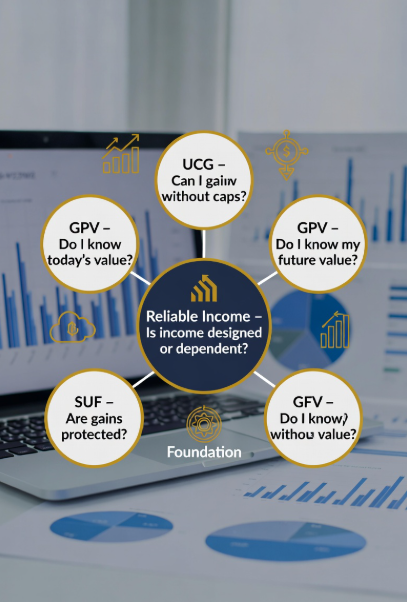
The goal is to move your money from the "Teens" (Assets at Risk) to the "Foundation" (Fully Performing Assets).
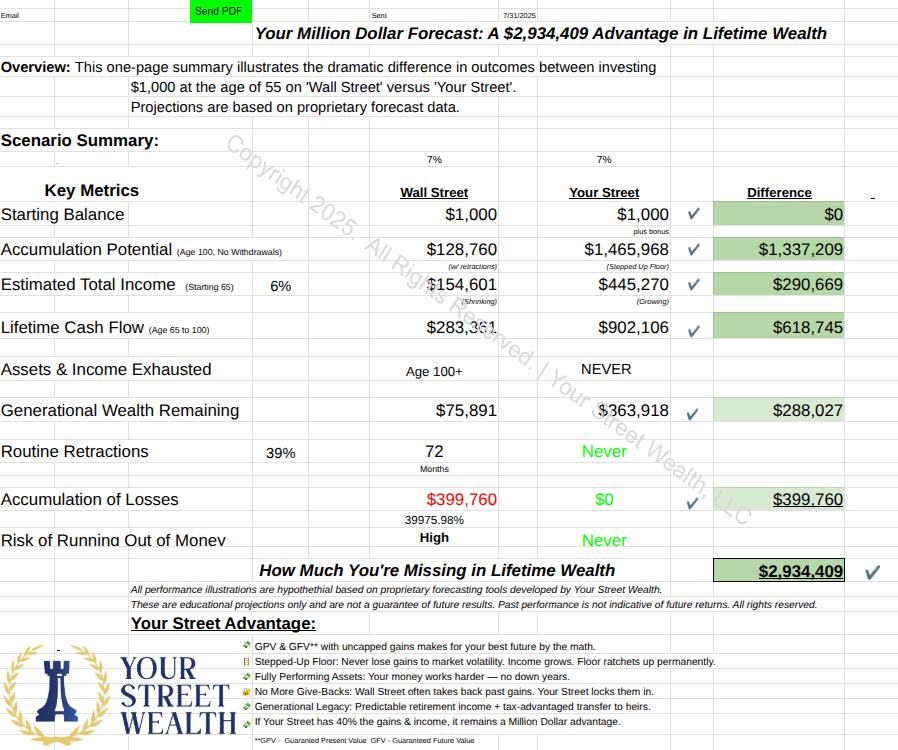
As you can see in the comparison above, the difference between a traditional Wall Street path and an engineered Your Street Wealth path isn't just a few percentage points. It’s the difference between asset exhaustion (running out of money) and generational wealth.
The Quiet Builder knows that wealth isn't built on macro headlines; it’s built on micro margins. It’s about Compounding Efficiency. When you eliminate the 30% drops, you don't need to chase 30% gains. You just need steady, reliable, and repeatable progress.
Why "Risk" is for Business, Not Retirement
You took risks to build your career. You took risks to start a business or climb the corporate ladder. You’ve done your time in the arena. Retirement is the time to harvest, not the time to keep your entire nest egg on a roulette table.
Wall Street uses hidden complexity to keep you addicted to the "daily research" and the buying and selling. They want you focused on the noise so you don't see the extraction of fees.
We believe in a different mantra: Your Money, Your Rules, In Your Time, On Your Street.
Peace is the path, and wisdom is the way. Wisdom tells us that a plan that requires the S&P 500 to perform perfectly for 30 years isn't a plan: it's a hope. An engineered plan, however, accounts for the "ripples" of interest rates and the "sharp knives" of market volatility.
Your Next Step: The Million Dollar Hour™ Forecast
If you are uneasy about the "Gap" in your current plan: the space between what you have and what you need to feel truly secure: it’s time for a professional scrutiny of your strategy.
The Million Dollar Hour™ Forecast is a premium, $995 engineering session designed for high-intent individuals who are tired of the "free cheese" mice-chasing and want a scrutinized, certain plan. This isn't a sales pitch; it’s a 60-minute session of fundamental financial architecture.
We will look at:
Your current Sequence of Return Margin.
Where your assets fall in the AAR, NPA, UPA, FPA framework.
How to consolidate "Single-Pillar" products into a "Multi-Pillar" strategy.
The "Math of Recovery" specific to your current portfolio.
Stop being a "participant" in someone else's game. Become the Architect of your own future.
Ready for clarity instead of confusion?
The Million Dollar Hour™ is your educational, one-on-one retirement review that reveals where your plan leads : not just where it’s been.
👉 Schedule your session today.
You can keep participating… Or you can finally see the outcome. The Million Dollar Hour™ shows you exactly:
✔ Where you are ✔ Where you’re going ✔ How to fix the gaps 👉 Book your session now
Check out the Retirement Blueprint
Concerned about market losses, taxes, or income reliability?
Take the 7 Question Retirement Stress Test →