
Wealth Killer #4: Fixing the Retirement Fee Leak
Wealth Killer #4: The Fee Leak : Is Your Retirement Plan a Rolodex in a SpaceX World?
One of the fastest ways to uncover hidden risk is to take our 7 Question Retirement Stress Test.
![[HERO] Wealth Killer #4: The Fee Leak : Is Your Retirement Plan a Rolodex in a SpaceX World?](https://cdn.marblism.com/9GIRhzPCBjA.webp "[HERO] Wealth Killer #4: The Fee Leak : Is Your Retirement Plan a Rolodex in a SpaceX World?")
Start here: See what your retirement actually looks like → 👉 Book Your Million Dollar Hour™
Your Retirement Plan is Leaking: And Wall Street is Holding the Bucket
Most retirement plans look polished on paper, but under the hood they’re clunkers leaking fuel.
That’s the part most Quiet Builders feel but can’t always name. The statement arrives. The pie chart looks respectable. The advisor says, “Stay the course.” But the account still feels heavier to push than it should. That drag has a name: The Fee Leak.
At Your Street Wealth, we use “Your Street vs. Wall Street” language for a reason. Wall Street sells participation. Your Street is about engineered performance. One asks you to tolerate noise, risk, and hidden costs. The other asks a simpler question: What is this plan actually doing for you after the leaks, losses, fees, and recovery math are done?
And in the Graduation Framework, this leak doesn’t just hit one area. It quietly breaks all four:
Money: less compounding, less usable income, less control
Rules: Wall Street’s rulebook gets paid first, whether you win or lose
Time: every leaked percentage point steals future years through slower compounding and longer recovery
Street: you end up living by their model, not Your Money, Your Rules, In Your Time, On Your Street
If you grew up in the era of the Rolodex, you remember the satisfaction of a well-organized desk. It was reliable. It was tactile. It worked. But if you tried to run a modern global logistics company or launch a rocket into orbit using a spinning wheel of paper cards, you’d be laughed out of the room.
The world moved on. Technology consolidated. We went from carrying a pager, a camera, a GPS, and a phone to carrying a single smartphone.
Yet, for some reason, when it comes to retirement planning, most Quiet Builders: engineers, business owners, former executives, and successful professionals who built carefully, not recklessly: are still using a financial Rolodex. They have a single-pillar asset here (a stock account), a single-pillar asset there (a bank CD), and maybe real estate over there.
This fragmented approach creates what I call The Fee Leak. It is the fourth great Wealth Killer, and it quietly drains time, wealth, and confidence from people who did everything “right” and still feel financially fatigued.
The Rolodex Analogy: Why Traditional Accounts Are Outdated Tech
A traditional 401(k) or brokerage account is not “bad” because it exists. It’s outdated because it asks modern retirees to solve modern risks with old technology.
It’s the same problem as using a Rolodex in a SpaceX world. Durable? Sure. Familiar? Yes. Enough for today’s speed, tax pressure, fee layering, and sequence risk? Not even close.
Wall Street still packages retirement planning like a drawer full of single-use devices. One product for growth. One for safety. One for income. One for emergencies. One for tax strategy. That’s the old single-pillar model.
Your Street takes a different view. Financial design should work more like the consolidation of technology. Phones, pagers, cameras, GPS units, and TVs all collapsed into one smartphone because single-use tools became inefficient. Finance is no different. Banks, stocks, and real estate are still mostly single-pillar assets. They may do one thing reasonably well, but they usually leave big gaps elsewhere.
That is why many Quiet Builders feel like they own “a lot” but still lack certainty. They have pieces, but not architecture.
Frank Day’s institutional-grade Asset Liability Management background is what changes the conversation. He doesn’t look at your accounts as products. He looks at them as a system. He studies what each dollar is doing, what it is costing, where the drag lives, and whether the structure is healing your balance sheet or quietly weakening it.
That’s the difference between Participation vs. Engineered Performance.
The Math of the "House" (Why 3% Is a 43% Tax on Profit)
Wall Street loves to talk about returns. It talks far less about what you actually keep.
Let’s keep the math simple. If your portfolio earns 7%, and your total fees equal 3%, you are not “just paying 3%.”
You are giving up 43% of your profit.
Here’s the formula:
7% gross return
3% total cost
4% net return left to you
That 3% fee consumed 3 out of the 7 points you earned. That’s about 43% of the gain.
That is the math of the house. The house gets paid first. You take the market risk, the emotional strain, the volatility, and the recovery burden. They take a big slice of the upside.
And that 3% total cost is not hard to reach:
1% AUM advisory fee
1% to 1.5% internal fund fees and trading friction
cash drag from money sitting idle but still counted in the plan
So no, this is not a rounding error. It is a profit tax hiding in plain sight.
And when losses hit, the math gets nastier. This is where The Math of Recovery matters. If you lose 30%, you need a 42% gain just to get back to even. If you lose 50%, you need 100% to recover. During that recovery climb, fees often keep draining the account.
That’s why Your Street rejects the false comfort of “average returns.” Average returns don’t pay retirement income. Actual account values do.

The Margin Audit™: Finding the 2% to 4% Hidden Leak
At Your Street Wealth, we don’t hunt for hot stocks. We study Compounding Efficiency.
That’s what the Margin Audit™ is built to do. It is a rules-based review designed to find the hidden 2% to 4% leak that many retirement plans carry year after year without the owner ever seeing it clearly.
Here’s where we typically find it:
Internal Fund Fees: The embedded costs inside mutual funds, model portfolios, and ETFs that rarely get explained in plain English.
Advisor Participation Fees: The AUM fee that keeps billing whether your money grows, stalls, or slides backward.
Cash Drag: Idle money sitting in low-performing sleeves while the overall plan still gets marketed as “fully invested” or “on track.”
Volatility Recovery Analysis: The leak nobody budgets for. When losses happen, your account has to spend future years climbing back to zero instead of compounding forward.
This is why we call Wall Street a False Model driven by fear and greed. High greed often means higher exposure to loss. High fear often means money gets trapped in low-yield positions that still fail to solve the real problem. Either way, the Quiet Builder gets stuck paying for participation without getting engineered results.
The Margin Audit™ shines a light on all of it. Not with jargon. Not with shiny pie charts. With math.
That’s also where Frank Day’s institutional-grade background matters. He brings banking architecture and Asset Liability Management discipline to personal retirement planning. In other words, he looks at your plan the way an institution would examine system design, pressure points, and structural leakage.
Peace is the path, wisdom is the way. And wisdom starts by measuring the leak.
The Solution: Moving to Structures With 0% to 1.5% Total Cost
The solution is not to “try harder” inside a leaking machine. The solution is to redesign the machine.
At Your Street, that means moving away from outdated single-pillar structures and toward Fully Performing Assets (FPA) built on modern banking architecture principles. Think of FPA as the smartphone of finance. Instead of one narrow function, it can consolidate 5 to 15 pillars of value into one coordinated structure.
That can include:
growth potential
principal protection
income design
tax efficiency
long-term care features
legacy transfer efficiency
lower total friction
stronger sequence of return margin
This is the core shift from Participation vs. Engineered Performance.
Instead of living in the Wall Street range of -30% to +30%, the goal is to move into Your Street design where a client can often operate in a 0% to +30% framework. No backward years means no recovery math draining time.
And just as important, these structures are often designed with 0% to 1.5% total cost, not the 3% to 4% leak that many traditional plans quietly carry.
When relevant, Fully Performing Assets may also include:
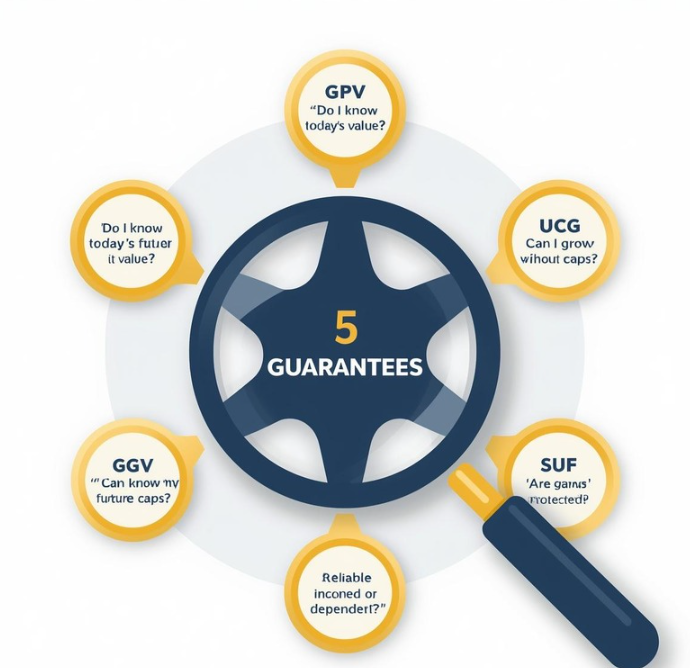
Uncapped Gains (UCG): upside crediting not trapped by the old “3% cap” broker myth
Expanded Market Participation (EMP): multiplier structures that can turn a 10% UCG into an 11% to 20% gain through 110% to 200% participation design
A+ guarantees: contractual protection designed to reduce uncertainty instead of amplifying it
This is not magic. It is architecture.
Wall Street asks you to participate and hope. Your Street is designed to protect time, recover margin, and create a more certain income path.

Participation vs. Engineered Performance
The difference between Wall Street and Your Street is the difference between "hoping it works" and "knowing it works."
Wall Street uses hidden complexity to drive daily research and addictive buying and selling. They want you checking your phone every five minutes because "volatility" is their friend: it generates trades and fees.
We view volatility through a different lens: Volatility Recovery Analysis. We know that wealth isn't built on macro headlines; it’s built on micro margins. If we can stop the fee leak and eliminate the recovery cycle, we don't need "home run" returns to win. We just need Engineered Performance.
When you move your money from Assets at Risk (AAR) to Fully Performing Assets (FPA), you are moving from a system designed to extract value to a system designed to protect it.
Why Successful People Accept This (And Why You Shouldn't)
Most "Quiet Builders" accept these fees because they’ve been told it’s just the "cost of doing business." They treat their retirement plan like a utility bill: something that just has to be paid.
But you didn't become successful by ignoring the margins in your business or your career. You became successful by optimizing. You became successful by demanding that every dollar has a job and every tool has a purpose.
If your current retirement plan is still a collection of "single-pillar" accounts, managed by an advisor who takes a cut of your total wealth every year regardless of performance, you are operating with a Rolodex in a SpaceX world.

The Path to Wisdom
Peace is the path, and wisdom is the way. Wisdom tells us that we cannot predict the future value of a portfolio when market volatility and fee leaks are uncontrollable. However, we can engineer a path where the costs are known, the floors are guaranteed, and the "Math of Recovery" is a ghost of the past.
Your money should follow your rules, in your time, on your street.
If you are tired of the "Participation" game and want to see the literal math of where your current plan is leaking, it might be time for a professional audit. We don’t do "free consultations" that turn into sales pitches. We provide an institutional-grade engineering review.
CTA: The Million Dollar Hour™ Forecast
The Million Dollar Hour™ Forecast is a $995 deep-dive session built for the Quiet Builder who wants facts, not fluff.
This is not a free coffee meeting dressed up as advice. It is a one-hour professional engineering review rooted in Frank Day’s institutional-grade Asset Liability Management experience and modern banking architecture principles.
In that session, we:
run a Margin Audit™
measure hidden fee leaks and cash drag
review your Sequence of Return Margin
evaluate Compounding Efficiency
compare Participation vs. Engineered Performance
show whether your current plan is built on Wall Street noise or Your Street design
The goal is simple: help you unlearn the myths, see the leaks, and understand whether your retirement structure is healing your balance sheet or quietly hurting it.
You’ve spent decades building wealth. This is the stage where protecting time matters just as much as growing money.
Is your retirement plan leaking fuel?
A hidden fee leak is often the difference between a retirement that thrives and one that just survives. But fees are only one of the 11 "Wealth Killers" that can quietly dismantle your life's work.
To identify which of these leaks are currently draining your retirement engine, take our 60-second diagnostic:
👉Start the 60-Second Wealth Killer Quiz
For a complete breakdown of all 11 diagnostic questions we use to audit a retirement plan, visit our Master Hub:
👉Read the Wealth Killer 11: Self-Diagnosis Guide
Ready to stop the leaks?
If you want to move from "participation" to "engineered performance" with total clarity on your costs and growth, schedule your Million Dollar Hour™ Forecast. We’ll perform a professional Margin Audit™ to show you exactly what you’re keeping versus what you’re losing.
👉Schedule Your Million Dollar Hour™ Here
Concerned about market losses, taxes, or income reliability?
Take the 7 Question Retirement Stress Test →
You can keep participating… Or you can finally see the outcome. The Million Dollar Hour™ shows you exactly:
✔ Where you are ✔ Where you’re going ✔ How to fix the gaps 👉 Book your session now
Check out the Retirement Blueprint
Wealth Killer #5: The Hidden and Mysterious Time Leak
https://wealthonyourstreet.com/post/wealth-killer-5-protect-retirement-from-the-time-leak