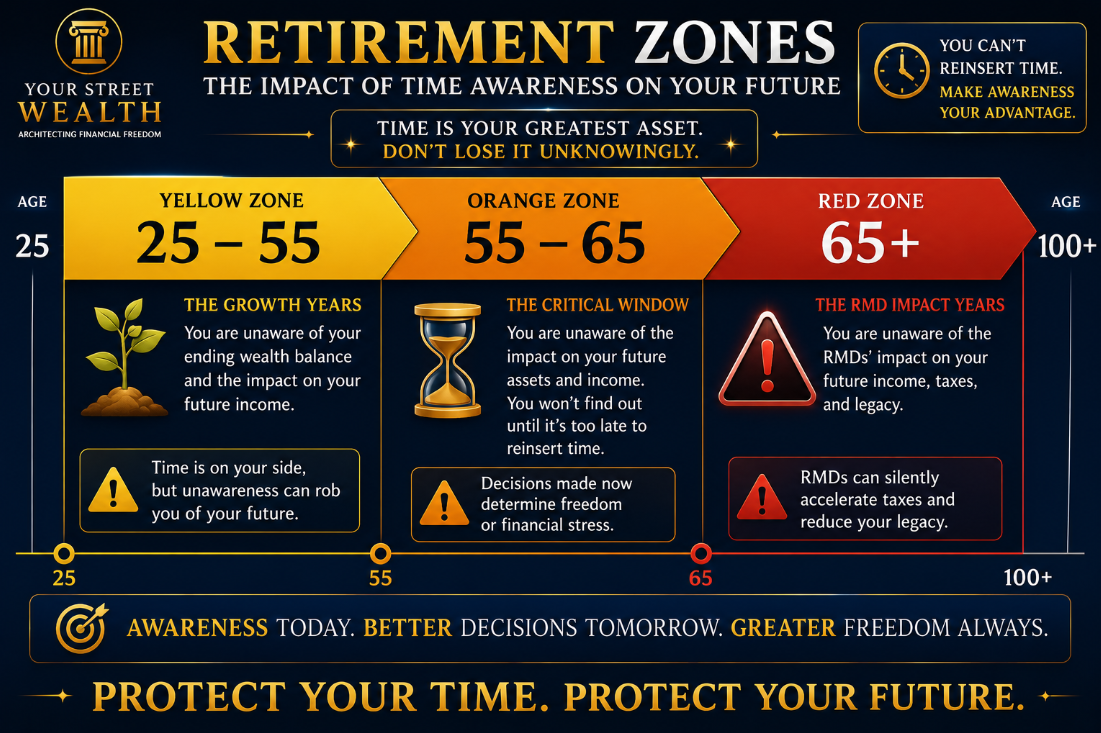
Why Market Volatility is Your Retirement’s Greatest Enemy
Wealth Killer #1: The Granddaddy : Why Market Volatility is Your Retirement’s Greatest Enemy
One of the fastest ways to uncover hidden risk is to take our 7 Question Retirement Stress Test.

Start here: See what your retirement actually looks like → 👉 Book Your Million Dollar Hour™
The $3 Million Procrastination Tax: Why the "Granddaddy" of Wealth Killers is Hiding in Your 401(k)
We’ve spent weeks dissecting the "Wealth Killers" that turn a perfectly good retirement into a financial horror story. We’ve covered everything from hidden fees to the tax man’s sticky fingers. But as I was looking through the archives with Frank, we realized we skipped a giant. The Granddaddy (Volatility) is the #1 reason why the answer to 'how much do I need to retire' is always higher than Wall Street tells you."
How Much Do I Need to Retire Without Volatility Killing My Plan?
We missed Wealth Killer #1. The Granddaddy. The "Big Bad" that Wall Street tries to dress up as "opportunity" while it’s actually picking your pocket.
And then, Frank dropped a bomb: The 11th Truth. A wealth killer so quiet, so subtle, that it could cost you $100,000 a year for the next 30 years. That’s a $3 million gap. Most people find that number impossible to believe because they’ve spent decades marinating in Wall Street myths instead of looking at the institutional math.
At Your Street Wealth, we believe you shouldn't have to guess your way through retirement. That’s why we use the Graduation Framework to move you away from the noise and into engineering:
Money: Transition from Assets at Risk (AAR) to Fully Performing Assets (FPA).
Rules: Move from Wall Street’s casino rules to Your Street Rules: guaranteed paths and uncapped growth.
Time: Stop wasting years in The Math of Recovery and reclaim the time you earned.
Street: Shift from the volatility of Wall Street to the reliability of Your Street.
Buckle up. We’re going to fix your broken retirement engine by looking at the engineering, not the hype.
The Broken Engine: Why Your Portfolio is a Rolodex in a SpaceX World
Most retirement plans are built on a "False Model" driven by the twin engines of fear and greed. Wall Street tells you to "participate" in the market. They want you addicted to the daily ticker, the research, and the constant buying and selling.
But here’s the truth: Participation is not Performance.
Traditional strategies: the ones involving banks, stocks, and real estate: are what we call "single-pillar" assets. They do one thing, and they usually do it with high fees or high risk. Relying on these for a modern retirement is like trying to manage your entire life with a Rolodex in a SpaceX world. It was a fine tool in the 1980s, but today? It’s inadequate for the speed and volatility of the current landscape.
The engine is broken because it relies on "hope" as a primary fuel source. You hope the market goes up. You hope the "sequence of returns" doesn't hit you at the wrong time. You hope you don't run out of money before you run out of breath.
Wealth Killer #1: The Math of Loss vs. The Myth of Average
Wall Street loves to talk about "Average Returns." They’ll tell you the market averages 8% or 10% over time. Sounds great, right?
Wrong. You can’t eat an "average." You can only spend actual dollars.
This is where The Math of Recovery comes in. If your portfolio takes a 30% hit: which happens about every five years: you don’t need a 30% gain to get back to even. You need a 42.8% gain just to see the same dollar amount you had before the crash.
But here’s the part most people miss: volatility is not just a loss of money. It’s an inefficient Use of funds. In simple "Sources and Uses of Funds" logic, your retirement assets should act like a reliable Source of growth and future income. But when market losses force your money into recovery mode, that capital gets consumed by repair work instead of productive compounding. The portfolio stops acting like a source and starts acting like a leak.
While you’re waiting for that 42.8% "recovery," guess what you aren't doing? You aren't compounding. You aren't growing. You are simply treading water while the clock of your life keeps ticking. This is "Volatility Recovery Analysis" 101.
In retirement, volatility isn't just a bump in the road; it’s a "Sequence of Return Margin" failure. If the market drops 20% the year you retire, and you start pulling income out of that shrinking pile, you are effectively "spinning sharp knives." You are liquidating assets at the worst possible time, creating a hole that most portfolios can never climb out of.
This is why Participation vs. Engineered Performance matters so much. Participation says, "Take the hit and hope it comes back." Engineered Performance asks a better question: "Why allow your money to be diverted into bad uses in the first place?" When you remove the 11 Wealth Killers, you stop feeding wasted uses and start restoring productive sources. That’s when the retirement engine begins to do what it was supposed to do all along: grow with purpose, produce with reliability, and protect both time and wealth.
Most people do not understand the size of the opportunity on the other side of those leaks. They only see the visible loss. They do not see the hidden growth that never had a chance to happen because too much capital was busy recovering, paying fees, covering tax drag, or compensating for Wall Street’s False Model.
The 11th Truth: The $3 Million Cost of Waiting
Now, let's talk about the "11th Truth" Frank revealed. This is the Cost of Inaction.
Most "Quiet Builders": those of you between 45 and 75 who have worked hard and played by the rules: feel a sense of "financial fatigue." You know something is off, but you figure you’ll deal with it "next quarter" or "after the election" or "when things settle down."
Here is the math they don't want you to see: The gap between a traditional "At-Risk" plan and an "Engineered Performance" plan can easily be $100,000 per year in spendable income. Over a 30-year retirement, that is $3,000,000.
People find this hard to believe because they’ve never seen the math: only the myths. They think a 1% fee or a 2% "drag" on performance doesn't matter. But when you apply a Margin Audit™ to a 30-year horizon, those micro-leaks turn into a macro-disaster. In Sources and Uses of Funds language, each of the 11 Wealth Killers is a bad use of capital. Each one steals efficiency from compounding and strips your portfolio of its ability to act as a dependable source. Every day you wait to move from "Participation" to "Architecture" is a day you are paying a voluntary tax to Wall Street. It's a part of the Sequence of Returns Risk.
And when those bad uses are removed, something powerful happens: wasted dollars become working dollars again. Lost momentum becomes compounding efficiency. A fragile retirement engine becomes a productive one. That is the opportunity most people never get shown. They’re taught to manage losses, not eliminate the leaks causing them.
The "Smartphone" of Finance: Multi-Pillar Engineering
If traditional assets are single-use tools, Fully Performing Assets (FPA) are the "smartphone" of the financial world.
Think about it: Your phone consolidated your camera, your pager, your map, and your computer into one device. An FPA does the same for your wealth. Instead of one pillar (growth), an FPA can provide 5 to 15 "pillars" of value, including:
Guaranteed Growth (No more -30% years)
Uncapped Gains (UCG) through Expanded Market Participation
Locked-in Protection (Once you gain it, you keep it)
Tax-Free Income potential
Long-Term Care benefits
We contrast the two worlds like this:
Wall Street: A range of -30% to +30%. (The "Spinning Knives" zone)
Your Street: A range of 0% to +30%. (The "Engineering of Certainty" zone)
When you eliminate the "down" years, the "Math of Recovery" disappears. You never have to wait to "break even." Every positive move is a step forward, not a step back toward the surface. This is how you protect retirement savings from a market crash while still enjoying uncapped gains.
Unlearning the Myths: Wisdom is the Way
To survive the Granddaddy of wealth killers, you have to unlearn the noise. Wall Street wants you focused on macro headlines because it keeps you from looking at your micro margins. They want you to believe that "risk" is a requirement for "return."
It isn't. Risk is for business; it has no place in your retirement foundation.
We use a "Greed/Fear Meter" to help our clients understand the environment. High greed in the market signals a high risk of loss. High fear signals a lower risk of loss. But wouldn't you rather move to a system that doesn't care what the meter says?
By using institutional-grade Asset Liability Management (ALM): the same principles used by major banks to ensure they always have the money when they need it: we can engineer a plan that provides guaranteed retirement income regardless of what the "Granddaddy" (Volatility) is doing.
The Play: Moving from Architect to Engineer
You can estimate your income needs all day long, but you cannot predict your future portfolio value if your "leaks" (fees/taxes) and "losses" (volatility) are out of your control.
This is the difference between being a "Participant" and an "Architect." An architect designs a structure to stand against the wind. An engineer ensures the math supports the design.
We don't chase "mice" looking for "FREE cheese." We work with Quiet Builders who want a scrutinized, certain plan. We offer the Million Dollar Hour™ Forecast: a $995 professional engineering session and Margin Audit™ designed to show you exactly where your current plan leads.
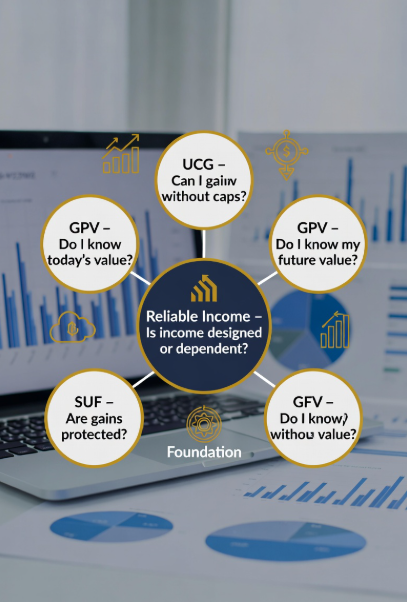
In 60 minutes, we help you unlearn the myths and learn the fundamental financial architecture that will last for the rest of your life. We look at the 7 questions your current broker probably can't answer:
Do you have a reliable income for life?
Are your gains uncapped?
Do you know your plan's future value today?
Are your gains protected from market crashes?
Is your foundation solid?
Peace is the path, and wisdom is the way. Don’t let the "Granddaddy" or the "Cost of Waiting" steal the future you’ve spent 40 years building.
It’s time to move your money off of Wall Street and onto Your Street.
Your Money, Your Rules, In Your Time, On Your Street.
Are you losing more than just market returns?
Volatility is the "Granddaddy," but it’s rarely the only leak in a retirement plan. Most people are losing significant wealth to several of the 11 specific "Wealth Killers" without even realizing it.
To see which of these traps are currently active in your plan, take our quick diagnostic quiz:
👉 Start the 60-Second Wealth Killer Quiz
If you want to see the full breakdown of all 11 diagnostic questions we use to evaluate a retirement engine, you can find them here in our Master Hub:
👉 Read the Wealth Killer 11: Self-Diagnosis Guide
Ready to stop guessing?
If you’re done with "hope" and want a guaranteed path to safer growth and lifetime income, schedule your Million Dollar Hour™ Forecast. We will perform a full Margin Audit™ to identify your specific leaks and show you exactly how to fix them.
👉 Schedule Your Million Dollar Hour™ Here

Wealth Killer #2: The 4% Rule Myth : Why 'Safe' Withdrawal Rates Are Dangerous
Concerned about market losses, taxes, or income reliability?
Take the 7 Question Retirement Stress Test →
You can keep participating… Or you can finally see the outcome. The Million Dollar Hour™ shows you exactly:
✔ Where you are ✔ Where you’re going ✔ How to fix the gaps 👉 Book your session now
Check out the Retirement Bluepri