
Retirement Strategies That Maximize Income, Eliminate Risk, and Help Ensure You Never Run Out of Money How to Achieve The Retirement Future Everyone Seeks
Most retirement plans are built on assumptions that no longer hold up—market averages, predictable tax rates, and the belief that time will always recover losses. But as you approach or enter retirement, the rules change. What worked during your accumulation years can become a liability during the withdrawal phase.
This blog is designed to help you rethink traditional strategies and discover a more engineered approach to retirement income—one focused on certainty, efficiency, and control.
Here, you’ll learn how to reduce or eliminate the biggest threats to your financial future, including market losses, rising taxes, hidden fees, and the silent erosion caused by lost time. We break down complex financial concepts into clear, actionable insights so you can make better decisions about your 401(k), IRA, and retirement income strategy.
You’ll also discover why many conventional approaches—like relying on average returns or the 4% rule—can expose you to unnecessary risk, especially when withdrawals begin. Instead, we explore strategies designed to protect your principal, improve compounding efficiency, and create predictable income streams that last.
Our focus is on helping you transition from “assets at risk” to a more stable and structured approach using fully performing assets—where growth, income, and protection work together instead of against each other.
Whether you’re still working or already retired, the goal is simple:
help you keep more of what you earn, generate more reliable income, and build a plan that doesn’t depend on hope, timing, or market luck.
If you’ve ever wondered:
* How to create tax-efficient retirement income
* How to avoid sequence of returns risk
* How to reduce fees and increase net returns
* How to design income that doesn’t run out
—you’re in the right place.
Explore the articles below and start building a retirement strategy based on engineering, not guesswork.
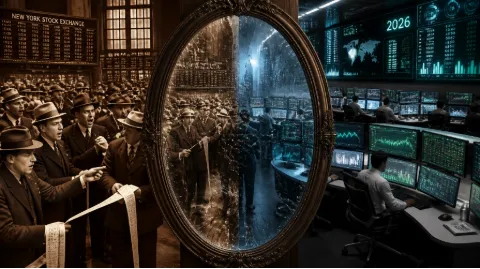
2026 vs 1929: Is a Market Crash Coming? | Your Street Wealth
The 100-Year Mirror: Is 2026 Preparing to Replay 1929?
Start here: See what your retirement actually looks like → 👉 Book Your Million Dollar Hour™

One of the fastest ways to uncover hidden risk is to take our 7 Question Retirement Stress Test.
Is 2026 Preparing to Replay 1929? The 100-Year Mirror:
Close your eyes for a moment. Look past the flashing green tickers of June 2026 and the constant "new high" notifications on your phone. What do you see?
If you look closely enough, you might see a ghost.
It is the ghost of 1929, and it is staring back at us through a 100-year mirror. The reflection is eerily familiar: a market so drunk on its own success that greed is no longer a whisper; it’s an oozing, unavoidable presence in every headline and dinner party conversation.
And at the center of that greed is something simple and dangerous: FOMO.
Fear of missing out is what makes smart people do dumb math. It is what makes people borrow on margin because "everyone else is making money." It is what turns common sense into crowd behavior. In the late 1920s, even the famous "shoeshine boy" became the symbol of speculative mania because everyone, from professionals to everyday workers, felt they had to get in before the easy money was gone.
That same emotional engine is running today. When greed gets loud enough, leverage starts to feel normal. Borrowing to invest starts sounding sophisticated. Margin debt starts looking like ambition instead of what it often is: desperation dressed up as confidence.
The confidence is breathtaking. But history suggests that when everyone is this sure the sky is the limit, the ground is closer than it looks. We are standing on a peak, riding higher and higher, but the "cliff" metaphor has never been more relevant.
Are you prepared to take your profits from Wall Street before Wall Street decides to take them back?
The Concentration Cliff: Why 10 Stocks Hold Your Future Hostage
In 1929, the market was dominated by a handful of industrial giants and railroads. Today, in 2026, we’ve achieved a level of concentration that would make a Gilded Age tycoon blush.
As of early this year, the top 10 stocks in the S&P 500 account for roughly 41% of the entire index’s value. Think about that. Nearly half of the "broad market" performance is being driven by a tiny group of megacap tech and AI companies.
When you "participate" in the market today, you aren't diversified. You are betting on a narrow pillar of giants. If one of them trips, the entire index tumbles. This is the difference between Participation (gambling on a trend) and Engineered Performance (designing for stability).

The $1.4 Trillion Debt Trap
Confidence doesn't just show up in stock prices; it shows up in debt. Margin debt: money borrowed to buy more stocks: has exploded to a staggering $1.4 trillion.
That is not just a number. It is a mood. It is greed with a loan application attached. It is FOMO overriding common sense and telling people that normal gains are not enough, so they need extreme leverage to chase even more.
Put it in plain English: if the market cap in view is roughly $7 trillion, then $1.4 trillion of margin debt equals about 20% of that total. That is a house of cards statistic. People are not just gambling with their own money. A huge slice of the system is being propped up by borrowed money.
In 1929, the leverage was extreme because people were buying on 10% down. The shoeshine-boy era was not just about stock tips. It was about a culture where speculation had become casual, social, and dangerously accepted. Today, the tools are different, but the behavior rhymes. When borrowed money floods into risk assets, people are no longer investing with discipline. They are participating in a False Model driven by fear and greed.
That 20% leverage is what makes the system so unstable. If the market dips, lenders do not wait patiently. They issue margin calls. Investors then have to sell assets fast to cover the loan. That forced selling pushes prices lower, which triggers more margin calls, which triggers more selling. That is the cascade. That is how a leveraged market turns into a cliff event.
While modern regulations are stricter, the nominal volume of $1.4 trillion creates a massive "Sequence of Return Margin" risk. When the market retracts: and we are closer to a 20%+ retraction than most care to admit: margin calls trigger a cascade of forced selling.
This is how a "correction" turns into a "cliff."
The Math of Recovery: Why "Wait and See" is a Poison
Wall Street loves to tell you to "stay the course." They preach "Hold and Hope." But for a Quiet Builder: someone between the ages of 45 and 75: time is the one asset you cannot recover.
Consider the Math of Recovery:
A 20% loss requires a 25% gain just to get back to zero.
A 30% loss requires a 42% gain to break even.
A 50% loss (like we saw in 2008 or 1929) requires a 100% gain.
How many years of your life are you willing to sacrifice to "get back to even"? Money can recover. Time never does. If history repeats itself: and it often does: the next decade could be a "Lost Decade" for those who refuse to move their allocation from Risk to Guarantees.

Single Pillar vs. Multi-Pillar: The "Smartphone" of Finance
Most retirement plans are built on "Single-Pillar" assets:
Banks: Low growth, no protection against inflation.
Stocks: High risk, high fees, zero guarantees.
Real Estate: Illiquid and management-heavy.
Relying on these is like carrying a Rolodex, a pager, and a bulky camera in 2026. It’s outdated. At Your Street Wealth, we focus on Fully Performing Assets (FPA). These are the "smartphones" of finance.
An FPA consolidates 5–15 "pillars" of value: including growth, 0% floors, and tax-free income: into one engineered vehicle. Instead of a -30% to +30% Wall Street gamble, we move you to a 0% to +30% environment. You get the Uncapped Gains (UCG) of the market without the downside of the cliff.
Take Your Profits Before They Are Taken From You
The most dangerous words in finance are "it's different this time." It's rarely different. The 100-year mirror is showing us exactly where the current path leads.
It is time to Audit the Margin.
You have worked too hard and waited too long to let a market retraction wipe out your "Quiet Builder" legacy. You need a strategy that shifts you from Uncertainty to Certainty and from Probabilities to Guarantees.
The Million Dollar Hour™: Your Engineering Blueprint
You don't need another sales pitch; you need an architecture.
The Million Dollar Hour™ is a $995 professional Engineering and Margin Audit. It is designed specifically for the person who is "financially fatigued" by the noise of Wall Street and wants a scrutinized, certain plan.
In this 60-minute session, we will:
Perform a Margin Audit™: Identify where your current plan is leaking wealth through hidden fees and taxes.
Conduct a Volatility Recovery Analysis: Show you exactly how many years you would lose in a 20% or 30% retraction.
Map Your Path from Risk to Guarantees: Move you from "Single-Pillar" products to a "Multi-Pillar" FPA strategy.
Stop depending on the market. Start controlling the outcome.
Peace is the path, wisdom is the way.
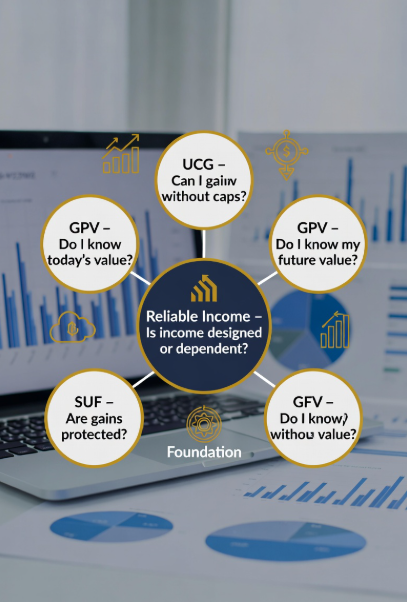
Ready for clarity instead of confusion?
The Million Dollar Hour™ is your educational, one-on-one retirement review that reveals where your plan leads : not just where it’s been.
👉 Schedule your session today.
Discover Which Wealth Killers Are Affecting You
Most people are impacted by 6–9 and don’t realize it
Wealth Killer #1: The Granddaddy : Why Market Volatility is Your Retirement’s Greatest Enemy
Concerned about market losses, taxes, or income reliability?
Take the 7 Question Retirement Stress Test →
You can keep participating… Or you can finally see the outcome. The Million Dollar Hour™ shows you exactly:
✔ Where you are ✔ Where you’re going ✔ How to fix the gaps 👉 Book your session now