
Retirement Strategies That Maximize Income, Eliminate Risk, and Help Ensure You Never Run Out of Money How to Achieve The Retirement Future Everyone Seeks
Most retirement plans are built on assumptions that no longer hold up—market averages, predictable tax rates, and the belief that time will always recover losses. But as you approach or enter retirement, the rules change. What worked during your accumulation years can become a liability during the withdrawal phase.
This blog is designed to help you rethink traditional strategies and discover a more engineered approach to retirement income—one focused on certainty, efficiency, and control.
Here, you’ll learn how to reduce or eliminate the biggest threats to your financial future, including market losses, rising taxes, hidden fees, and the silent erosion caused by lost time. We break down complex financial concepts into clear, actionable insights so you can make better decisions about your 401(k), IRA, and retirement income strategy.
You’ll also discover why many conventional approaches—like relying on average returns or the 4% rule—can expose you to unnecessary risk, especially when withdrawals begin. Instead, we explore strategies designed to protect your principal, improve compounding efficiency, and create predictable income streams that last.
Our focus is on helping you transition from “assets at risk” to a more stable and structured approach using fully performing assets—where growth, income, and protection work together instead of against each other.
Whether you’re still working or already retired, the goal is simple:
help you keep more of what you earn, generate more reliable income, and build a plan that doesn’t depend on hope, timing, or market luck.
If you’ve ever wondered:
* How to create tax-efficient retirement income
* How to avoid sequence of returns risk
* How to reduce fees and increase net returns
* How to design income that doesn’t run out
—you’re in the right place.
Explore the articles below and start building a retirement strategy based on engineering, not guesswork.

4 Retirement Income Mistakes: Avoid the Back to Even Trap
Are You Making These Common Retirement Income Planning Mistakes? (The 'Back to Even' Trap)
One of the fastest ways to uncover hidden risk is to take our 7 Question Retirement Stress Test.
![[HERO] Are You Making These Common Retirement Income Planning Mistakes? (The 'Back to Even' Trap)](https://cdn.marblism.com/JiVPZ_-iM4U.webp "[HERO] Are You Making These Common Retirement Income Planning Mistakes? (The 'Back to Even' Trap)")
Start here: See what your retirement actually looks like → 👉 Book Your Million Dollar Hour™
Why Wall Street Hopes You Never Do the Math on “Getting Back to Even”
If you’ve spent any time in the traditional investment world, you’ve likely felt the sting of the "Back to Even" trap. It’s that nauseating period: usually lasting three to seven years: where you aren’t actually making money; you’re just trying to claw back the money you used to have.
Wall Street loves this cycle. They call it "staying the course." They tell you that "the market always goes up in the long run." But for a Quiet Builder: someone between 45 and 75 who is eyeing the finish line of their career: the "long run" is a luxury you can no longer afford to gamble with.
In retirement planning, the math doesn't care about your "intentions." It only cares about architecture. Most people are operating on a "False Model" driven by the Greed/Fear meter, chasing macro headlines while their micro margins are being devoured by volatility.
Let’s look at the "Math of Recovery" and why the biggest mistake you can make is playing a game where "getting back to zero" is considered a victory.
1. The Math of Recovery: The 30% Loss / 42% Gain Reality Check
Most investors think in linear terms. They think if they lose 30% in a market correction, they just need a 30% gain to be "back to even."
The math says otherwise.
If you have $1,000,000 and you lose 30%, you now have $700,000. To get back to $1,000,000, you don't need a 30% gain. You need a 42.8% gain just to see the same number you saw three years ago.
This is the fundamental flaw in traditional "Participation" strategies. You are participating in the downside, which forces you to work twice as hard on the upside just to stand still. While you’re waiting for that 42% gain to materialize, your life is on hold. You aren't compounding wealth; you are repairing a leak.
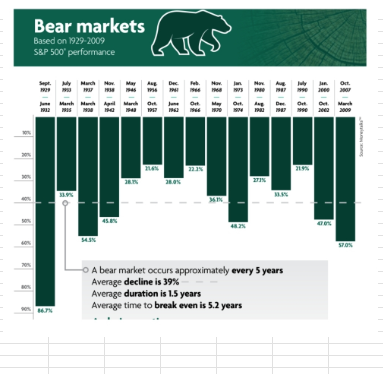
As this chart shows, bear markets aren't "once-in-a-lifetime" events; they happen roughly every five years. If it takes an average of 5.2 years to break even after a downturn, and the downturns happen every five years, many investors spend their entire adult lives in a perpetual state of "Back to Even."
2. Average Returns (The Lie) vs. Actual Returns (The Life)
Wall Street marketing is built on the "Lie of the Average."
If a broker tells you a fund has an "average annual return of 7%," that sounds great. But "average" is a mathematical ghost. Imagine a scenario where you lose 50% in Year 1 and gain 50% in Year 2.
Your Average Return is 0% (-50 + 50 divided by 2).
Your Actual Return is a 25% loss. (If you started with $100, you dropped to $50, then gained 50% of $50, leaving you with $75).
You can’t spend "averages" in retirement. You spend "Actuals."
This is why we focus on Compounding Efficiency. When you eliminate the negative years with a 0% Floor, every gain is a real gain from a higher baseline. You stop the "two steps forward, one step back" dance that keeps most retirees in a state of financial fatigue.
3. The Time Leak: You Can’t Buy Back the Years
The most expensive thing in your retirement plan isn't the management fee or the taxes: it’s the Time Leak.
When your portfolio drops, you lose more than just money. You lose the 5–7 years it takes to recover. In your 30s, you can ignore this. In your 60s, those 5–7 years represent your "Go-Go" years: the window where you have the health and energy to actually enjoy the wealth you've built.
Spending your first decade of retirement just trying to get back to the account balance you had on your last day of work is a tragedy of design. It’s the result of using "single-pillar" assets: like traditional stocks or real estate: that require you to take on 100% of the risk in exchange for a hope and a prayer.
We view financial planning as an engineering challenge, not a cheering section for the S&P 500. By using Fully Performing Assets (FPA), we consolidate multiple pillars of value (growth, protection, income) into one vehicle. It’s the "smartphone" of finance. Why use a Rolodex (traditional banking/brokerage) in a SpaceX world?

4. Sequence of Returns Risk: The Permanent Life Sentence
This is the "Silent Killer" of retirement plans. Sequence of Returns Risk is the danger that the market will tank right as you start taking withdrawals.
If you lose 30% of your portfolio while you are simultaneously pulling 4% out for living expenses, you aren't just down 30%. You are effectively hollowing out the foundation of your plan. You are "spinning sharp knives" with your future.
A loss early in retirement can be a permanent life sentence for your lifestyle. It forces you to spend less, worry more, and constantly check the "Fear Meter" on the news.
Contrast this with the Your Street Strategy. By engineering a Sequence of Return Margin™, we ensure that your income isn't tied to the daily whims of a volatile market. We use a Volatility Recovery Analysis™ to identify exactly where your current plan would break and then we build a bridge over that gap.
Architecture vs. Participation
Wall Street wants you to "Participate." They want you addicted to the noise, the headlines, and the constant buying and selling. Why? Because participation requires their "management," which keeps their fees flowing regardless of whether you are winning or losing.
We prefer Performance. Specifically, Engineered Performance.

Instead of "Participation" (gambling), we use Asset Liability Management (ALM): the same institutional-grade engineering used by major banks. We categorize assets into four categories:
Non-Performing Assets (NPA): Your cash and emergencies (Infants).
Assets at Risk (AAR): Traditional stocks and bonds (Teens: high maintenance and unpredictable).
Under-Performing Assets (UPA): Low-yield, high-fee relics.
Fully Performing Assets (FPA): The foundation of a Your Street plan.
FPA provides Uncapped Gains (UCG) and Expanded Market Participation (EMP). This isn't the "3% cap" nonsense your broker might have warned you about. This is a 110%–200% multiplier on market gains with a contractual 0% floor.
If the market goes up 10%, you might see 11% or 12% via EMP. If the market goes down 30%, you see 0%. You stay at the top of the hill while everyone else is sliding back down to the bottom.
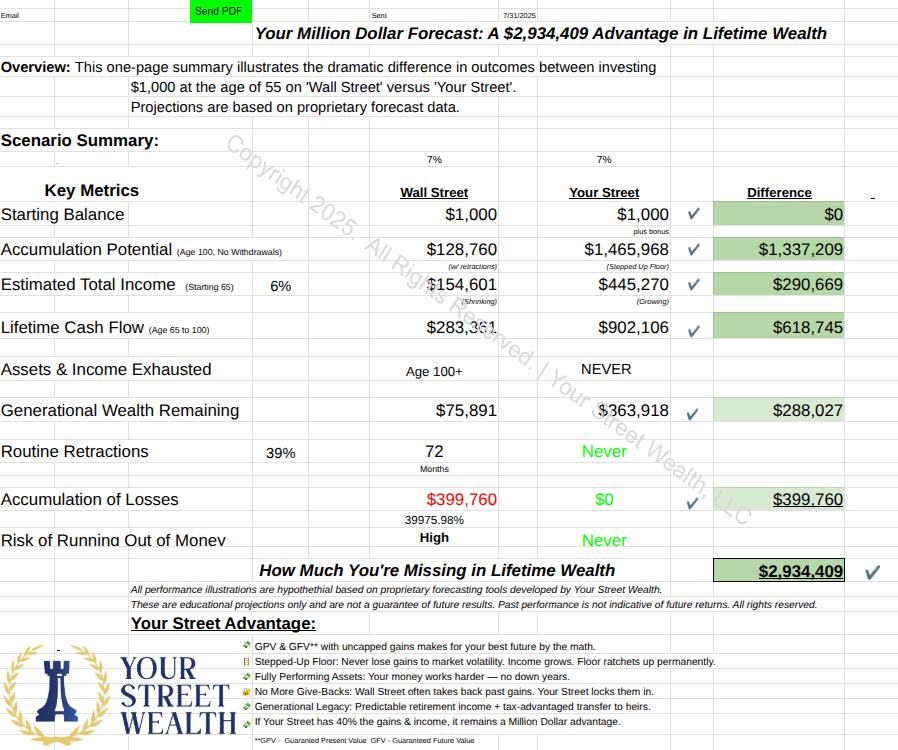
The Margin Audit™: Finding the Leaks
Most retirement plans are full of "Future Liens": hidden costs, taxes, and volatility gaps that will be called due exactly when you can least afford them.
The Margin Audit™ is how we find these leaks. We don't guess; we engineer. We look at your "Compounding Efficiency" and ask: If the market has a "lost decade," what happens to your ability to take your grandkids to Disney?
If you don't know the answer to that question with mathematical certainty, you aren't planning; you’re participating in a false architecture.
Peace is the path, and wisdom is the way. You’ve worked too hard to let a bad sequence of returns or a "Back to Even" trap steal the time you’ve earned. It’s time to move from a plan based on "What If" to a plan based on "What Is."
Your Money, Your Rules, In Your Time, On Your Street.
Are You Ready for a Volatility Recovery Analysis?
The traditional "buy and hold" model was a durable solution for the Reagan era, but it is a "Rolodex in a SpaceX world" today. The complexity of modern markets requires a higher standard of engineering.
We offer a high-friction, high-clarity professional service called the Million Dollar Hour™. This is not a "free consultation" designed to sell you a product. It is a $995 institutional-grade Engineering and Margin Audit designed for Quiet Builders who want to unlearn the myths of Wall Street and learn the fundamental architecture of wealth.
In 60 minutes, we provide a Million Dollar Hour™ Forecast that answers the five core questions of your retirement with 100% transparency:
How much reliable income will you have?
Are your gains truly uncapped?
What is your current and future value knowledge?
How is your gain protected?
Is your foundation built on "single-pillar" risk or "multi-pillar" certainty?
If you are tired of the rollercoaster and ready for a scrutinized, certain plan, we are ready to build it with you.
Ready for clarity instead of confusion?
The Million Dollar Hour™ is your educational, one-on-one retirement review that reveals where your plan leads : not just where it’s been.
👉 Schedule your session today.
Discover Which Wealth Killers Are Affecting You
👉 Take the 60-Second Quiz
Most people are impacted by 6–9 and don’t realize it
Wealth Killer #1: The Granddaddy : Why Market Volatility is Your Retirement’s Greatest Enemy
Concerned about market losses, taxes, or income reliability?
Take the 7 Question Retirement Stress Test →
You can keep participating… Or you can finally see the outcome. The Million Dollar Hour™ shows you exactly:
✔ Where you are ✔ Where you’re going ✔ How to fix the gaps 👉 Book your session now
Check out the Retirement Blueprint