
Retirement Strategies That Maximize Income, Eliminate Risk, and Help Ensure You Never Run Out of Money How to Achieve The Retirement Future Everyone Seeks
Most retirement plans are built on assumptions that no longer hold up—market averages, predictable tax rates, and the belief that time will always recover losses. But as you approach or enter retirement, the rules change. What worked during your accumulation years can become a liability during the withdrawal phase.
This blog is designed to help you rethink traditional strategies and discover a more engineered approach to retirement income—one focused on certainty, efficiency, and control.
Here, you’ll learn how to reduce or eliminate the biggest threats to your financial future, including market losses, rising taxes, hidden fees, and the silent erosion caused by lost time. We break down complex financial concepts into clear, actionable insights so you can make better decisions about your 401(k), IRA, and retirement income strategy.
You’ll also discover why many conventional approaches—like relying on average returns or the 4% rule—can expose you to unnecessary risk, especially when withdrawals begin. Instead, we explore strategies designed to protect your principal, improve compounding efficiency, and create predictable income streams that last.
Our focus is on helping you transition from “assets at risk” to a more stable and structured approach using fully performing assets—where growth, income, and protection work together instead of against each other.
Whether you’re still working or already retired, the goal is simple:
help you keep more of what you earn, generate more reliable income, and build a plan that doesn’t depend on hope, timing, or market luck.
If you’ve ever wondered:
* How to create tax-efficient retirement income
* How to avoid sequence of returns risk
* How to reduce fees and increase net returns
* How to design income that doesn’t run out
—you’re in the right place.
Explore the articles below and start building a retirement strategy based on engineering, not guesswork.

401(k) vs. FPA: Why Doing Nothing is Your Riskiest Move
The Peter Pan Choice: Why "Doing Nothing" is the Riskiest Move You’ll Ever Make
One of the fastest ways to uncover hidden risk is to take our 7 Question Retirement Stress Test.
![[HERO] The Peter Pan Choice: Why "Doing Nothing" is the Riskiest Move You’ll Ever Make](https://cdn.marblism.com/cUohAe6jEHf.webp "[HERO] The Peter Pan Choice: Why \"Doing Nothing\" is the Riskiest Move You’ll Ever Make")
Start here: See what your retirement actually looks like → 👉 Book Your Million Dollar Hour™
401(k) vs. FPA: Why Doing Nothing is Your Riskiest Move
In the classic tale, Peter Pan makes a choice that seems, on the surface, quite enviable. He chooses eternal youth, zero responsibility, and a life of play in Neverland. He avoids the "pain" of growing up. But as anyone who has actually read the original story knows, that choice comes with a devastating price. By refusing to grow up, Peter becomes stagnant. He loses the ability to truly connect, to evolve, and eventually, he loses Wendy.
In the world of financial planning, most Americans are currently playing the role of Peter Pan.
They are clutching their 401(k) statements like a handful of pixie dust, hoping that if they just "think happy thoughts" (or stay the course), they’ll eventually fly into a secure retirement. But here’s the reality: staying the course is often just a fancy way of saying "I’m choosing to do nothing."
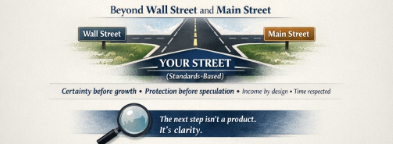
At Your Street Wealth, we call this Informed Inertia. It’s the moment you learn the mathematical truth about your path, realize the bridge ahead is out, and decide to keep driving anyway because turning the wheel feels like too much work.
The 2026 Benchmark Trap: Are You "Average" or Are You Safe?
As we move through April 2026, the data is in. According to the latest Vanguard and Fidelity benchmarks, 401(k) balances are rising with age. On paper, it looks like progress. But "average" is a dangerous place to be when you're dealing with Wall Street's volatility.
Here is what the "average" 401(k) participant looks like right now:
Gen Z: $17,900
Ages 25-34: $42,640
Ages 35-44: $103,552
Ages 45-54: $188,643
Ages 55-64: $271,320
Baby Boomers: $270,000+
If you are in that 55-64 bracket with $271,000, Wall Street tells you that you’re doing "fine." You’re above average! But let’s apply some adult logic. If you pull 4% a year for income (the old-school rule), that’s $10,840 a year.
Does $900 a month feel like a "Fully Performing" retirement to you?
The problem is that a 401(k) is a "Peter Pan" asset. It refuses to grow up. It has no maturity date. It has no guarantee of principal. It’s a "Single-Pillar" traditional asset that is high-risk, high-fee, and entirely dependent on market sentiment. It’s a Rolodex in a SpaceX world: a tool that worked in the 1980s but is woefully inadequate for the speed and technical demands of 2026.
The Power of Informed Inertia
When we sit down with a "Quiet Builder" for a Million Dollar Hour™ Forecast, we perform what’s called a Margin Audit™. We look at the P+R+T equation (Principal, Rate, and Time) to see where your current path actually leads.
Sometimes, a client sees the math: they see the "Time Leak," the hidden fees, and the "Math of Recovery" (the fact that a 30% loss requires a 42% gain just to get back to zero): and they still choose to change nothing.

Frank Day always says: "If you learn the truth and change nothing, at least you’ve made an informed decision."
⚠️ If this applies to you… your retirement may already be at risk.
There is a certain dignity in that. Most people are failing by accident. They are victims of a "False Model" driven by Wall Street’s greed and fear. If you choose to fail on purpose because you prefer the familiarity of your current plan, that’s your prerogative. But as Frank also points out, it’s not likely: unless you are Peter Pan: to change nothing once you see the engineering behind the curtain.
Participation vs. Engineered Performance
The reason most people "do nothing" is that they’ve been trained to believe that "doing something" means gambling on a different stock or finding a "hotter" mutual fund. That’s just trading one Neverland for another.
At Your Street Wealth, we don’t move from one "Participation" product to another. We move from Participation to Engineered Performance.
We categorize assets into four clear buckets:
AAR (Assets At Risk): Your typical 401(k) or brokerage account. These are "Teens": erratic, unpredictable, and prone to emotional outbursts.
NPA (Non-Performing Assets): Cash under the mattress or in low-yield savings. These are "Infants": they need protection and don't contribute much to the household yet.
UPA (Underperforming Assets): Assets that have some growth but are being eaten alive by fees or taxes.
FPA (Fully Performing Assets): The "Adults." These are multi-pillar assets that provide growth, protection, tax efficiency, and guaranteed income.
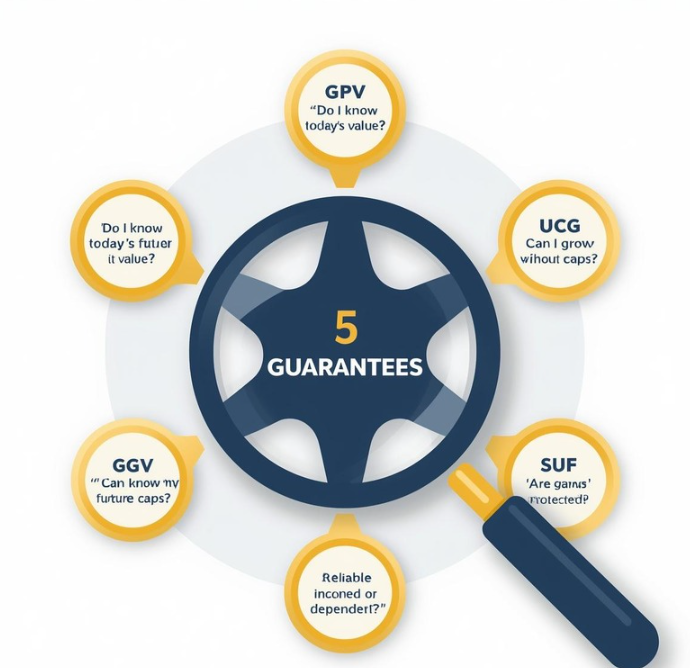
An FPA is like the "smartphone" of finance. Remember when you had a pager, a camera, a GPS, and a phone? Now you just have one device. A Fully Performing Asset consolidates 5 to 15 "pillars" of value: such as Uncapped Gains (UCG), Expanded Market Participation (EMP), and LTC protection: into a single, engineered vehicle.
The Rule of 1000 vs. the Rule of 100
You’ve probably heard of the "Rule of 72" and the "Rule of 100." One is a shortcut for estimating doubling time. The other is a tool for deciding how much market risk may belong in a portfolio. But the real issue is not the formula. It’s whether you are using a rule to act responsibly, or using no rule at all.
That’s where the Rule of 1000 comes in. In practice, it often becomes the Rule of Irresponsibility: the default setting people drift into when they let their money float in the Peter Pan zone with no real plan, no maturity design, and no end date. It’s financial Neverland. Money stays in motion, statements keep arriving, and everyone pretends that participation is the same thing as progress.
Here’s the punchline: the Rule of 1000 fundamentally says, "Time doesn’t matter." And Wall Street loves that idea. Why? Because if time doesn’t matter, then lost years don’t matter. Delays don’t matter. Recovery time doesn’t matter. You just stay passive, keep contributing, keep hoping, and ignore the ticking clock. It is a perfect sales tool for a false model built on participation, because it trains people to act like they have forever.
But you don’t have forever. Time is your most precious asset because it is the only one you can spend without getting it back. That is why the Million Dollar Hour™ Forecast starts with time, not headlines. We forecast forward so you can see where your current path really ends, then we look back from that future point to identify which better decisions today would have protected more time, preserved more wealth, and created more certainty. That is the core logic of responsible planning.
By contrast, the Rule of 100 is the tool for the responsible adult. It forces a planning conversation. It gives you a way to forecast forward, see the future you are heading toward, and then look back from that future point to ask a much better question: Which decisions today would have helped me most? That "forecast forward, then look back" process is the core logic of the Million Dollar Hour™ Forecast.
That is also where The Margin Audit™ becomes so valuable. We don’t just ask whether your money is growing. We ask whether it is growing efficiently enough, safely enough, and predictably enough to support the life you want later. We measure Sequence of Return Margin, expose weak spots, and show how Participation vs. Engineered Performance changes the outcome.
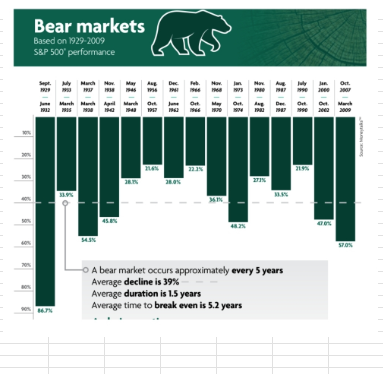
When you look at the S&P 500 Bear Markets chart, you see a sobering reality: bear markets happen every 5 years on average, with average losses of 39%. If you are "doing nothing" in a 401(k), you are essentially choosing to lose 5.2 years of your life every time the market catches a cold. That is The Math of Recovery at its most brutal.
The Architecture of Certainty
Successful retirement isn't about chasing macro headlines or guessing which way the Fed will pivot. It’s built on micro margins. It’s about a Volatility Recovery Analysis that ensures you never have to "recover" because you never took the hit in the first place.
While Wall Street uses hidden complexity to keep you addicted to daily research and "rebalancing," we use engineering to create clarity. We shift the focus from "opportunity" (which is just another word for "risk") to "architecture."
A designed process grows and heals. A "Participation" plan merely extracts value and creates hidden harm.
If you are a "Quiet Builder": someone who has worked hard, accumulated a decent nest egg (perhaps hitting those 2026 benchmarks), but feels a sense of financial fatigue: it’s time to stop being Peter Pan. It’s time to leave Neverland and step onto Your Street.
What Happens in a Million Dollar Hour™?
We don't offer "free" consultations that are actually just sales pitches for the flavor of the month. The Million Dollar Hour™ is a $995 professional engineering session. It is a high-friction, high-clarity audit for people who are tired of "guessing" and ready for "knowing."
In that one hour, we:
Perform a Margin Audit™ on your current trajectory.
Calculate your Compounding Efficiency.
Show you a side-by-side Forecast of your current "Peter Pan" path versus an "Engineered FPA" path.
Identify the "Wealth Killers" (fees, taxes, and inflation) that are leaking out of your bucket.
Peace is the Path, Wisdom is the Way
Doing nothing is a choice. It is the choice to remain a "participant" in someone else's game. It is the choice to accept "average" balances that may or may not be there when you actually need to spend them.
But if you’re ready to unlearn the myths of Wall Street and learn the fundamental architecture of wealth, there is a better way. You can have a plan where your money follows your rules, in your time, on your street.
Don't wait until the "Expiration of Time" to find out your plan was never designed to get you home. Schedule your Forecast. Get the math. Even if you choose to change nothing, at least you'll be the person who knew the truth and chose their path anyway.
But we suspect that once you see the difference between spinning sharp knives and standing on a solid foundation, you’ll be ready to grow up.
Ready for clarity instead of confusion?
The Million Dollar Hour™ is your educational, one-on-one retirement review that reveals where your plan leads : not just where it’s been.
👉 Schedule your session today.
Discover Which Wealth Killers Are Affecting You
Most people are impacted by 6–9 and don’t realize it
Wealth Killer #1: The Granddaddy : Why Market Volatility is Your Retirement’s Greatest Enemy
Concerned about market losses, taxes, or income reliability?
Take the 7 Question Retirement Stress Test →
You can keep participating… Or you can finally see the outcome. The Million Dollar Hour™ shows you exactly:
✔ Where you are ✔ Where you’re going ✔ How to fix the gaps 👉 Book your session now
Check out the Retirement Blueprint