
Retirement Strategies That Maximize Income, Eliminate Risk, and Help Ensure You Never Run Out of Money How to Achieve The Retirement Future Everyone Seeks
Most retirement plans are built on assumptions that no longer hold up—market averages, predictable tax rates, and the belief that time will always recover losses. But as you approach or enter retirement, the rules change. What worked during your accumulation years can become a liability during the withdrawal phase.
This blog is designed to help you rethink traditional strategies and discover a more engineered approach to retirement income—one focused on certainty, efficiency, and control.
Here, you’ll learn how to reduce or eliminate the biggest threats to your financial future, including market losses, rising taxes, hidden fees, and the silent erosion caused by lost time. We break down complex financial concepts into clear, actionable insights so you can make better decisions about your 401(k), IRA, and retirement income strategy.
You’ll also discover why many conventional approaches—like relying on average returns or the 4% rule—can expose you to unnecessary risk, especially when withdrawals begin. Instead, we explore strategies designed to protect your principal, improve compounding efficiency, and create predictable income streams that last.
Our focus is on helping you transition from “assets at risk” to a more stable and structured approach using fully performing assets—where growth, income, and protection work together instead of against each other.
Whether you’re still working or already retired, the goal is simple:
help you keep more of what you earn, generate more reliable income, and build a plan that doesn’t depend on hope, timing, or market luck.
If you’ve ever wondered:
* How to create tax-efficient retirement income
* How to avoid sequence of returns risk
* How to reduce fees and increase net returns
* How to design income that doesn’t run out
—you’re in the right place.
Explore the articles below and start building a retirement strategy based on engineering, not guesswork.

: Best Retirement Income Strategies: Avoiding the FOMO Trap
The FOMO Trap: Why Wall Street Wants You Greedy (And the 'Facts of Maxxing Out')
One of the fastest ways to uncover hidden risk is to take our 7 Question Retirement Stress Test.
![[HERO] The FOMO Trap: Why Wall Street Wants You Greedy (And the 'Facts of Maxxing Out')](https://cdn.marblism.com/VYe_I9sTLoV.webp "[HERO] The FOMO Trap: Why Wall Street Wants You Greedy (And the 'Facts of Maxxing Out')")
Start here: See what your retirement actually looks like → 👉 Book Your Million Dollar Hour™
Stop Being Wall Street’s "Exit Liquidity": The FOMO Trap
FOMO. Fear Of Missing Out.
On Wall Street, FOMO is a feature, not a bug. It is the high-octane fuel that drives the market to its peaks. It’s the Greed that makes you look at your neighbor’s gains, your brother-in-law's "hot tip," or the latest AI-driven rally and think, “I’d be an idiot not to be all-in right now.”
But here is the reality Wall Street won’t tell you: You cannot experience the peaks without the mirroring valleys. The accounting must always balance in a Win/Lose platform. For every 1929-style collapse, there are recurring 18-month "micro-losses" of 10% to 20% that quietly erode your most valuable asset: Time.
In the Wall Street machine, gains are speculative, but losses are reliable. It’s time to move past the binary choice of "Wall Street vs. Main Street" and find the tertiary path. Welcome to Your Street.
The Mirror of Greed: Why Peaks Always Have Valleys
Wall Street thrives on false confidence. When the market is at an all-time high, they encourage you to be 100% invested, illiquid, and "patient." They call it "long-term investing." We call it being a victim to the timing of Wall Street.
Think about the cycle. The peaks are driven by Greed (FOMO). The valleys are driven by Fear. But the Wall Street Titans don’t play by those rules. They buy at the bottom of the valleys and sell to the masses at the peak of Greed. They are the ones taking the profit while you are told to "stay the course" into the next 20% drawdown.

When you stay 100% exposed at the peak, you are inviting Sequence of Returns Risk: the professional assassin of retirement wealth. If you hit a market crash right as you start taking income, your "long-term" plan doesn't just bend; it breaks. Money can recover. Time never does.
The Vegas Rule: Taking Your Winnings Off the Table
Imagine you’re in Las Vegas. You sat down at a table with $10,000, and through a stroke of luck, you’re now up to $100,000. Would you leave every single dollar on the table and bet it all on the next spin?
Of course not. You’d take your original $10,000 plus a healthy chunk of the profit and put it in your pocket. You’d play the rest with "house money."
Yet, when it comes to retirement, most people leave 100% of their winnings on the table every single day. They allow Wall Street to keep the keys to their entire life savings.
To protect retirement savings from market crash, you must apply the Rule of 100 or, even better, the Rule of 50.
The Rule of 100: Subtract your age from 100. That is the maximum percentage you should have at risk.
The Rule of 50: Subtract your age from 50. If you are 60 years old, that means you should have -10% at risk: meaning you should be in total safety with a focus on guaranteed growth.
Take your profits off Wall Street before Wall Street takes them back. Now is the time. Today is the day. You cannot keep doing what you are doing and expect a different outcome.

The Math of Recovery: Why 0% is a Hero
Wall Street loves to talk about "average returns." But you don't spend averages; you spend actual dollars. If your portfolio drops 30%, you don't need a 30% gain to get back to even. You need a 42.8% gain just to see the surface again.
That is the Math of Recovery. While you are waiting for that 42.8% gain to happen, you aren't just losing money: you are losing the compounding power of time. This is why we focus on Volatility Recovery Analysis.
There is an alternative to the traditional FOMO. We call it the Facts Of Maxxing Out.
Fact: You can lose ZERO money.
Fact: You can lose ZERO time.
Fact: You can participate in the gains without being a victim of the losses.
The Strategy Triangle: FIAAR vs. The Binary Trap
Most investors think the choice is binary: Wall Street (Stocks/Bonds) vs. Main Street (Real Estate/Savings). This is a trap. We believe in a tertiary choice: Your Street.
To navigate this, we use the Strategy Triangle (FIAAR):
Foundation: Guaranteed safety.
Income: Reliable, increasing cash flow.
Assets: High-performance, low-leakage vehicles.
Architecture: A rules-based design.
Results: Performance over participation.
Your decision should not be based on market noise, but on an engineered, guaranteed path. Wall Street uses hidden complexity to keep you addicted to daily research and the "spinning sharp knives" of interest-rate ripples. We use institutional-grade engineering to build a structure that stands regardless of the market cycle.

The Asset Triangle: UPA, NPA, and FPA
Not all assets are created equal. We categorize them into three groups:
UPA (Under-Performing Assets): These are your "Teens": high-risk, high-fee, and often declining in utility as you age.
NPA (Non-Performing Assets): These are your "Infants": cash or emergency funds that sit idle, losing value to inflation. They have a single mono-pillar of value: liquidity.
FPA (Fully Performing Assets): This is the foundation.
Traditional assets like banks, stocks, and real estate are "single-pillar" assets. They do one thing, often with high fees and high risk. They are a Rolodex in a SpaceX world.
Fully Performing Assets (FPA) are the "smartphones" of finance. Just as your phone consolidated your pager, camera, map, and computer into one device, an FPA consolidates 5 to 15 "pillars" of value: growth, protection, tax-free income, and long-term care: into one vehicle.
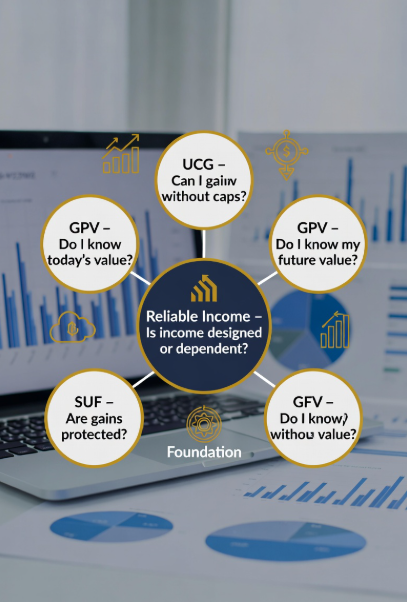
With FPAs, you get Uncapped Gains (UCG) and Expanded Market Participation (EMP). Imagine a 110% to 200% multiplier on your gains, while your floor is locked at 0%. If the market goes up 10%, you might see 15%. If the market goes down 30%, you see 0%.
0% to 30% (Your Street) beats -30% to +30% (Wall Street) every single time the math is run.

The Margin Audit™: Engineering Your Certainty
You have spent 40 years accumulating wealth. Why spend the next 40 years worrying about whether a "Sequence of Returns" event will wipe out your legacy?
You can estimate your income needs, but you cannot predict future portfolio value when losses and leaks (fees and taxes) are uncontrollable. This is why a retirement plan review must go deeper than a simple "allocation" check. You need a Margin Audit™.
Wealth is built on micro margins, not macro headlines. We audit the gaps where your money is leaking out to the Titans and the Taxman. We shift you from "Participation" (hoping the market works) to "Performance" (engineering the outcome).
Only 2% of investors win the Wall Street game long-term. The other 98% are just exit liquidity for the banks. It’s time to decide which group you belong to. It’s your money, your rules, in your time, on your street.
Facts Over Fear
The "Fear of Losing Out" is the real fear you should have: the fear of losing the time you’ve worked so hard to buy. You cannot keep using the same thinking that got you into this "Silo Trap" if you want a better outcome.
Find the tertiary choice. Build on poly-pillars. Move your money from the platform where you are a victim of timing to the platform where you are the architect of certainty.
Peace is the path, wisdom is the way.
Ready for clarity instead of confusion?
The Million Dollar Hour™ is your educational, one-on-one retirement review that reveals where your plan leads : not just where it’s been.
👉 Schedule your session today.
Discover Which Wealth Killers Are Affecting You
Most people are impacted by 6–9 and don’t realize it
Wealth Killer #1: The Granddaddy : Why Market Volatility is Your Retirement’s Greatest Enemy
Concerned about market losses, taxes, or income reliability?
Take the 7 Question Retirement Stress Test →
You can keep participating… Or you can finally see the outcome. The Million Dollar Hour™ shows you exactly:
✔ Where you are ✔ Where you’re going ✔ How to fix the gaps 👉 Book your session now
Check out the Retirement Blueprint