
Retirement Strategies That Maximize Income, Eliminate Risk, and Help Ensure You Never Run Out of Money How to Achieve The Retirement Future Everyone Seeks
Most retirement plans are built on assumptions that no longer hold up—market averages, predictable tax rates, and the belief that time will always recover losses. But as you approach or enter retirement, the rules change. What worked during your accumulation years can become a liability during the withdrawal phase.
This blog is designed to help you rethink traditional strategies and discover a more engineered approach to retirement income—one focused on certainty, efficiency, and control.
Here, you’ll learn how to reduce or eliminate the biggest threats to your financial future, including market losses, rising taxes, hidden fees, and the silent erosion caused by lost time. We break down complex financial concepts into clear, actionable insights so you can make better decisions about your 401(k), IRA, and retirement income strategy.
You’ll also discover why many conventional approaches—like relying on average returns or the 4% rule—can expose you to unnecessary risk, especially when withdrawals begin. Instead, we explore strategies designed to protect your principal, improve compounding efficiency, and create predictable income streams that last.
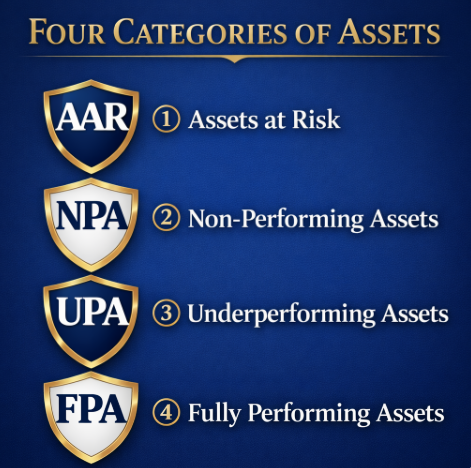
Our focus is on helping you transition from “assets at risk” to a more stable and structured approach using fully performing assets—where growth, income, and protection work together instead of against each other.
Whether you’re still working or already retired, the goal is simple:
help you keep more of what you earn, generate more reliable income, and build a plan that doesn’t depend on hope, timing, or market luck.
If you’ve ever wondered:
* How to create tax-efficient retirement income
* How to avoid sequence of returns risk
* How to reduce fees and increase net returns
* How to design income that doesn’t run out
—you’re in the right place.
Explore the articles below and start building a retirement strategy based on engineering, not guesswork.
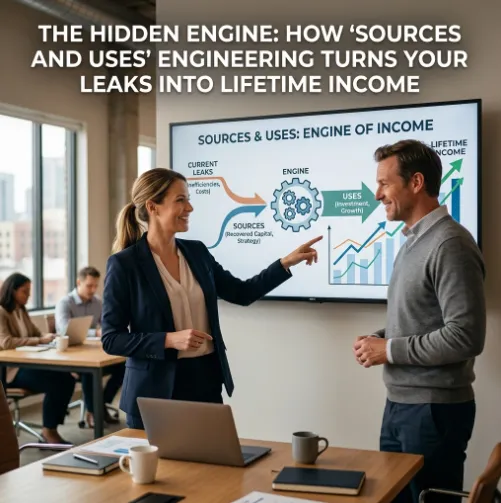
Best Retirement Income Strategies: Sources and Uses Engineering
The Hidden Engine: How 'Sources and Uses' Engineering Turns Your Leaks into Lifetime Income
One of the fastest ways to uncover hidden risk is to take our 7 Question Retirement Stress Test.
![[HERO] The Hidden Engine: How 'Sources and Uses' Engineering Turns Your Leaks into Lifetime Income](https://cdn.marblism.com/p30huV7WtXd.webp "[HERO] The Hidden Engine: How 'Sources and Uses' Engineering Turns Your Leaks into Lifetime Income")
Start here: See what your retirement actually looks like → 👉 Book Your Million Dollar Hour™
Why You’re Paying a $3 Million ‘Voluntary Tax’ to Wall Street (And How to Stop)
Best Retirement Income Strategies: Sources and Uses Engineering
Most people approach retirement planning like a leaky bucket. They spend all their time trying to find a faster faucet: a higher rate of return, a "hot" stock tip, or a slightly better mutual fund: thinking that if they just pour water in fast enough, the bucket will eventually fill up.
But here is the truth that Wall Street won't tell you: It doesn’t matter how fast the water is flowing in if the bottom of your bucket looks like a piece of Swiss cheese.
In the world of institutional-grade banking and asset management, we don’t just look at how much money you’re making. We look at the Sources and Uses of Funds. If your retirement plan is failing, it’s rarely because of the "Sources." It’s almost always because the "Uses" are out of control.
The Great Retirement Misunderstanding: Sources vs. Uses
When we talk about your financial life, "Sources" are where your money comes from. This includes your salary, your Social Security, your 401(k) contributions, and that 7% return you’re hoping the market delivers this year.
"Uses," on the other hand, are where that money goes. Most people think "Uses" just means the mortgage, the groceries, and the occasional trip to see the grandkids. But in a traditional Wall Street model, your biggest "Uses" are often invisible. They are the 11 Wealth Killers: the hidden leaks like taxes, unnecessary fees, market volatility, and the "cost of procrastination."
If you have a $2 million portfolio and you're losing 1% to fees, 2% to hidden inflation, and 3% to "volatility drag" (the math of recovery), you aren't just losing 6%. You are creating a massive "Use" of funds that could have been a "Source" of lifetime income.
The $3 Million "Voluntary Tax"
Let’s look at the math, because the myths will lie to you, but the numbers never do.
One of the most insidious of the 11 Wealth Killers is the cost of missed opportunity: what we often call Wealth Killer #11. When your plan is inefficiently engineered, the gap between what you could have and what you actually have can easily reach $100,000 per year.
Over a 30-year retirement, that is a $3 million gap.
Most people find that number hard to believe. They think, "There’s no way I’m losing $3 million." But that’s because they’ve never seen the math; they’ve only heard the myths. They’ve been told that a "diversified portfolio" is enough. They’ve been told that "hanging in there" during a market crash is a strategy.
It’s not a strategy. It’s a "voluntary tax" you are paying to Wall Street for the privilege of taking all the risk while they take all the fees.
The Circular Game of Loss and Time
This is where most retirement plans quietly break down: not just in losses, but in waiting.
A lot of people think they need more education before they make a move. And yes, education matters. But education without urgency is often just procrastination wearing glasses. It feels responsible while it quietly charges you a voluntary tax on time.
That tax is brutal because money can recover. Time cannot.
This is the Circular Game of Loss and Time. No matter what the market is doing, people stuck in the Wall Street participation model keep waiting for the "right" moment:
When the market is high: they feel safe, so they wait. They think, "Why change now? Everything looks fine." But that often means they fail to capture gains into a Fully Performing Asset (FPA) before the next fall. They stay exposed, and the clock keeps running.
When the market is down: they wait for the recovery. They tell themselves, "I’ll move when it comes back." But recovery is not guaranteed on their timeline. It may take years. It may stall. It may drop further. That means more sequence risk, more lost compounding efficiency, and more lost time.
When the market is sideways: they wait for "something to happen." No crisis. No breakout. Just drift. And drift is expensive when you don’t know what to do next. Sideways markets often create invisible damage because they keep people frozen while inflation, fees, and uncertainty keep eating away at the plan.
Three different market conditions. Same result: waiting.
That is the casino mindset. People sit at the table waiting for a big day, a better headline, a cleaner entry point, or some magical signal that finally makes the future feel certain. But retirement architecture is not built on a lucky spin. It is built on rules, precision, and timing that protects both wealth and years.
This is why Participation vs. Engineered Performance matters so much. Participation says, "Wait and see." Engineered performance says, "Measure the gap, fix the leak, protect the time."
The real problem is not just loss. It is the loop:
loss creates fear, fear creates waiting, waiting creates more lost time, and lost time makes the next decision even harder.
That is why we use The Math of Recovery and The Margin Audit™ together. The Math of Recovery shows how hard it is to climb back after a drop. The Margin Audit™ shows where waiting is costing you money, income, and years you cannot buy back.
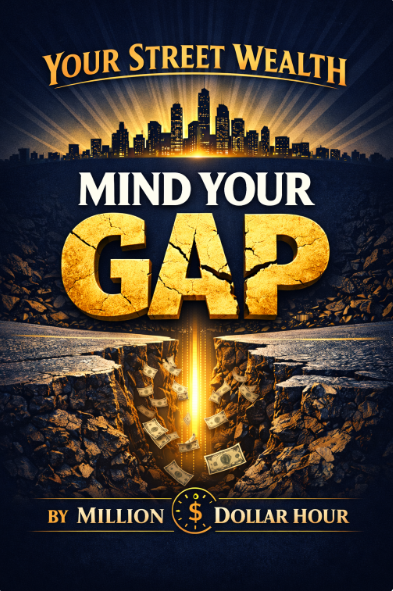
Every second spent waiting is a second that cannot be recovered. That is why "Mind Your Gap" is more than a graphic. It is a warning. The gap between what you have and what your plan could be doing does not stay still. In a false model driven by fear and greed, the gap widens while people wait.
⚠️ If this applies to you… your retirement may already be at risk.
Participation vs. Engineering: Are You a Gambler or an Architect?
The fundamental difference between how most people "do" retirement and how we design it at Your Street Wealth comes down to one distinction: Participation vs. Engineering.
Wall Street wants you to be a Participant. They want you to "participate" in the market's upside (while quietly ignoring the downside). They want you to participate in their latest products. Participation is passive. It’s gambling disguised as investing. It relies on "hope" as a primary strategy.
We prefer Engineering.
An Architect doesn’t "hope" a bridge stays up; they engineer it to withstand the wind, the weight, and the weather. In your retirement, "Uses" engineering means we perform a Margin Audit™ to identify exactly where your wealth is leaking. We look at your "Volatility Recovery Analysis": the fact that a 30% loss requires a 42% gain just to get back to zero: and we engineer a way to remove the loss from the equation entirely.

The "Smartphone" of Finance: Moving to Fully Performing Assets
In the 1980s, if you wanted to make a call, you used a phone. If you wanted to page someone, you had a pager. If you wanted to take a photo, you had a camera. These were "single-pillar" tools.
Traditional retirement assets: like basic stocks, bonds, or savings accounts: are "single-pillar" assets. They do one thing, usually poorly, and they often come with high risks or high fees. We call these Assets at Risk (AAR) or Underperforming Assets (UPA).
Modern financial engineering has moved past the "Rolodex" era. We now utilize Fully Performing Assets (FPA). Think of FPA as the "smartphone" of your wealth. Just as your phone consolidated your camera, pager, map, and phone into one device, an FPA consolidates 5 to 15 "pillars" of value into one vehicle:
Uncapped Gains (UCG): The ability to grow when the market grows.
Expanded Market Participation (EMP): Using multipliers (110%–200%) to grow faster than the index itself.
Protection of Principal: A contractual floor of 0%, so you never pay the "math of recovery" tax.
Tax-Free Income: Engineering your "Uses" so the IRS isn't your biggest beneficiary.
When you move your money from "Assets at Risk" to "Fully Performing Assets," you aren't just changing a ticker symbol. You are re-engineering the engine of your life.
The Margin Audit™: Finding the "Lost" Money
The most exciting part of this engineering approach is that we don’t necessarily need you to find "new" money to save. We just need to stop the "Uses" that are currently killing your wealth.
When we eliminate the 11 Wealth Killers, we are effectively "finding" money you were already losing. This recovered capital becomes your most powerful source of growth. Because it’s money you already had, it doesn’t require a change in lifestyle: it just requires a change in Architecture.
If we find $50,000 a year in "leaks" (fees, taxes, volatility drag, and inefficiency) and redirect that into an FPA with Uncapped Gains, the compounding efficiency of your plan doesn't just improve: it transforms. You move from a state of "Financial Fatigue" to a state of "Certainty."
Stop Chasing the Macro, Start Engineering the Micro
Wall Street wants you obsessed with the macro headlines: the Fed's next move, the election, the global economy. Why? Because as long as you’re looking at the big, scary headlines, you aren't looking at the micro margins of your own plan where they are making their money.
Wealth isn't built on macro headlines. It’s built on micro margins.
It’s built on knowing your Sequence of Return Margin. It’s built on Volatility Recovery Analysis. It’s built on ensuring that your "Uses" of funds are as efficient as humanly possible.
You can try to protect your retirement savings from a market crash by "diversifying" (which often just means losing money in five different directions at once), or you can engineer a plan where a market crash is a non-event.
The Beneficiary Tax: Why Urgency is an Act of Love
Education matters. It builds credibility. It helps people see the false model, understand the leaks, and finally make sense of Participation vs. Engineered Performance. That part is important.
But education alone is not the reason to move.
The deeper reason is what happens to the people you love if you stay stuck in the Circular Game of Loss and Time.
Every year spent waiting is not just a hit to your own retirement lifestyle. It is a direct tax on your legacy. It is a quiet subtraction from what your children, grandchildren, church, or favorite charities might one day receive. If your Million Dollar Hour™ Forecast reveals a $3 million gap, that is not just a planning problem. That is $3 million your beneficiaries will never see because of a decision to "wait and see."
That is why waiting is never neutral. Waiting is a choice. And in many cases, it is a choice that heirs end up paying for.
This is where urgency becomes more than emotion. It becomes stewardship. It becomes love expressed through architecture, not hope. You are not just protecting your income. You are protecting the transfer of everything your work was supposed to accomplish.
Education is for credibility, Urgency is for beneficiaries.
That line matters because it tells the truth. Learning gives you confidence in the strategy. Acting protects the people behind the strategy.
So yes, understand the math. Learn The Math of Recovery. See the leaks in The Margin Audit™. But do not confuse understanding with action. Every year left inside a false Wall Street model can become a permanent reduction in the legacy you leave behind.

Your Next Step: The Million Dollar Hour™
Most people spend more time planning a two-week vacation than they do engineering the 30-year "vacation" that is retirement. They settle for being "Participants" when they should be "Architects."
If you’re a Quiet Builder: someone who has done the work, saved the money, but feels an uneasy sense that the traditional Wall Street model is failing you: it’s time for a different conversation.
We don't do "free consultations" that are just thinly veiled sales pitches. We provide a high-friction, high-clarity professional service called the Million Dollar Hour™ Forecast. For a $995 engineering fee, we perform a full Margin Audit™ on your current plan. We look at the "Sources and Uses" of your funds, identify which of the 11 Wealth Killers are currently draining your bucket, and show you the math of how to fix it.
In sixty minutes, you can unlearn the myths and learn the fundamental financial architecture that will last for the rest of your life.
Stop wondering where the leaks are. Start engineering your certainty.
Peace is the path. Wisdom is the way. Your Money, Your Rules, In Your Time, On Your Street.
Schedule your Million Dollar Hour™ Forecast here.
Ready for clarity instead of confusion?
The Million Dollar Hour™ is your educational, one-on-one retirement review that reveals where your plan leads : not just where it’s been.
👉 Schedule your session today.
Discover Which Wealth Killers Are Affecting You
Most people are impacted by 6–9 and don’t realize it
Concerned about market losses, taxes, or income reliability?
Take the 7 Question Retirement Stress Test →
You can keep participating… Or you can finally see the outcome. The Million Dollar Hour™ shows you exactly:
✔ Where you are ✔ Where you’re going ✔ How to fix the gaps 👉 Book your session now
Check out the Retirement Blueprint