
Retirement Strategies That Maximize Income, Eliminate Risk, and Help Ensure You Never Run Out of Money How to Achieve The Retirement Future Everyone Seeks
Most retirement plans are built on assumptions that no longer hold up—market averages, predictable tax rates, and the belief that time will always recover losses. But as you approach or enter retirement, the rules change. What worked during your accumulation years can become a liability during the withdrawal phase.
This blog is designed to help you rethink traditional strategies and discover a more engineered approach to retirement income—one focused on certainty, efficiency, and control.
Here, you’ll learn how to reduce or eliminate the biggest threats to your financial future, including market losses, rising taxes, hidden fees, and the silent erosion caused by lost time. We break down complex financial concepts into clear, actionable insights so you can make better decisions about your 401(k), IRA, and retirement income strategy.
You’ll also discover why many conventional approaches—like relying on average returns or the 4% rule—can expose you to unnecessary risk, especially when withdrawals begin. Instead, we explore strategies designed to protect your principal, improve compounding efficiency, and create predictable income streams that last.
Our focus is on helping you transition from “assets at risk” to a more stable and structured approach using fully performing assets—where growth, income, and protection work together instead of against each other.
Whether you’re still working or already retired, the goal is simple:
help you keep more of what you earn, generate more reliable income, and build a plan that doesn’t depend on hope, timing, or market luck.
If you’ve ever wondered:
* How to create tax-efficient retirement income
* How to avoid sequence of returns risk
* How to reduce fees and increase net returns
* How to design income that doesn’t run out
—you’re in the right place.
Explore the articles below and start building a retirement strategy based on engineering, not guesswork.

Dunning-Kruger in Retirement: Why Overconfidence Fails
The Dunning-Kruger Retirement: Why What You 'Know' Might Be Killing Your Wealth
One of the fastest ways to uncover hidden risk is to take our 7 Question Retirement Stress Test.
![[HERO] The Dunning-Kruger Retirement: Why What You 'Know' Might Be Killing Your Wealth](https://cdn.marblism.com/dhGfXpqZU7_.webp "[HERO] The Dunning-Kruger Retirement: Why What You 'Know' Might Be Killing Your Wealth")
Start here: See what your retirement actually looks like → 👉 Book Your Million Dollar Hour™
The Dunning-Kruger Trap: Is Your "Market Wisdom" a Retirement Wealth Killer?
There is a psychological phenomenon that is quietly dismantling more retirements than inflation and taxes combined. It’s called the Dunning-Kruger Effect.
In short, it’s a cognitive bias where people with limited knowledge of a topic significantly overestimate their own competence. In the world of social media, it’s often referred to as "Mount Stupid": that peak where you’ve learned just enough to feel like an expert, but not nearly enough to realize you’re standing on a collapsing ledge.
If you’ve spent the last decade watching your 401(k) grow because the S&P 500 has been on a historic tear, you might feel like a financial genius. You’ve seen the green arrows, you’ve checked the apps, and you’ve "participated" in the growth.
But here’s the cold, hard truth: Participation is not Performance.
Wall Street marketing thrives on keeping you on Mount Stupid. They want you to believe that because you understand how to buy a stock or read a basic chart, you are qualified to architect a 30-year distribution plan. They want you to stay addicted to the daily noise because as long as you’re "participating," they are extracting fees.
At Your Street Wealth, we don’t gamble on participation. We build through the Engineering of Certainty.
The View from Mount Stupid: Why "Green Arrows" are Dangerous
The most dangerous time for a "Quiet Builder": those successful, hard-working professionals between 45 and 75: is during a long bull market. When the tide is high, every boat looks like it’s being piloted by a master captain.
Wall Street creates a false sense of confidence by simplifying the complex. They give you a "Rolodex" strategy in a "SpaceX" world. They tell you to "diversify" into a handful of single-pillar assets (stocks, bonds, real estate) and hope for the best.
But hope is not a strategy. It’s a symptom of the Dunning-Kruger effect.
When you are in the "Accumulation Phase," you can afford to be a little bit wrong. If the market drops, you have time and a paycheck to make it up. But as you approach the "Distribution Phase," the rules of physics change. You move from the safety of the ground to the high-wire act of retirement income.
This is where Sequence of Returns Risk becomes a retirement death sentence. If you experience a market crash in the first few years of your retirement, the "Math of Recovery" dictates that you might never break even.
The Math of Recovery: Why Your Brain is Lying to You
Most people think that if they lose 30%, they just need a 30% gain to get back to even. That is a Dunning-Kruger myth.
As we’ve discussed in our Volatility Recovery Analysis, the math is brutal:
A 10% loss requires an 11.1% gain to recover.
A 30% loss requires a 42.8% gain to recover.
A 50% loss requires a 100% gain to recover.
When you factor in the "Sequence of Return Margin": the reality that you are also withdrawing money for living expenses while the market is down: the hole gets deeper. You aren't just losing money; you are losing Compounding Efficiency. You are burning the furniture to keep the house warm.

Wall Street operates on a "False Model" driven by the Greed/Fear meter. When greed is high, they tell you to take more risk. When fear is high, they tell you to "hold on for the long term." Neither of these is an engineered solution. They are psychological nudges designed to keep your money in their system.
The Architect vs. The Participant
At Your Street Wealth, we treat retirement planning like institutional-grade Engineering. We don’t look for "opportunities"; we look for Architecture.
Think about the technology in your pocket. Twenty years ago, you had a phone, a pager, a camera, a GPS, and a Walkman. These were "single-pillar" tools. Today, you have a smartphone: a consolidation of technology that provides 15+ pillars of value in one device.
Most retirement plans are still using the "Rolodex" model. They have:
Banks (NPA - Non-Performing Assets: Low growth, high safety).
Stocks/Mutual Funds (AAR - Assets at Risk: High growth potential, zero protection).
Real Estate (UPA - Under-Performing Assets: Illiquid, high management).
These are single-pillar assets. They do one thing, and they often do it with high fees (1.5%+) and massive exposure to market volatility.
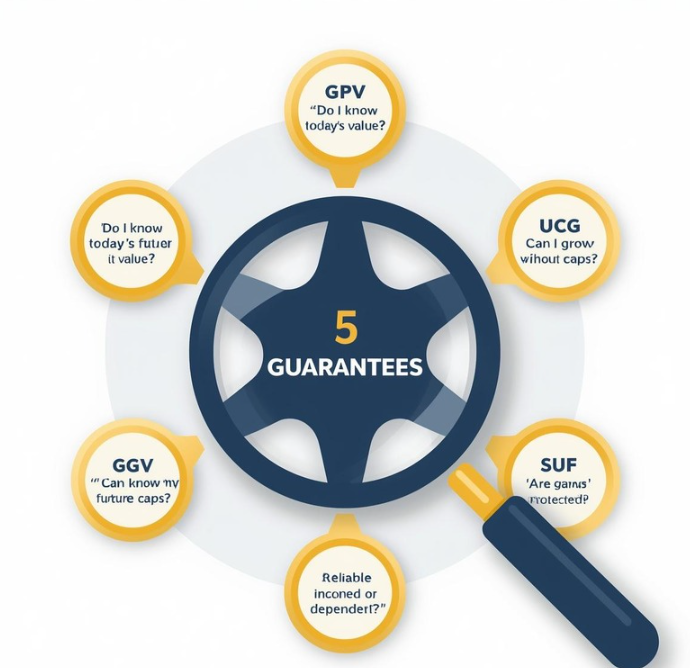
Contrast this with Fully Performing Assets (FPA). This is the "smartphone" of the financial world. An FPA is a multi-pillar asset that can provide 5 to 15 pillars of value within a single vehicle. We’re talking about Guaranteed Retirement Income, tax-free growth, Long-Term Care (LTC) benefits, and Uncapped Gains (UCG) with a floor of 0%.
In an FPA, if the market goes up 20%, you participate (often with a multiplier like Expanded Market Participation that can turn a 10% gain into a 15% gain). But if the market drops 30%? Your account stays at 0%. You never have to deal with the "Math of Recovery" because you never lost the principal.
Why Quiet Builders Need a Professional Audit
The "Quiet Builder" is someone who has spent 30 years mastering their own craft. You are an expert engineer, a skilled surgeon, or a successful business owner. You don't have the time: or the desire: to spend 40 hours a week researching the "spinning sharp knives" of interest-rate ripples or banking architecture.
This is where the Dunning-Kruger effect gets dangerous. Because you are successful in your field, you might assume that success translates to managing complex financial liabilities.
But wealth is built on micro margins, not macro headlines.
Wall Street uses "hidden complexity" to keep you confused. They want you to think you need to watch CNBC every morning. We believe in the Engineering of Certainty. We don't want you to watch the news; we want you to own the "Rules of the Game."
You wouldn't design your own bridge or perform your own heart surgery just because you read a few articles online. Why would you design your own 30-year retirement architecture without a professional Margin Audit™?
The Million Dollar Hour™: Bridging the Gap
We don't chase "mice" looking for free cheese. We work with individuals who understand that true wisdom and certain plans have a price.
The Million Dollar Hour™ is a high-impact, 60-minute retirement plan review designed to bridge the gap between where you are (Mount Stupid) and where you need to be (The Plateau of Sustainability).
In this session, we conduct a full Margin Audit™. We look for the "leaks": the fees, the taxes, and the unnecessary volatility that are draining your wealth. We move you away from "Participation" (gambling on market noise) and toward "Performance" (engineered results).
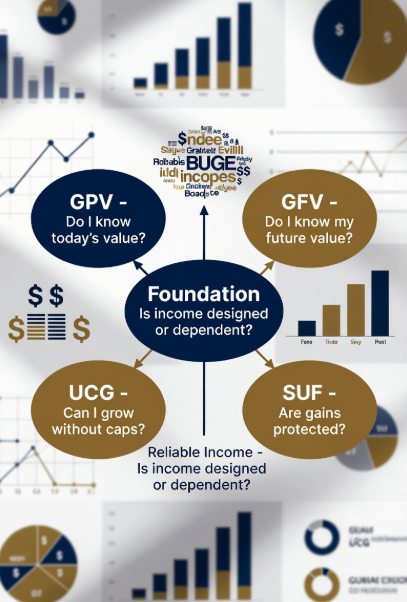
We look at your Asset Pyramid:
Infants (NPA): Emergency cash.
Teens (AAR): Assets at risk that should decline as you age.
Foundation (FPA): The bedrock of your plan that ensures your income is designed, not dependent.
Peace is the Path, Wisdom is the Way
If your current plan relies on the "4% Rule" (which is a myth) or the hope that the market will always go up, you are living in a state of high-friction uncertainty.
You can estimate your income needs, but you cannot predict your future portfolio value when losses and leaks are uncontrollable. Wall Street thrives on that uncertainty. We eliminate it.
Stop "participating" in a system designed to extract value from you. Start engineering a plan that protects your time and your wealth.
It’s time to move off Mount Stupid and onto Your Street.
Your Money, Your Rules, In Your Time, On Your Street.
Ready for clarity instead of confusion?
The Million Dollar Hour™ is your educational, one-on-one retirement review that reveals where your plan leads : not just where it’s been.
👉 Schedule your session today
Discover Which Wealth Killers Are Affecting You
Most people are impacted by 6–9 and don’t realize it
Wealth Killer #1: The Granddaddy : Why Market Volatility is Your Retirement’s Greatest Enemy
Concerned about market losses, taxes, or income reliability?
Take the 7 Question Retirement Stress Test →
You can keep participating… Or you can finally see the outcome. The Million Dollar Hour™ shows you exactly:
✔ Where you are ✔ Where you’re going ✔ How to fix the gaps 👉 Book your session now
Check out the Retirement Blueprint