
Retirement Strategies That Maximize Income, Eliminate Risk, and Help Ensure You Never Run Out of Money How to Achieve The Retirement Future Everyone Seeks
Most retirement plans are built on assumptions that no longer hold up—market averages, predictable tax rates, and the belief that time will always recover losses. But as you approach or enter retirement, the rules change. What worked during your accumulation years can become a liability during the withdrawal phase.
This blog is designed to help you rethink traditional strategies and discover a more engineered approach to retirement income—one focused on certainty, efficiency, and control.
Here, you’ll learn how to reduce or eliminate the biggest threats to your financial future, including market losses, rising taxes, hidden fees, and the silent erosion caused by lost time. We break down complex financial concepts into clear, actionable insights so you can make better decisions about your 401(k), IRA, and retirement income strategy.
You’ll also discover why many conventional approaches—like relying on average returns or the 4% rule—can expose you to unnecessary risk, especially when withdrawals begin. Instead, we explore strategies designed to protect your principal, improve compounding efficiency, and create predictable income streams that last.
Our focus is on helping you transition from “assets at risk” to a more stable and structured approach using fully performing assets—where growth, income, and protection work together instead of against each other.
Whether you’re still working or already retired, the goal is simple:
help you keep more of what you earn, generate more reliable income, and build a plan that doesn’t depend on hope, timing, or market luck.
If you’ve ever wondered:
* How to create tax-efficient retirement income
* How to avoid sequence of returns risk
* How to reduce fees and increase net returns
* How to design income that doesn’t run out
—you’re in the right place.
Explore the articles below and start building a retirement strategy based on engineering, not guesswork.
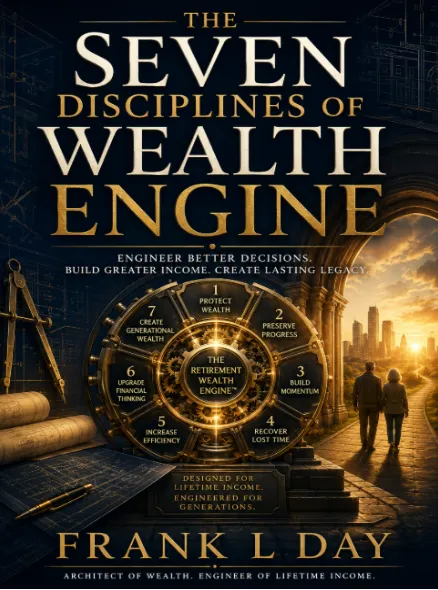
Engineering CBA: Why Wall Street’s Architecture Fails
Engineering CBA: Why Wall Street’s Architecture Fails
Start here: See what your retirement actually looks like → 👉 Book Your Million Dollar Hour™

By Frank L. Day, Inventor of the Million Dollar Hour™ and the Complete Wealth Engineering™ Process. One of the fastest ways to uncover hidden risk is to take our 7 Question Retirement Stress Test.
The Architecture of Extortion: Why Wall Street's Constrained Design Guarantees Financial Failure
The Architecture of Extortion: Why Wall Street's Constrained Design Guarantees Financial FailureWhen you engineer a capability, you must test it to determine its weaknesses, trade-offs, and corresponding Total Cost of Ownership (TCO). In any serious engineering discipline: whether aerospace, bridge building, or institutional banking architecture: you do not leave structural load-bearing capacity to chance, hope, or market sentiment.
Yet, when you don't engineer a capability: which is the standard operating model of Wall Street: it is delivered with one-to-many hidden weaknesses and trade-offs. The result? Exponential increases in your Total Cost of Ownership due to a constrained, fragile architecture.
Any benefits added to traditional Assets at Risk (AAR) come with direct and hidden indirect costs, routinely traded off against incremental fees, tax inefficiencies, and unmitigated market exposure. You pay more to get less, while the architecture silently drains your compounding engine.
1. Disrupt Thinking: The Hidden Costs of Unengineered Systems
In traditional finance, retail investors are handed a collection of single-pillar products: mutual funds, index trackers, and volatile equities: and told to cross their fingers. This is not system design; it is participation without architecture.
When an asset is bolted together without rigorous engineering, every minor adjustment incurs a toll. Advisory fees, transaction costs, management expense ratios, and tax friction accumulate silently. More destructively, the system fails to account for Financial Gravity: the relentless downward pull of market drawdowns, inflation, and sequence of returns risk.

When your balance sheet lacks proper load distribution, volatility does not merely fluctuate your account balance: it fractures your retirement timeline.
2. Reveal Financial Gravity: Assets at Risk and the Mechanics of Decay
Every choice in retirement planning has a mathematical consequence. When capital is trapped in Assets at Risk (AAR), every market retraction triggers a compounding penalty.
As we frequently observe in our forensic audits: The Wealth Killers accompany poorly designed or no design, while the Wealth Builders are value-added synergy to the design of Fully Performing Assets.
Consider what happens when a portfolio is left unengineered. The silent wealth drains: taxes, fees, inflation, volatility, and lost time: feed upon the principal.

When a 30% market correction strikes an unengineered portfolio, it does not just subtract 30% of your capital; it requires an immediate 42% gain simply to return to breakeven. That recovery period consumes years of your life: years of compounding that you can never reclaim. Money can be recovered; time never does.
3. The Architecture of Leverage: AAR vs. Fully Performing Assets
When results are designed and engineered rather than cobbled together from retail product catalogs, the entire equation inverts.
Engineered wealth gives you the opportunity to deliver one cost to many benefits, built on an architecture designed to expand benefits over time while holding costs still.
This perfectly describes Fully Performing Assets (FPAs). FPAs add synergies of time and money without increasing costs: delivering added value that costs almost nothing to the provider because of superior structural design.
This structural synergy is precisely what triggers the classic reaction from successful Quiet Builders:
"Why has no one ever told me?"
"It sounds too good to be true."
The disbelief doesn't stem from the math being false; it stems from your understanding having been indoctrinated into a constrained architecture. To break free, you must unlearn the false economy of Assets at Risk and embrace the principles of Fully Performing Assets.
4. The RRA & MDH Requirement: Protecting Your Architecture
A vital operational warning for Quiet Builders: Someone who benefits from FPAs initially, but fails to continue with monthly discipline, will sooner or later "go back to Egypt."
They slip back into Assets at Risk (AAR) under the pall and misunderstanding of traditional financial myths. You cannot simply install an engineered asset once and walk away. You must learn continuously through the Retirement Reliability Academy (RRA), which convenes on a monthly basis, and run your diagnostic baseline in the Million Dollar Hour™ (MDH) at least annually.

Continuous learning is not an optional upgrade; it is the moral and intellectual duty of every Quiet Builder. Seeking wisdom prevents catastrophic consequences.
5. Refracting the Invisible into Visible Realities
It is now possible to test these assets and their variables side-by-side against the consequences of different future scenarios, driven by your choice of variables.
This is why the Million Dollar Hour™ Retirement Forecast Laboratory was built: to illuminate the future by refracting the invisible into the visible.

Inside the laboratory, you test total costs of ownership, sequence of returns risk, tax drag, and inflation impact before those assumptions become your financial reality.
Here is the brutal mathematical reality of the timeline: Once you see the future in the laboratory, if you remain inactive, time strips away your ability to create the future you just witnessed. You cannot go back and compare historical total costs of ownership. The data is lost forever, consumed by the indirect costs of Assets at Risk and the silent compounding of losses to time and money.
Only Fully Performing Assets: equipped with a Stepped-Up Floor (SUF): provide the structural certainty to hold the line against financial gravity.
Ready for clarity instead of confusion?
The Million Dollar Hour™ is your educational, one-on-one retirement review that reveals where your plan leads : not just where it’s been.
👉 Schedule your session today.

Discover Which Wealth Killers Are Affecting You
Most people are impacted by 6–9 and don’t realize it
Wealth Killer #1: The Granddaddy : Why Market Volatility is Your Retirement’s Greatest Enemy
Concerned about market losses, taxes, or income reliability?
Take the 7 Question Retirement Stress Test →
You can keep participating… Or you can finally see the outcome. The Million Dollar Hour™ shows you exactly:
✔ Where you are ✔ Where you’re going ✔ How to fix the gaps 👉 Book your session now