
Retirement Strategies That Maximize Income, Eliminate Risk, and Help Ensure You Never Run Out of Money How to Achieve The Retirement Future Everyone Seeks
Most retirement plans are built on assumptions that no longer hold up—market averages, predictable tax rates, and the belief that time will always recover losses. But as you approach or enter retirement, the rules change. What worked during your accumulation years can become a liability during the withdrawal phase.
This blog is designed to help you rethink traditional strategies and discover a more engineered approach to retirement income—one focused on certainty, efficiency, and control.
Here, you’ll learn how to reduce or eliminate the biggest threats to your financial future, including market losses, rising taxes, hidden fees, and the silent erosion caused by lost time. We break down complex financial concepts into clear, actionable insights so you can make better decisions about your 401(k), IRA, and retirement income strategy.
You’ll also discover why many conventional approaches—like relying on average returns or the 4% rule—can expose you to unnecessary risk, especially when withdrawals begin. Instead, we explore strategies designed to protect your principal, improve compounding efficiency, and create predictable income streams that last.
Our focus is on helping you transition from “assets at risk” to a more stable and structured approach using fully performing assets—where growth, income, and protection work together instead of against each other.
Whether you’re still working or already retired, the goal is simple:
help you keep more of what you earn, generate more reliable income, and build a plan that doesn’t depend on hope, timing, or market luck.
If you’ve ever wondered:
* How to create tax-efficient retirement income
* How to avoid sequence of returns risk
* How to reduce fees and increase net returns
* How to design income that doesn’t run out
—you’re in the right place.
Explore the articles below and start building a retirement strategy based on engineering, not guesswork.

FinanceX vs. Real Engineering: Designing a Secure Retirement
FinanceX vs. Real Engineering: How to Build a Retirement That Actually Launches
One of the fastest ways to uncover hidden risk is to take our 7 Question Retirement Stress Test.
![[HERO] FinanceX vs. Real Engineering: How to Build a Retirement That Actually Launches](https://cdn.marblism.com/bu0tErhJD2L.webp "[HERO] FinanceX vs. Real Engineering: How to Build a Retirement That Actually Launches")
Start here: See what your retirement actually looks like → 👉 Book Your Million Dollar Hour™
Why Wall Street is the Hindenburg of Retirement Planning (and How to Build a Rocket Instead)
If you’re an engineer, a business owner, or someone who spends their life solving complex problems, you know one thing to be true: Math doesn’t care about your feelings.
In the world of structural engineering, a bridge that stands "on average" is a catastrophe. If a bridge is safe 360 days a year but collapses during the other five, the "average" safety rating doesn't matter. You’re still at the bottom of the river.
Yet, when you walk into a traditional wealth management firm, they hand you a plan built entirely on "averages." They call it "Financial Engineering," but let’s call it what it really is: FinanceX.
FinanceX is the Wall Street marketing engine. It’s the shiny gloss applied to a "Buy and Hold" strategy that essentially asks you to "Hope and Pray" that the market doesn’t crater the year you decide to stop working. It’s a Rolodex strategy in a SpaceX world.
If you want a retirement that actually launches: and stays in orbit: you have to stop "participating" and start designing. You need real engineering.
The "Average" Fallacy: Why Your Calculator is Lying
Most retirement calculators are built on the "FinanceX" model. They ask for your age, your savings, and an "average rate of return": usually 7% or 8%. They hit "calculate," a green line goes up and to the right, and you feel a warm sense of security.
That security is an illusion.
In real engineering, we don’t design for the average day. We design for the "Failure Point." We design for the 100-year flood, the Category 5 hurricane, and the structural resonance that could tear the system apart.
Wall Street ignores the failure point. They tell you that "the market always goes up in the long run." But you don't live in the long run; you live in the now. If the market drops 30% right as you enter retirement, your "average" is irrelevant.
The Math of Recovery
Let’s look at the actual math: not the marketing. If your portfolio takes a 30% hit, you don’t need a 30% gain to get back to even. You need a 42.8% gain just to see the surface again.
⚠️ If this applies to you… your retirement may already be at risk.
_____________________________________________________________________________________
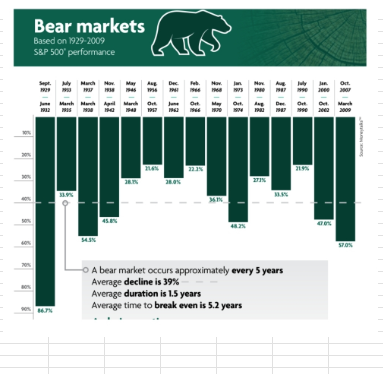
While you’re waiting for that 42.8% recovery, time is ticking. Money can recover. Time never does. This is what we call Volatility Recovery Analysis. FinanceX ignores this. Real engineering audits the margin to ensure you never have to play catch-up with your life’s work.
Mission Profiles vs. "Buy and Hold"
In aerospace, a flight plan isn't a suggestion. It’s a series of non-negotiable maneuvers designed to reach a specific destination within a specific margin of safety. This is a Mission Profile.
"Buy and Hold" is not a mission profile. It is "Participation."
When you "participate" in the market, you are a passenger on someone else’s ship. You have no control over the fuel, the navigation, or the heat shield. If the market hits a pocket of turbulence, the captain (Wall Street) tells you to "stay the course" while they continue to collect their fees from your shrinking pile of assets.
Real Engineering requires you to design the outcome.
Instead of wondering what the market will do, you create a plan based on contractual guarantees rather than market probabilities. You move from knowing to hoping. In a real mission profile, we identify the "Sequence of Return Margin." We ensure that even if the market has a "bad year," your income stream remains untouched.
The Margin of Safety: Why You Need a Stepped UP Floor
Every engineer understands the "Margin of Safety." You build a crane to lift 10 tons even if you only plan to lift five. You build in redundancies.
Why doesn't your retirement plan have a redundancy?
In the FinanceX world, your downside is unlimited. If the S&P 500 drops 40%, your retirement date moves five years into the future. That’s a failed design.
In a Real Engineering model, we utilize Fully Performing Assets (FPA) that include a 0% Floor.
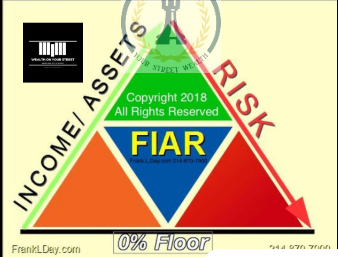
Imagine a "Stepped UP Floor" where your gains are locked in every year. If the market goes up, you capture Uncapped Gains (UCG) or even Expanded Market Participation (EMP): where a 10% market gain can be engineered into a 15% or 20% gain for your portfolio. But if the market crashes? You stay at zero. You don’t lose a dime of your principal or your previous gains.
This isn't magic; it’s Compounding Efficiency. By eliminating the "Math of Recovery," you keep your forward momentum. Peace is the path, wisdom is the way.
Participation vs. Design: Assets at Risk (AAR) vs. Fully Performing Assets (FPA)
To build a structure that lasts, you have to categorize your materials. At Your Street Wealth, we look at your balance sheet through the lens of the Asset Pyramid.
Non-Performing Assets (NPA): These are the "Infants." Your cash in the bank, your emergency fund. Necessary, but they aren't growing.
Assets at Risk (AAR): These are the "Teens." This is your typical Wall Street portfolio. They have high energy but are volatile and unpredictable. As you get older, your allocation to these should decline.
Fully Performing Assets (FPA): This is your "Foundation."
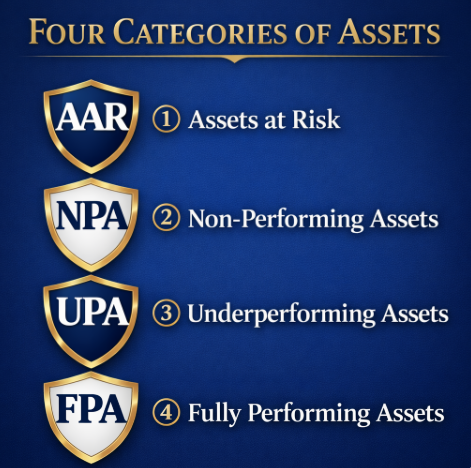
Most people are told to "participate" in AAR for their entire lives. We argue that for a retirement to actually launch, you need to migrate toward FPA.
Think of it like the Consolidation of Technology. Thirty years ago, you had a camera, a pager, a map, and a phone. Today, you have a smartphone that does it all.
Traditional assets (Banks, Stocks, Real Estate) are "single-pillar" assets. They do one thing, often with high fees or high risk. Fully Performing Assets are the "smartphones" of finance. They are "multi-pillar" vehicles that can provide 5–15 pillars of value: including growth, protection, tax-free income, and long-term care: all consolidated into one engineered structure.
The Engineering Audit: Stop Guessing, Start Building
If you were building a $5 million facility, you wouldn't start pouring concrete based on a "feeling." You would hire an architect to perform a rigorous audit of the site and the blueprints.
Your retirement is the most expensive project you will ever fund. Why are you still using a "Buy and Hold" blueprint from the 1980s?
Wall Street thrives on hidden complexity. They want you addicted to the daily research, the "sharp knives" of interest-rate ripples, and the noise of the 24-hour news cycle. They want you to believe that "participation" is the only way.
It isn't.

We don't do "free consultations." We don't chase "mice" looking for "free cheese." We work with Quiet Builders: the men and women who have spent decades accumulating wealth and are now ready to protect it with the same precision they used to build it.
The Million Dollar Hour™ is our version of a high-level Engineering Audit. It is a one-hour, intensive session designed to perform a Margin Audit™ on your current plan. We don't look at "projections"; we look at the math.
We identify:
The Volatility Gap: How much of your wealth is currently at risk of a 30% "Boil-off."
The Fee Leak: Where hidden costs are draining your compounding efficiency.
The Mission Profile: A clear, rules-based path to transition from Assets at Risk to Fully Performing Assets.
You can estimate your income needs, but you cannot predict future portfolio value when losses and leaks are uncontrollable. Contrast that uncertainty with an engineered, guaranteed path.
Audit the margin. Protect your time. Engineer certainty.
Your Money, Your Rules, In Your Time, On Your Street.
Ready for clarity instead of confusion?
The Million Dollar Hour™ is your educational, one-on-one retirement review that reveals where your plan leads : not just where it’s been.
👉 Schedule your session today.
Discover Which Wealth Killers Are Affecting You
👉 Take the 60-Second Quiz
Most people are impacted by 6–9 and don’t realize it
Wealth Killer #1: The Granddaddy : Why Market Volatility is Your Retirement’s Greatest Enemy
Concerned about market losses, taxes, or income reliability?
Take the 7 Question Retirement Stress Test →
You can keep participating… Or you can finally see the outcome. The Million Dollar Hour™ shows you exactly:
✔ Where you are ✔ Where you’re going ✔ How to fix the gaps 👉 Book your session now
Check out the Retirement Blueprint