
Retirement Strategies That Maximize Income, Eliminate Risk, and Help Ensure You Never Run Out of Money How to Achieve The Retirement Future Everyone Seeks
Most retirement plans are built on assumptions that no longer hold up—market averages, predictable tax rates, and the belief that time will always recover losses. But as you approach or enter retirement, the rules change. What worked during your accumulation years can become a liability during the withdrawal phase.
This blog is designed to help you rethink traditional strategies and discover a more engineered approach to retirement income—one focused on certainty, efficiency, and control.
Here, you’ll learn how to reduce or eliminate the biggest threats to your financial future, including market losses, rising taxes, hidden fees, and the silent erosion caused by lost time. We break down complex financial concepts into clear, actionable insights so you can make better decisions about your 401(k), IRA, and retirement income strategy.
You’ll also discover why many conventional approaches—like relying on average returns or the 4% rule—can expose you to unnecessary risk, especially when withdrawals begin. Instead, we explore strategies designed to protect your principal, improve compounding efficiency, and create predictable income streams that last.
Our focus is on helping you transition from “assets at risk” to a more stable and structured approach using fully performing assets—where growth, income, and protection work together instead of against each other.
Whether you’re still working or already retired, the goal is simple:
help you keep more of what you earn, generate more reliable income, and build a plan that doesn’t depend on hope, timing, or market luck.
If you’ve ever wondered:
* How to create tax-efficient retirement income
* How to avoid sequence of returns risk
* How to reduce fees and increase net returns
* How to design income that doesn’t run out
—you’re in the right place.
Explore the articles below and start building a retirement strategy based on engineering, not guesswork.

How Much Do I Need to Retire
How Much Do I Need to Retire
One of the fastest ways to uncover hidden risk is to take our 7 Question Retirement Stress Test.
![[HERO] How Much Do I Need to Retire: The Engineering vs. Guesswork Guide](https://cdn.marblism.com/a3XnDP6lniv.webp "[HERO] How Much Do I Need to Retire: The Engineering vs. Guesswork Guide")
Start here: See what your retirement actually looks like → 👉 Book Your Million Dollar Hour™
Stop Guessing and Start Engineering: Why Your "Retirement Number" is a Mathematical Lie
Ask any "expert" on Wall Street how much do i need to retire, and they’ll likely toss a number at you with the confidence of a weather-man predicting sunshine in a hurricane.
Usually, that number is followed by the "4% Rule": a dusty relic of the 1990s that suggests you can safely peel off 4% of your portfolio every year and never go broke. It sounds simple. It sounds safe. It sounds like a plan.
It’s actually guesswork.
For the Quiet Builders: the successful, financially fatigued professionals who have spent decades accumulating wealth: guesswork isn't just annoying; it’s dangerous. You didn't build your career or your business on "hope" and "maybe." You built it on precision, logic, and results. Why should your retirement be any different?
In this guide, we’re going to dismantle the Guesswork Model of Wall Street and introduce you to the Engineering of Certainty.
The Guesswork Model: A Rolodex in a SpaceX World
Traditional financial planning treats your retirement like a game of "Participation." They tell you to diversify, stay the course, and accept the "average" returns of the market.
But here’s the problem: You don’t live on averages. You live on cash flow.
Wall Street’s model is built on probabilities, not guarantees. They use hidden complexity to keep you addicted to daily research and the "buy/sell" cycle. They want you focused on the macro headlines while they ignore the micro margins that actually determine your success.
When you ask how much you need to retire, the Guesswork Model ignores three massive wealth killers:
The Math of Recovery: The invisible weight of market losses.
The Fee Leak: The dripping faucet that drains your compounding power.
The Tax Trap: The silent partner (Uncle Sam) who owns a massive, un-calculated chunk of your 401(k).

Visual Suggestion: A split-screen comparison showing a chaotic, hand-drawn "Guesswork" map versus a clean, blue-printed "Engineering" schematic.
The Math of Recovery: Why "Participation" is a Trap
Wall Street loves to talk about "average returns." If the market goes up 20% one year and down 20% the next, your "average" return is 0%.
But your actual math? You’re in the hole.
If you have $1,000,000 and lose 30%, you’re down to $700,000. To get back to that million-dollar mark, you don’t need a 30% gain. You need a 42.8% gain just to break even.
This is the Volatility Recovery Analysis. While you’re waiting for the market to "recover," you’re losing the one asset you can never buy back: Time. Money can recover. Time never does.
In the Guesswork Model, you are "participating" in the market’s chaos. In the Engineering Model, we focus on Engineered Performance. We prioritize growth without the reset button of market losses.

The Dripping Faucet: Auditing the Margin
Most people have no idea what they are actually paying for their retirement "participation." Between advisory fees, internal fund expenses, and turnover costs, you might be losing 2% to 3% of your total wealth every single year: regardless of whether the market goes up or down.
Imagine a dripping faucet. It doesn't look like much, but over 20 years, it can flood your basement. In financial terms, a 2% fee doesn't just take 2% of your money; it takes 100% of the compounding power that money would have generated over decades.
We use a Margin Audit™ to identify these leaks. If you want to know how much you need to retire, you first have to know how much you’re losing before you even get started.

Single-Pillar vs. Multi-Pillar Assets
To understand why traditional planning fails, look at the tools being used. Most people hold "Single-Pillar" assets:
Banks: Safe, but zero growth and fully taxable.
Stocks: High growth potential, but high risk and high fees.
Real Estate: Good cash flow, but illiquid and management-intensive.
These are like the pagers and flip-phones of the financial world. They do one thing, and they do it okay, but they are inadequate for the speed of modern retirement.
Fully Performing Assets (FPA) are the "Smartphones" of finance. An FPA is a multi-pillar vehicle that consolidates 5 to 15 different benefits into one structure:
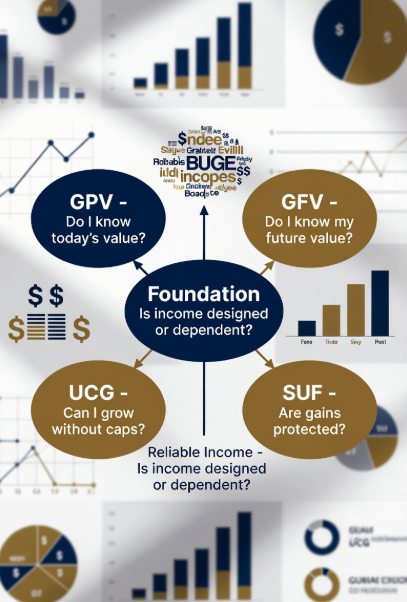
Uncapped Gains (UCG): You capture the upside of the market.
Protected Gains (SUF): Once you make it, you keep it. Your floor is 0%.
Expanded Market Participation (EMP): Using multipliers (110%–200%) to outperform the index itself.
Tax-Free Income: Removing the largest future liability from your balance sheet.
Long-Term Care Provisions: Built-in protection for your health.
When you use FPAs, you stop "participating" and start "performing."
The Asset Pyramid: Where Your Money Lives
In our engineering framework, we categorize assets into four tiers. To answer "how much do I need to retire," you must see where your current wealth is sitting:
NPA (Non-Performing Assets): The "Infants." This is your emergency cash. It’s necessary but it isn't doing any heavy lifting.
AAR (Assets At Risk): The "Teens." These are your traditional stocks and mutual funds. They have potential, but they are volatile and require constant supervision. As you age, your allocation here should decline.
UPA (Under-Performing Assets): Assets that are tied up in high fees or low-efficiency structures.
FPA (Fully Performing Assets): The "Foundation." These are the engineered vehicles that provide contractual certainty, tax efficiency, and uncapped growth.

The Engineering of Certainty
So, how much do i need to retire?
The truth is, if you stay in the Guesswork Model, you will never have enough. Why? Because you are depending on variables you cannot control: market cycles, tax law changes, and the whims of Wall Street. You are spinning sharp knives and hoping you don't get cut.
Engineering your retirement means shifting the focus from Probability to Guarantees. It means moving from Uncertainty to Knowing.
When we engineer a plan, we don't just look at a "number." We perform a Sequence of Return Margin analysis. We look at Compounding Efficiency. We design a system that grows and heals, rather than a portfolio that simply sits there and prays for a "green" day on CNBC.
Peace is the path, wisdom is the way. Your money should follow your rules, in your time, on your street.
Stop Guessing. Start Building.
You can spend the next ten years checking your accounts every morning, wondering if the next "Wealth Killer" (volatility or inflation) is going to reset your clock. Or, you can choose to unlearn the myths of Wall Street and learn the fundamental architecture of wealth.
The "magic number" isn't a dollar amount. It's a design.
It’s the difference between a house built on sand (Participation) and a skyscraper built on an engineered foundation (Performance).
Ready for clarity instead of confusion?
The Million Dollar Hour™ is your educational, one-on-one retirement review that reveals where your plan leads : not just where it’s been.
👉 Schedule your session today.
Discover Which Wealth Killers Are Affecting You
Most people are impacted by 6–9 and don’t realize it
Wealth Killer #1: The Granddaddy : Why Market Volatility is Your Retirement’s Greatest Enemy
Concerned about market losses, taxes, or income reliability?
Take the 7 Question Retirement Stress Test →
You can keep participating… Or you can finally see the outcome. The Million Dollar Hour™ shows you exactly:
✔ Where you are ✔ Where you’re going ✔ How to fix the gaps 👉 Book your session now
Check out the Retirement Blueprint