
Retirement Strategies That Maximize Income, Eliminate Risk, and Help Ensure You Never Run Out of Money How to Achieve The Retirement Future Everyone Seeks
Most retirement plans are built on assumptions that no longer hold up—market averages, predictable tax rates, and the belief that time will always recover losses. But as you approach or enter retirement, the rules change. What worked during your accumulation years can become a liability during the withdrawal phase.
This blog is designed to help you rethink traditional strategies and discover a more engineered approach to retirement income—one focused on certainty, efficiency, and control.
Here, you’ll learn how to reduce or eliminate the biggest threats to your financial future, including market losses, rising taxes, hidden fees, and the silent erosion caused by lost time. We break down complex financial concepts into clear, actionable insights so you can make better decisions about your 401(k), IRA, and retirement income strategy.
You’ll also discover why many conventional approaches—like relying on average returns or the 4% rule—can expose you to unnecessary risk, especially when withdrawals begin. Instead, we explore strategies designed to protect your principal, improve compounding efficiency, and create predictable income streams that last.
Our focus is on helping you transition from “assets at risk” to a more stable and structured approach using fully performing assets—where growth, income, and protection work together instead of against each other.
Whether you’re still working or already retired, the goal is simple:
help you keep more of what you earn, generate more reliable income, and build a plan that doesn’t depend on hope, timing, or market luck.
If you’ve ever wondered:
* How to create tax-efficient retirement income
* How to avoid sequence of returns risk
* How to reduce fees and increase net returns
* How to design income that doesn’t run out
—you’re in the right place.
Explore the articles below and start building a retirement strategy based on engineering, not guesswork.
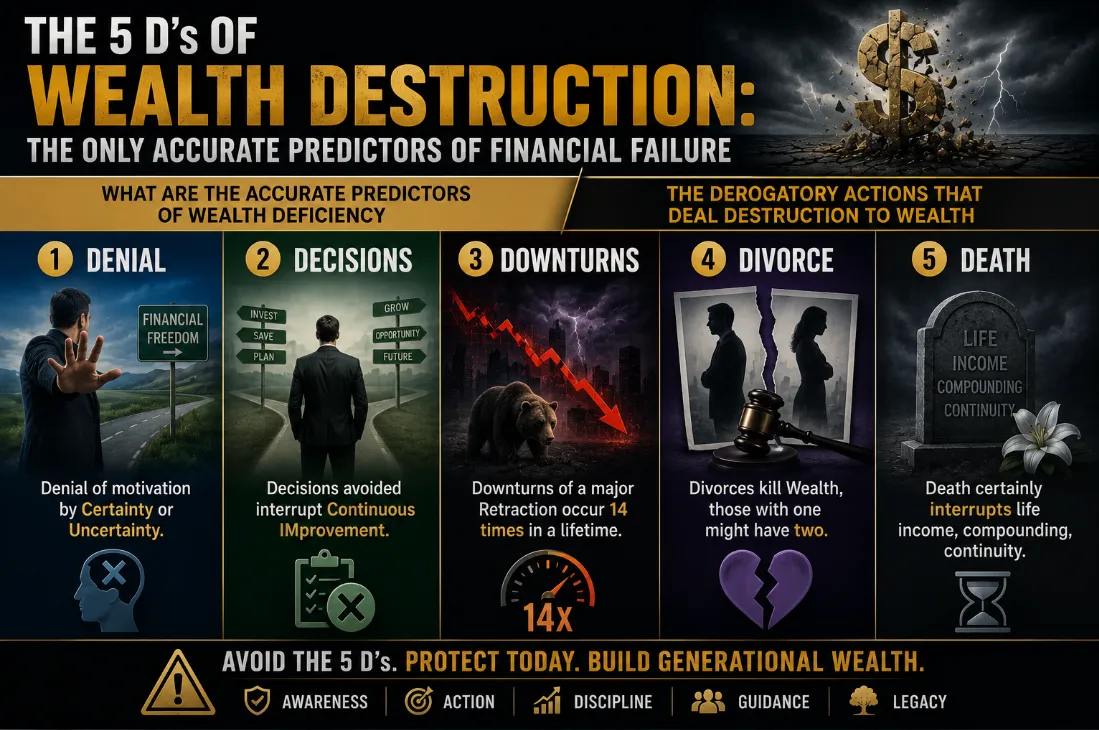
Protect Retirement Savings from Market Crash: The 5 D's
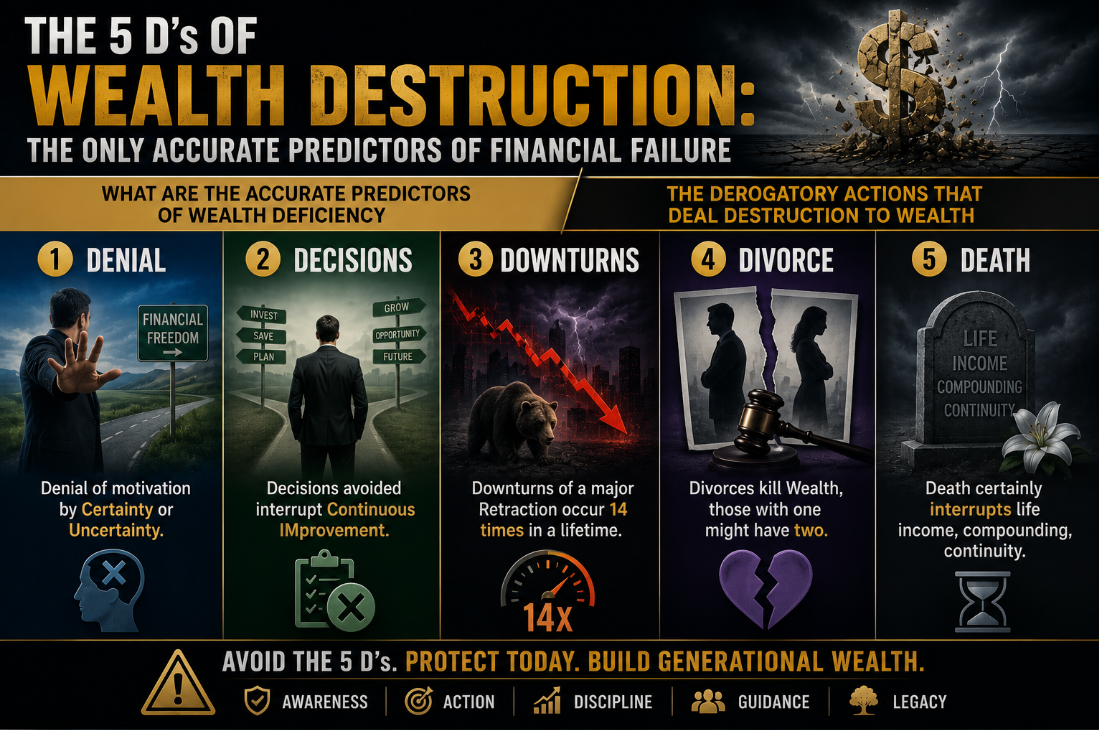
The 5 D's of Wealth Destruction: The Only Accurate Predictors of Financial Failure
Start here: See what your retirement actually looks like → 👉 Book Your Million Dollar Hour™
One of the fastest ways to uncover hidden risk is to take our 7 Question Retirement Stress Test.
Most financial planning is an exercise in hope. You sit across from a professional who shows you colorful "Monte Carlo simulations": essentially a weather report for your money based on the last 50 years of "average" rain.
But averages don’t pay the bills. If the market drops 30% the year you retire, your "average" is irrelevant. You are in a crisis.
At Your Street Wealth, we don’t play the guessing game of Wall Street "Participation." We focus on Engineering Performance. To build a structure that lasts, you don't just look at the quality of the bricks; you look at the forces trying to tear the building down.
We call these the 5 D's of Wealth Destruction. They are the only accurate predictors of wealth deficiency. If you can identify and engineer around these five derogatory actions, you are 90% more likely to successfully build and keep your wealth.
1. Denial: The Motivation Killer
Denial is the silent architect of failure. In our Million Dollar Hour™ Forecast, we often see clients in one of two states of denial:
Denial of Uncertainty: This is the belief that "the market always comes back" or "my advisor has a handle on it." It’s an abdication of leadership over your own capital.
Denial of Certainty: This is the refusal to accept mathematical truths: like the fact that fees, taxes, and inflation are guaranteed to erode your buying power unless you use Fully Performing Assets (FPA).
Whether the outlook is certain or uncertain, denial prevents you from taking the pilot's seat. When you deny the reality of the Margin Audit™, you lose the ability to correct your course before you hit the mountain.
2. Decisions: The Cost of Procrastination
Wealth isn't built on one big "win"; it’s built on Continuous Improvement.
When you avoid making a decision: whether it’s moving out of a high-fee "Single Pillar" asset or shielding your gains from the next retraction: you interrupt the compounding efficiency of your life. But decisions are not just about delay. They are also about whether you ever question the status quo in the first place.

Procrastination is a decision to stay the course. But so is following the default path just because "everyone else" is on it. That is the trap of herd mentality. The direction of the masses may feel safe, but the crowd is not a compass.
In a Wall Street model, "staying the course" often means staying in the line of fire. It often means accepting the status quo, outsourcing leadership, and confusing popularity with precision. Following the crowd is still a decision, and it is often a costly one.
The real act of leadership is to question what everyone else is doing before your time and wealth get volunteered to a false model. Every day you wait to engineer certainty is a day of Time Lost. And as we say: Money can recover. Time never does.
3. Downturns: The 14-Strike Rule
Wall Street treats market crashes like "black swan" events: rare, unpredictable anomalies. The math says otherwise.
A major market retraction occurs, on average, 14 times in a single human lifetime.
If you are 55 years old, you have already lived through several. You likely have two or three more major "wealth-reset" events waiting for you before you're done. If your plan relies on "Participation" in the market, you are essentially spinning sharp knives and hoping you don't get cut.

This is where the Math of Recovery becomes brutal. If your portfolio takes a 30% hit in one of these 14 downturns, you don't just need a 30% gain to get back to even. You need a 42.8% gain just to see the surface again. While you're busy "recovering," your peers using an engineered 0% Floor are already miles ahead.
We use Volatility Recovery Analysis to show you exactly how many years of your life have been stolen by these routine retractions.
4. Divorce: The Wealth Multiplier (In Reverse)
It is a hard truth: Divorce kills wealth. It doesn't just split assets in half; it destroys the Compounding Efficiency of the family unit. Legal fees, liquidated real estate, and the doubling of living expenses act as a massive "leak" in your financial bucket.
Those who have had one divorce are statistically more likely to have a second. From an engineering perspective, divorce is a structural failure that requires Level Yield Amortization: a way to heal the balance sheet and protect the continuity of what remains.
Without a plan that emphasizes Control vs. Dependence, a divorce can turn a comfortable retirement into a decade of playing catch-up.
5. Death: The Ultimate Interrupter
Death is the final "D," and it is the only one that is 100% guaranteed.
Death interrupts three critical things:
Life Income: The paycheck stops.
Compounding: The momentum of the strategy often dies with the owner.
Continuity: The legacy becomes a tax liability for the next generation.
Traditional "Single Pillar" assets (like a standard brokerage account or a 401k) are "Single-Use." They provide growth or income, but they rarely provide a tax-free legacy and long-term care protection.
We contrast this with Fully Performing Assets (FPA). Think of an FPA like a smartphone. Your old "Rolodex" (a bank account) and your "Pager" (a stock) and your "Camera" (real estate) are now consolidated into one vehicle that provides 5–15 pillars of value: including guaranteed death benefits that ensure your wealth continuity is never interrupted.
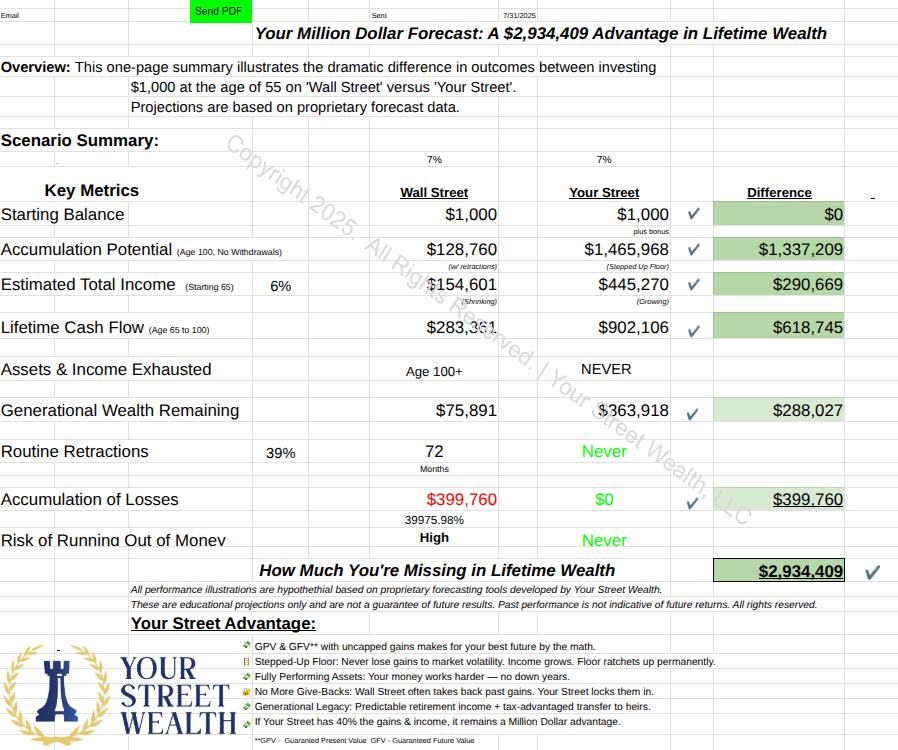
From Participation to Performance
Wall Street operates on a False Model driven by the Greed/Fear meter. When greed is high, they sell you "Opportunity." When fear is high, they tell you to "Hold on."
Both are forms of gambling.
At Your Street Wealth, we build for Quiet Builders: the business owners and executives who are tired of the noise. We don't want you to "participate" in a market; we want you to engineer a result.
By avoiding the 5 D's and shifting your foundation to Multi-Pillar assets, you move from the uncertainty of "Hoping" to the contractual power of "Knowing."
We use Expanded Market Participation (EMP) to give you 110%–200% multipliers on market gains with a contractual 0% Floor. That is the difference between a 1980s-era "Rolodex" plan and a modern, high-performance financial architecture.
Peace is the path, wisdom is the way.
Your Money, Your Rules, In Your Time, On Your Street.
Ready for clarity instead of confusion?
The Million Dollar Hour™ is your educational, one-on-one retirement review that reveals where your plan leads : not just where it’s been.
👉 Schedule your session today.
Discover Which Wealth Killers Are Affecting You
Most people are impacted by 6–9 and don’t realize it
Wealth Killer #1: The Granddaddy : Why Market Volatility is Your Retirement’s Greatest Enemy
Concerned about market losses, taxes, or income reliability?
Take the 7 Question Retirement Stress Test →
You can keep participating… Or you can finally see the outcome. The Million Dollar Hour™ shows you exactly:
✔ Where you are ✔ Where you’re going ✔ How to fix the gaps 👉 Book your session now