
Retirement Strategies That Maximize Income, Eliminate Risk, and Help Ensure You Never Run Out of Money How to Achieve The Retirement Future Everyone Seeks
Most retirement plans are built on assumptions that no longer hold up—market averages, predictable tax rates, and the belief that time will always recover losses. But as you approach or enter retirement, the rules change. What worked during your accumulation years can become a liability during the withdrawal phase.
This blog is designed to help you rethink traditional strategies and discover a more engineered approach to retirement income—one focused on certainty, efficiency, and control.
Here, you’ll learn how to reduce or eliminate the biggest threats to your financial future, including market losses, rising taxes, hidden fees, and the silent erosion caused by lost time. We break down complex financial concepts into clear, actionable insights so you can make better decisions about your 401(k), IRA, and retirement income strategy.
You’ll also discover why many conventional approaches—like relying on average returns or the 4% rule—can expose you to unnecessary risk, especially when withdrawals begin. Instead, we explore strategies designed to protect your principal, improve compounding efficiency, and create predictable income streams that last.
Our focus is on helping you transition from “assets at risk” to a more stable and structured approach using fully performing assets—where growth, income, and protection work together instead of against each other.
Whether you’re still working or already retired, the goal is simple:
help you keep more of what you earn, generate more reliable income, and build a plan that doesn’t depend on hope, timing, or market luck.
If you’ve ever wondered:
* How to create tax-efficient retirement income
* How to avoid sequence of returns risk
* How to reduce fees and increase net returns
* How to design income that doesn’t run out
—you’re in the right place.
Explore the articles below and start building a retirement strategy based on engineering, not guesswork.

Protect Retirement Savings: Why Your 401k Growth is a Myth
The Fox in the Henhouse: Why Pinching Pennies Won’t Save a Failing 401(k)
One of the fastest ways to uncover hidden risk is to take our 7 Question Retirement Stress Test.
![[HERO] The Fox in the Henhouse: Why Pinching Pennies Won’t Save a Failing 401(k)](https://cdn.marblism.com/FpFENxs2V0v.webp "[HERO] The Fox in the Henhouse: Why Pinching Pennies Won’t Save a Failing 401(k)")
Start here: See what your retirement actually looks like → 👉 Book Your Million Dollar Hour™
The Fox in the Henhouse: Why Pinching Pennies Won’t Save a Failing 401(k)
You’ve seen the headlines. You’ve felt the "financial fatigue." Maybe you’ve even caught yourself looking at your monthly budget, wondering if skipping that extra steak dinner or switching to a cheaper streaming service will finally tip the scales in your favor.
It’s a common reflex. When we feel like we’re losing ground, we squeeze down on our spending. We pinch pennies. We tighten the belt.
But here’s the uncomfortable truth: while you’re at the front door of your financial life counting the eggs and worrying about the cost of chicken feed, there is a fox at the back door. And that fox isn't interested in your pennies. He’s taking the hens, the eggs, and the entire coop.
In the world of retirement planning, that fox has a name: Wall Street Wally.
At Your Street Wealth, we see this play out every day. People are obsessed with their monthly expenditures: the "margin" between what they spend and what they could spend: while completely ignoring the massive wealth leakage happening inside their 401(k).
If you want to survive the next twenty years, it’s time to stop looking at the grocery receipt and start performing a Margin Audit™ on your actual retirement engine.
The 401(k) Myth: Why the Math Doesn’t Work
Most people believe their 401(k) is a wealth-building machine. They think that if they just keep contributing, the magic of compounding will eventually turn that pile of "assets at risk" into a million-dollar nest egg.
But have you ever actually looked at the math of your account's growth over a ten or twenty-year period?
The truth is, for the vast majority of Americans, the total value of their 401(k) only increases over time by the aggregate amount of their monthly contributions.
Read that again.
If you put in $1,000 a month for ten years, and your account is worth $125,000, Wall Street hasn't really "grown" your money. You simply saved $120,000 and the market gave you a participation trophy. When you factor in the Sequence of Returns Risk and the "Math of Theft": the accumulated losses from gains lost: the actual Compound Annual Growth Rate (CAGR) often hovers at less than +/- 2% over time.

The Math of Theft: Losing 4-10x Your Contributions
Why does this happen? It’s the "roller coaster" effect. You’re aware that your funds go up and down, but you’re usually only watching the percentages. You don’t know how much it will go up after it goes down, and you certainly don’t know when.
This uncertainty is the fox’s greatest tool.
A common question we hear is: "How could I lose $500,000 when my account is only $100,000?" The answer is simple once you stop looking only at the account balance and start looking at the lost growth path. The theft is not just what disappears from the statement today. It’s what never gets the chance to compound tomorrow. While you keep contributing, the fox is raiding the back door by stealing the future growth potential of every dollar that got knocked off course.
When your 401(k) takes a 30% hit, you don't just need a 30% gain to get back to even. You need a 42% gain just to return to the starting line. During those years spent "recovering," you aren't just losing money; you’re losing time.
We call this the Math of Recovery. Every time the market dips, your compounding efficiency is reset to zero. Over a lifetime, you can easily lose anywhere between 4-10x your total contributions in "lost opportunity" gains. Your money is sitting in a process where the managers make money for themselves regardless of whether you win or lose.
Wall Street Wally tells you the market goes up 7% a year on average. But Wall Street won’t guarantee you even a 1% gain. They’ve created a "Win/Lose" platform where you take all the risk, the government takes a future tax lien, and the money managers take their fees off the top.
⚠️ If this applies to you… your retirement may already be at risk.
_____________________________________________________________________________________
Pinching Pennies vs. Plugging Leaks
The overwhelming compulsion for the "Quiet Builder": the successful professional who is tired of the noise: is to try to increase contributions to "make up" for the lack of growth.
But if the engine is broken, adding more fuel won’t make the car go faster.
While you’re living frugally to save an extra $200 a month, the "Wealth Killers" (fees, taxes, and volatility) are raiding the back door. You are worrying about the "dripping faucet" of your lifestyle while ignoring the "burst pipe" of your retirement plan.

The tax reduction you get today for your 401(k) contribution is often framed as a "win." But in reality, you’re just creating a massive, unknown tax liability for your future self. You’re letting the government become a partner in your henhouse: a partner who gets to decide later how many of your eggs they want to take.
"Inspect What You Expect": The Forecast of Reality
At Your Street Wealth, we believe you should never follow a trail just because "everyone else is doing it." That is cultural magnetism, not engineering.
When was the last time you saw a side-by-side comparison of how your money would perform on different "Streets"?
Wall Street: The roller coaster of risk and hidden fees.
Main Street: Low-interest "safe" bets that can't keep up with inflation.
Vegas Street: High-risk speculation.
Easy Street: The dream that never manifests.
Your Street: An engineered, guaranteed path using Fully Performing Assets.

You need to "Inspect what you Expect." This means walking forward with a forecast of reality. That is where the Seven Question Retirement Stress Test comes in. We take 18-month and 5-year cycles of history and push them into the future so you can, in effect, look back at your future under the reality of life’s duress. If you are aiming for a $1M retirement but you’re in a 30% tax bracket and Wall Street Wally is running the show, the math simply doesn’t get you there.
Most people are following a deepening trail created by corporate replacement of pension liabilities. Your 401(k) isn't the secret to the American Dream; it’s a myth propagated to keep you in the "Participation" model instead of the "Performance" model.
The Cure: A Margin Audit™ and Fully Performing Assets
So, is there a better way?
If you want an outcome that is greater than the sum of your contributions, you have to move away from "Single-Pillar" traditional assets.
Think of it like the evolution of technology. In the 90s, you had a pager, a camera, a calculator, and a phone. Today, you have a smartphone that does it all. Traditional assets (Stocks, Real Estate, Banks) are like that old Rolodex: they serve one purpose and carry high individual risks.
Fully Performing Assets (FPA) are the "smartphones" of the financial world. They provide 5-15 "pillars" of value: growth, protection, long-term care benefits, and tax-free income: all in one vehicle.
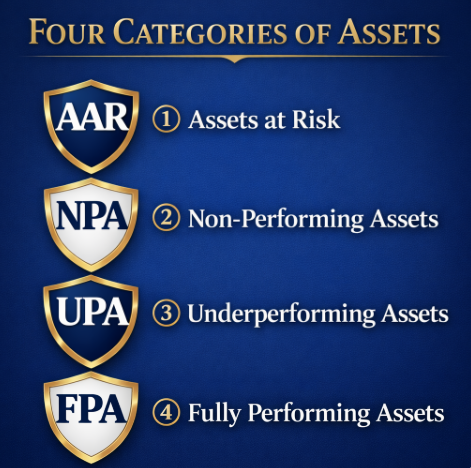
By moving from Assets at Risk (AAR) to Fully Performing Assets (FPA), you stop the raid on the henhouse. You shift from:
-30% to +30% (Wall Street Volatility)
to 0% to +30% (Your Street Certainty)
When you eliminate the "down" years, the power of compounding actually works. You stop losing 4-10x your contributions to the Math of Theft. You stop worrying about the fox because you’ve finally built a secure coop.
Your Money, Your Rules, On Your Street
Your uniqueness won’t overcome the power of losses that Wall Street Wally has in store for you. Staying the course just means watching your contributions wane as they fail to provide for your future.
It’s time to stop pinching pennies and start auditing your margins.
The Million Dollar Hour™ is designed specifically for this. It isn't a "sales pitch" for the latest hot stock; it is an institutional-grade Margin Audit™ and Forecast. We look at your current path and compare it to an engineered path: one that uses banking architecture and Asset Liability Management (ALM) to ensure you arrive at your destination with certainty.
Stop letting the fox distract you at the front door. It’s time to secure the back.
Ready for clarity instead of confusion?
The Million Dollar Hour™ is your educational, one-on-one retirement review that reveals where your plan leads : not just where it’s been.
👉 Schedule your session today.
Discover Which Wealth Killers Are Affecting You
Most people are impacted by 6–9 and don’t realize it
Wealth Killer #1: The Granddaddy : Why Market Volatility is Your Retirement’s Greatest Enemy
Concerned about market losses, taxes, or income reliability?
Take the 7 Question Retirement Stress Test →
You can keep participating… Or you can finally see the outcome. The Million Dollar Hour™ shows you exactly:
✔ Where you are ✔ Where you’re going ✔ How to fix the gaps 👉 Book your session now
Check out the Retirement Blueprint