
Retirement Strategies That Maximize Income, Eliminate Risk, and Help Ensure You Never Run Out of Money How to Achieve The Retirement Future Everyone Seeks
Most retirement plans are built on assumptions that no longer hold up—market averages, predictable tax rates, and the belief that time will always recover losses. But as you approach or enter retirement, the rules change. What worked during your accumulation years can become a liability during the withdrawal phase.
This blog is designed to help you rethink traditional strategies and discover a more engineered approach to retirement income—one focused on certainty, efficiency, and control.
Here, you’ll learn how to reduce or eliminate the biggest threats to your financial future, including market losses, rising taxes, hidden fees, and the silent erosion caused by lost time. We break down complex financial concepts into clear, actionable insights so you can make better decisions about your 401(k), IRA, and retirement income strategy.
You’ll also discover why many conventional approaches—like relying on average returns or the 4% rule—can expose you to unnecessary risk, especially when withdrawals begin. Instead, we explore strategies designed to protect your principal, improve compounding efficiency, and create predictable income streams that last.
Our focus is on helping you transition from “assets at risk” to a more stable and structured approach using fully performing assets—where growth, income, and protection work together instead of against each other.
Whether you’re still working or already retired, the goal is simple:
help you keep more of what you earn, generate more reliable income, and build a plan that doesn’t depend on hope, timing, or market luck.
If you’ve ever wondered:
* How to create tax-efficient retirement income
* How to avoid sequence of returns risk
* How to reduce fees and increase net returns
* How to design income that doesn’t run out
—you’re in the right place.
Explore the articles below and start building a retirement strategy based on engineering, not guesswork.

Raptor 4 Retirement vs. Traditional Market Risk Strategies
Raptor 4 Retirement: Why Your ‘Win/Lose’ Strategy is Stuck on a Single Pillar
Start here: See what your retirement actually looks like → 👉 Book Your Million Dollar Hour™

One of the fastest ways to uncover hidden risk is to take our 7 Question Retirement Stress Test.
Raptor 4 Retirement: Why The Win/Win Platform deserves Interrogation
In the world of aviation, the transition from a prop plane to a jet engine wasn't just a "tweak": it was a fundamental shift in the laws of physics. In the world of wealth, we are currently witnessing a similar evolution.
While the majority of retirees are still trying to navigate a SpaceX-speed world using a 1970s Rolodex, a small group of "Quiet Builders" has moved beyond the noise. They aren't "participating" in the market; they are engineering their outcomes.
We call this transition the shift from Raptor 3 to Raptor 4 Retirement.
If you are currently relying on Wall Street’s "Win/Lose" platform, you aren’t just taking a risk: you are building your entire future on a single, fragile pillar that literally cannot upgrade.
The Win/Lose Platform: Why AAR is a Dead End
Most people build their retirement on a foundation of AAR (Assets at Risk). This is the hallmark of the Win/Lose platform.
On this platform, Wall Street uses hidden complexity and "opportunity" language to keep you addicted to daily research and the emotional roller coaster of buying and selling. But here is the structural flaw: AAR never upgrades.
The Win/Lose platform is built on "Single-Pillar" assets. Whether it’s a stock portfolio, a traditional bond ladder, or a piece of real estate, these are single-use tools. They do one thing (hopefully) well, but they offer no structural support when the market shifts.
The platform won’t allow an upgrade because it requires your participation in risk. It feeds on the "Math of Recovery." If your portfolio takes a 30% hit: a common occurrence in the Win/Lose world: it doesn't just take a 30% gain to get back to even. It takes a 42% gain just to see the surface again.
That is time you can never recover. Money can be rebuilt, but your time is a non-renewable resource.
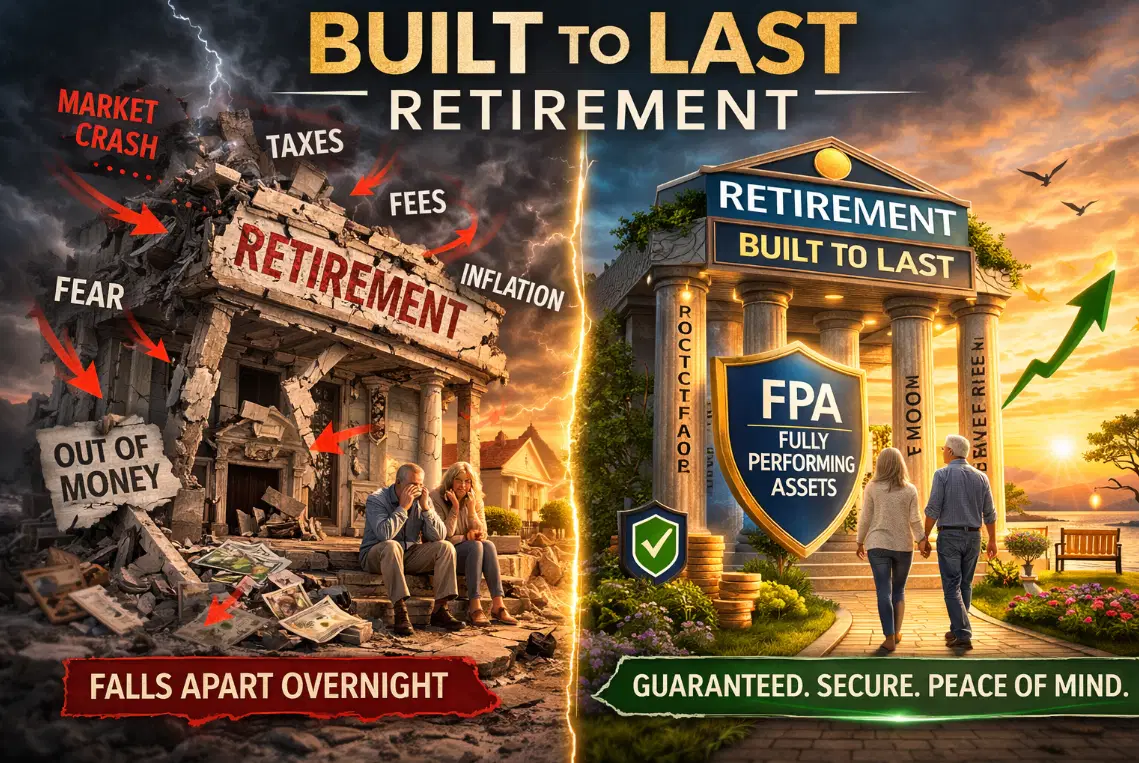
The Win/Win Platform: The Evolution of the Multi-Pillar Asset
Contrast this with the "Win/Win" platform, the home of Fully Performing Assets (FPA).
While Wall Street has been spinning the same "buy and hold" yarn for decades, the FPA architecture has been quietly evolving since the beginning of time. As the demand for capital increases, the number of "pillars" within an FPA must go up to maintain structural integrity. That is not branding. That is engineering.
A larger bridge needs more support. A taller building needs deeper reinforcement. Wealth works the same way. When more capital is placed under pressure from volatility, taxes, fees, income demands, health events, and legacy goals, a weak structure fails faster. A strong structure adds support. That is why the Win/Win platform evolved across the 1900s and into the 2000s by adding more pillars as economic pressure increased.
The Win/Lose platform cannot do that. The AAR model is stuck in a single-pillar failure mode. It can only expose more capital to more market dependency. It cannot add guarantees. It cannot add a 0% floor. It cannot add tax-free income design. It cannot add LTC support inside the same structure. As capital demands grow, the Win/Lose platform becomes more fragile, not more stable.
In the 1900s, an FPA might have offered two or three pillars of value. In the 2000s, those pillars expanded as design improved and capital demands became more complex. Today, those assets can deliver 5 to 15 pillars through modern banking architecture, including growth, protection, liquidity, tax advantages, LTC support, and legacy efficiency. That is the heritage and lineage of the Win/Win platform. It did not appear overnight. It was refined over time, and its evolution proves that the architecture is designed to scale with economic pressure.
Here is where this becomes personal.
My grandfather was born in 1904. He saw the dawn of aviation. He watched Henry Ford & JP Morgan change how America moved. At 25, he lived through the 1929 crash and saw what the AAR gamble really does when the floor disappears. He learned, early, that Participation vs. Engineered Performance is not a theory. It is the difference between losing years and preserving them.
Back then, Fully Performing Assets had fewer pillars than they do today, but the core truth was already there. His transition was not just a change of mind. It was a tactical shift in allocation %. He moved capital away from the instability of Assets at Risk (AAR) and toward the stability of FPA engineered design, built on pillars of guarantees. He did not merely adopt a new opinion. He changed the structure.
That allocation shift is the blueprint for moving from a Win/Lose platform to a Win/Win platform. It means moving from assets that can fail to a design that cannot. It means reducing exposure to loss-driven resets and increasing exposure to contractual strength. He stopped the loss of time. He stepped away from the reset button of Wall Street retractions. He built legacy wealth on a stronger foundation. That transition is the origin story of Your Street Wealth.
Think about the consolidation of technology. We used to carry a pager, a camera, a map, and a phone. Today, they are consolidated into one high-performance device. Fully Performing Assets do the same for your wealth. Traditional banks, stocks, and real estate are single-pillar tools. Useful in isolation, but outdated as a complete retirement architecture. In a modern retirement, relying on those alone is like using a Rolodex in a SpaceX world.
An FPA doesn’t just offer growth. It consolidates 5 to 15 pillars of value into one vehicle:
Uncapped Gains (UCG): Growth potential without the ceiling.
Expanded Market Participation (EMP): A 110% to 200% multiplier on those gains.
0% Floors: You never lose a dime to market volatility.
Tax-Free Income: Protecting your "Sequence of Return Margin."
LTC & Protection: Built-in safeguards for your health and legacy.
This is the Raptor 4 upgrade. It is an engineered system designed to heal your balance sheet through Level Yield Amortization rather than just "hoping" the market goes up.

Heritage, Lineage, and the Curse of Multi-Generational Wealth
Should I tell no one or tell everyone?
That is not a marketing question. It is a moral one.
Families work for decades to build wealth, and then too often watch it dissolve in a generation or two. Why? Because money without architecture usually falls back into the AAR gamble. Children inherit assets, but not always the rules. They inherit value, but not always the discipline. They get pulled back into Participation, into noise, into the False Model of fear and greed.
That is the curse of multi-generational wealth, and it often turns into generational skipping. Not in the legal sense. In the knowledge sense. One generation learns a painful truth. The next generation inherits money without inheriting the architecture. The warning gets skipped. The math gets skipped. The discipline gets skipped. Then the wealth gets pulled right back onto the Win/Lose platform.
In Frank’s family, this was not theory. It was history.
His grandfather learned hard lessons early and used tools like Revocable Living Trusts (RLTs) as part of a broader legacy protection mindset. That mattered. It showed that wealth was not just something to grow. It had to be protected, transferred, and governed. Structure was part of the heritage.
But the irony is what came next.
Frank’s father still lost the majority of his Assets at Risk (AAR) to the market, despite having what most people would call a "great" broker. That is the hidden tragedy of the Win/Lose platform. A nice broker does not fix a bad structure. Charm does not replace math. Participation does not become engineered performance just because the salesperson sounds confident.
This is the missing-knowledge problem.
AAR often evolves through one-offs. Add a mutual fund here. Add a managed account there. Add an annuity rider. Add a bond sleeve. Add a separate income bucket. Add another advisor, another fee, another layer of risk, another explanation. It starts to look sophisticated, but it is usually just a pile of disconnected parts. More moving pieces. More friction. More fees. More dependence. Not more architecture.
That is why the warning against the Win/Lose platform matters so much. It does not fail all at once. It leaks through complexity. It resets through loss. It distracts through activity. It invites families to confuse motion with progress and accumulation with protection.
This is why Frank authored Wealth on Your Street, Growth on Your Street, and Safety on Your Street. Those books were written to stop the skip. Stop generational skipping. Stop the loss of principles between parent and child. Stop the cycle where one generation builds, the next participates, and the third wonders where the margin went.
This is why we choose to tell everyone.
We do not keep this quiet while people lose time to market retractions, sequence risk, fees, and taxes. We do not watch families hand a lifetime of effort back to Wall Street because nobody explained Participation vs. Engineered Performance, The Math of Recovery, The Margin Audit™, or the difference between a single-pillar asset and a multi-pillar foundation.
Tell the truth. Audit the margin. Protect the time.
My grandfather’s lesson was simple: stop gambling with time. Build with structure. Frank’s father’s loss made the lesson impossible to ignore. That lesson became a lineage. That lineage became a platform. That platform became Your Street Wealth.
Peace is the path, wisdom is the way.

Hoping is No Strategy. Interrogation is the Sign of Intelligence.
Are you stuck or losing ground, clinging to the hope that your Assets at Risk (AAR) will gain more than they lose in the next retraction?
Hoping is not a strategy. It is a surrender of control.
In the world of institutional-grade engineering, we don’t hope. We interrogate. We use a Margin Audit™ to scrutinize every leak in your current plan: the fees, the taxes, and the lost compounding efficiency.

If you aren't interrogating your plan, you are effectively "spinning sharp knives" and hoping the interest-rate ripples don't cut you.
It is time to INspect what you EXpect.
If you expect a retirement of peace and certainty, but your current plan is built on a "False Model" driven by greed and fear, you have a structural disconnect. When greed is high, your risk of loss is at its peak. When fear is high, you miss the recovery. It’s a game designed for you to lose.
The Raptor 4 Shift: Engineering Your Certainty
The shift from Raptor 3 to Raptor 4 is about moving from "Participation" to "Performance."
Participation is gambling. It’s noise. It’s depending on the market to do the heavy lifting for you.
Performance is architecture. It’s design. It’s knowing exactly where your plan leads before you even start the engine.
Wealth isn't built on macro headlines; it is built on micro margins. It’s built on protecting your time and ensuring that your money is always working on the "Your Street" side of the fence: where the rules are yours and the growth is guaranteed.
We use the 7-Vector Wealth Navigation System™ to map out these truths. It isn’t about "projections"; it’s about contractual guarantees.

Your Choice: The Rolodex or the Raptor?
You can stay on the Win/Lose platform, watching your time reset every time the market decides to "retract." Or, you can upgrade to the Win/Win architecture of a Fully Performing Asset.
One path leads to uncertainty, hidden fees, and the fear of outliving your money. The other leads to Peace as the path and Wisdom as the way.
It’s time to stop chasing "free cheese" and start investing in true financial architecture. The math doesn't lie, and the clock doesn't stop.
Protect your time. Engineer your certainty. Audit the margin.
The Million Dollar Hour™ is the bridge between where you are and the Raptor 4 future you deserve. It is a $995 Engineering Audit designed for the "Quiet Builder" who is ready to unlearn the myths of Wall Street and embrace the precision of a designed path.
Your Money, Your Rules, In Your Time, On Your Street.
Ready for clarity instead of confusion?
The Million Dollar Hour™ is your educational, one-on-one retirement review that reveals where your plan leads — not just where it’s been.
👉 Schedule your session today.
Discover Which Wealth Killers Are Affecting You
Most people are impacted by 6–9 and don’t realize it
Wealth Killer #1: The Granddaddy : Why Market Volatility is Your Retirement’s Greatest Enemy
Concerned about market losses, taxes, or income reliability?
Take the 7 Question Retirement Stress Test →
You can keep participating… Or you can finally see the outcome. The Million Dollar Hour™ shows you exactly:
✔ Where you are ✔ Where you’re going ✔ How to fix the gaps 👉 Book your session now