
Retirement Strategies That Maximize Income, Eliminate Risk, and Help Ensure You Never Run Out of Money How to Achieve The Retirement Future Everyone Seeks
Most retirement plans are built on assumptions that no longer hold up—market averages, predictable tax rates, and the belief that time will always recover losses. But as you approach or enter retirement, the rules change. What worked during your accumulation years can become a liability during the withdrawal phase.
This blog is designed to help you rethink traditional strategies and discover a more engineered approach to retirement income—one focused on certainty, efficiency, and control.
Here, you’ll learn how to reduce or eliminate the biggest threats to your financial future, including market losses, rising taxes, hidden fees, and the silent erosion caused by lost time. We break down complex financial concepts into clear, actionable insights so you can make better decisions about your 401(k), IRA, and retirement income strategy.
You’ll also discover why many conventional approaches—like relying on average returns or the 4% rule—can expose you to unnecessary risk, especially when withdrawals begin. Instead, we explore strategies designed to protect your principal, improve compounding efficiency, and create predictable income streams that last.
Our focus is on helping you transition from “assets at risk” to a more stable and structured approach using fully performing assets—where growth, income, and protection work together instead of against each other.
Whether you’re still working or already retired, the goal is simple:
help you keep more of what you earn, generate more reliable income, and build a plan that doesn’t depend on hope, timing, or market luck.
If you’ve ever wondered:
* How to create tax-efficient retirement income
* How to avoid sequence of returns risk
* How to reduce fees and increase net returns
* How to design income that doesn’t run out
—you’re in the right place.
Explore the articles below and start building a retirement strategy based on engineering, not guesswork.
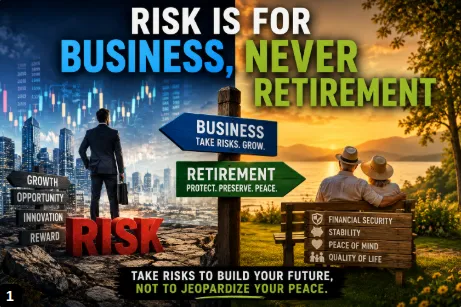
Risk is for Business, Not Retirement: Why Your 401(k) is a 'Working' Asset
Risk is for Business, Not Retirement: Why Your 401(k) is a 'Working' Asset Trying to Do a 'Retired' Job
One of the fastest ways to uncover hidden risk is to take our 7 Question Retirement Stress Test.
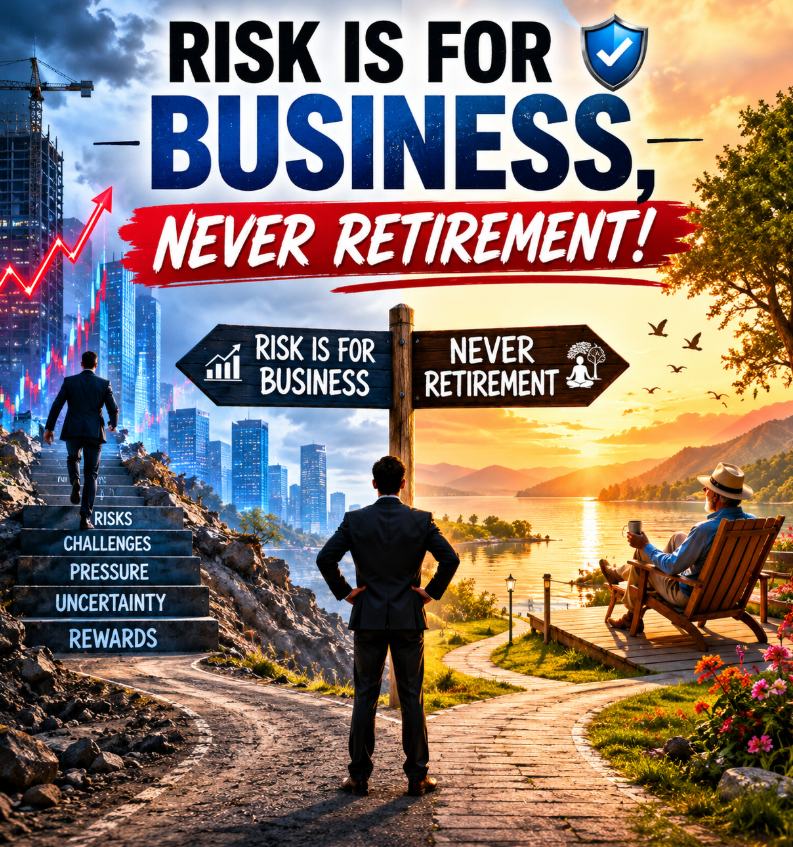
Start here: See what your retirement actually looks like → 👉 Book Your Million Dollar Hour™
You’ve spent the last 30 or 40 years as a "Quiet Builder." You took risks. You grew a business, climbed the corporate ladder, or managed complex engineering projects. You understood that to build something of value, you had to put capital at risk. In the world of business, risk is the price of admission for growth.
But there's a fundamental difference you might be missing: in your business, you were the risk-mitigation strategy. You used your skill, knowledge, and sheer commitment to navigate the waters. You had a hand on the wheel. Wall Street risk? That's a different animal. It’s unpredictable, external, and entirely out of your control. No one knows when the market will drop, how deep the cut will be, or how often it will happen. You’ve moved from a game of skill to a game of chance, and that’s a dangerous place to park your retirement.
But now, as you look toward the finish line, something feels off. You’re checking the "Greed/Fear meter" of the market every morning. You’re looking at your 401(k) statement and wondering if a bad week on Wall Street is going to postpone your travel plans or, worse, your retirement date.
Here is the "Red Pill" truth: Risk is for business, not retirement.
The tools you used to accumulate your wealth: the 401(k)s, the stock portfolios, the aggressive "Participation" models: are the absolute wrong tools to distribute that wealth. You are trying to use a "Working Asset" to do a "Retired Asset's" job. It’s like trying to use a race car to tow a boat; it’s high-performance in the wrong environment, and eventually, the engine is going to blow.
The Identity Crisis: From Growth to Certainty
When you are in the "Accumulation Phase," you are playing the Wall Street game. Their game is built on Participation. They want you to participate in the market's ups and downs because they get paid on the assets under management, regardless of whether you win or lose. They use hidden complexity and daily "noise" to keep you addicted to the buying and selling cycle.
But retirement isn't about "opportunity" anymore. It’s about Engineering.
A "Working Asset" like a 401(k) is basically an employee still on the clock. It has to show up every day, survive the market, and hope conditions cooperate. A "Retired Asset" like an FPA is the boss. It pays you regardless of the weather. That is the identity crisis hiding inside most retirement plans.
In retirement, your goals shift from "How much can I make?" to "How much can I keep and spend with 100% certainty?" This is where most traditional retirement income planning fails. It relies on probabilities and "average returns" rather than contractual guarantees.

Working Assets vs. Retired Assets
Think of your assets in two categories:
Working Assets (The Teens): These are your 401(k)s, IRAs, and brokerage accounts. They are volatile, tax-exposed, and subject to the whims of the market. They are "Single-Pillar" assets: meaning they really only do one thing: they might go up in value. They are "Teens" because they are unpredictable and require constant supervision.
Retired Assets (The Foundation): These are Fully Performing Assets (FPA). These are the "Smartphones" of the financial world. Just as your smartphone consolidated your phone, camera, pager, and GPS into one device, an FPA consolidates 5 to 15 pillars of value: growth, protection, LTC, and tax-free income: into one vehicle.
When fear is high, Wall Street sells you "protection" through so-called diversification. That is the ultimate bait-and-switch. They trap you in short-term trading inside a "long-term" world, constantly violating the very identity and strategy they claim to represent. AI and diversification are just shiny wrappers for the same old win/lose game.
The contradiction of modern retirement is trying to solve a certainty-based problem (lifetime income) with a risk-based tool (the stock market).
You didn't work 40 years to become a full-time hedge fund manager for your own groceries. You worked to buy back your time. If you’re still worried about market volatility, you haven't retired; you’ve just changed bosses from a CEO to a ticker symbol.
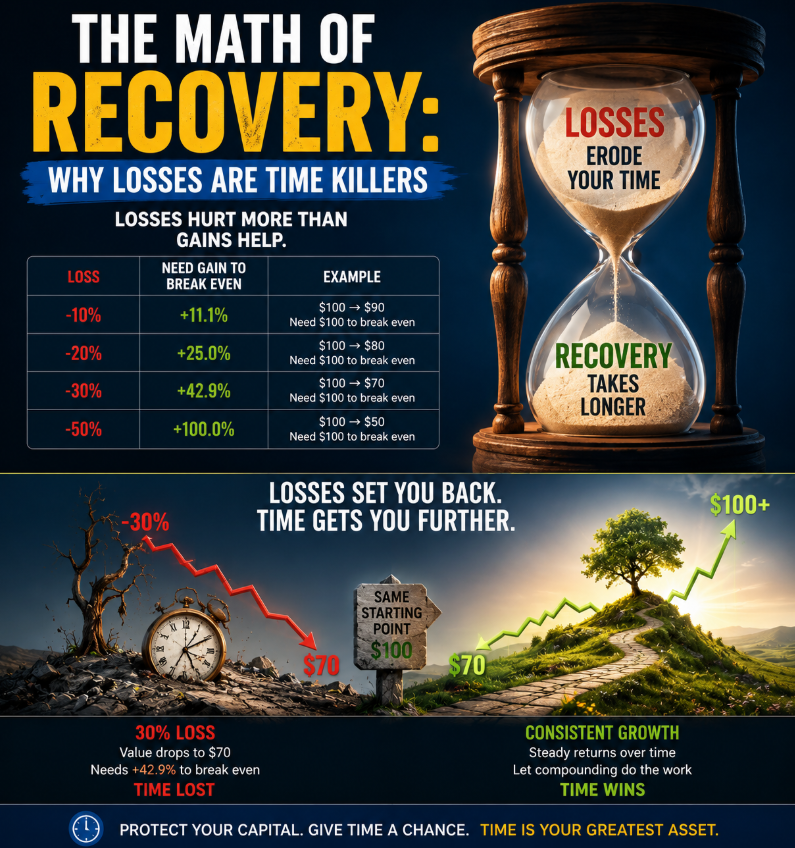
The Math of Recovery: Why Losses are Time Killers
Wall Street loves to talk about "Average Returns." But you can’t spend an average at the grocery store. You spend actual dollars.
Let’s look at The Math of Recovery. If your portfolio takes a 30% hit: something we’ve seen happen repeatedly in recent decades: you don't just need a 30% gain to get back to even. Because you are working with a smaller pile of money, you actually need a 42.9% gain just to return to your starting point.
In retirement, this math is even more lethal. If you are withdrawing money for income while the market is down, you are cannibalizing your "Retirement Engine." This is called Sequence of Return Risk, and it is the professional assassin of wealth. While money can eventually recover, time never does. Every year spent "getting back to even" is a year of your life you’ll never get back.

The Margin Audit™: Engineering vs. Hoping
On Your Street, we don't "hope" for a good market. We use Engineered Performance. We perform a Margin Audit™ to look at the micro-margins of your plan: the fees, the taxes, and the "leaks" that Wall Street ignores.
We categorize your wealth using the Asset Pyramid:
NPA (Non-Performing Assets): Cash and emergency funds. Necessary, but they don't move the needle.
AAR (Assets At Risk): Your traditional Wall Street "Participation" accounts. Fine for building, dangerous for withdrawing.
FPA (Fully Performing Assets): The foundation. These offer Uncapped Gains (UCG) and Expanded Market Participation (EMP). Imagine a world where you can capture 110% to 200% of the market's upside, but your floor is 0%. If the market drops 30%, you stay at zero. You never have to do the "Math of Recovery."
This isn't a "1980s Reagan-era" strategy. This is modern, institutional-grade Asset Liability Management (ALM). It’s the same architecture used by major banks to ensure they never run out of money. Why wouldn't you use the same architecture for your own household?
A Rolodex in a SpaceX World
Most people are entering retirement using a financial plan that looks like a "Rolodex in a SpaceX world." It was durable for its era, but it’s inadequate for the speed and volatility of today’s markets.
The best retirement income strategies today require a shift from "Single-Pillar" thinking (buying a stock and hoping it goes up) to "Multi-Pillar" engineering. When you move your money from Wall Street’s "False Model" to Your Street’s Engineering, you gain:
Certainty vs. Uncertainty: Knowing your future value instead of hoping for it.
Guarantees vs. Probabilities: Contractual promises instead of optimistic projections.
Control vs. Dependence: You control the outcome; you don't depend on a market "Greed Cycle."
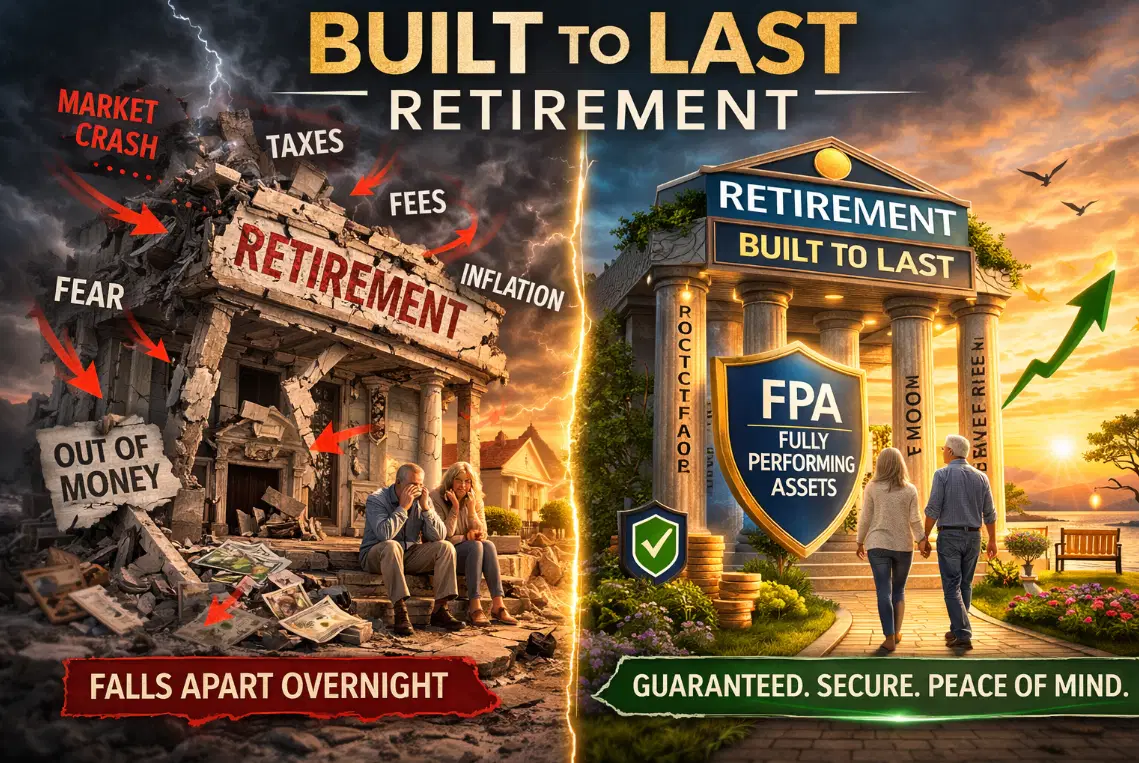
Protect Your Time, Engineer Your Peace
If you are uneasy, it’s not because you lack money; it’s because you lack a designed process. You are currently "Participating" in a system designed to extract value from you. It’s time to move to a system designed to provide value to you.
The path to a guaranteed retirement income and the ability to protect retirement savings from a market crash isn't found in a new "hot stock" or a "balanced" mutual fund. It's found in the architecture.
Audit the margin. Protect your time. Engineer certainty.
Peace is the path, wisdom is the way. It’s your money, your rules, in your time, on your street.
Ready for clarity instead of confusion?
The Million Dollar Hour™ is your educational, one-on-one retirement review that reveals where your plan leads : not just where it’s been.
👉 Schedule your session today.
Discover Which Wealth Killers Are Affecting You
Most people are impacted by 6–9 and don’t realize it
Wealth Killer #1: The Granddaddy : Why Market Volatility is Your Retirement’s Greatest Enemy
Concerned about market losses, taxes, or income reliability?
Take the 7 Question Retirement Stress Test →
You can keep participating… Or you can finally see the outcome. The Million Dollar Hour™ shows you exactly:
✔ Where you are ✔ Where you’re going ✔ How to fix the gaps 👉 Book your session now
Check out the Retirement Blueprint