
Retirement Strategies That Maximize Income, Eliminate Risk, and Help Ensure You Never Run Out of Money How to Achieve The Retirement Future Everyone Seeks
Most retirement plans are built on assumptions that no longer hold up—market averages, predictable tax rates, and the belief that time will always recover losses. But as you approach or enter retirement, the rules change. What worked during your accumulation years can become a liability during the withdrawal phase.
This blog is designed to help you rethink traditional strategies and discover a more engineered approach to retirement income—one focused on certainty, efficiency, and control.
Here, you’ll learn how to reduce or eliminate the biggest threats to your financial future, including market losses, rising taxes, hidden fees, and the silent erosion caused by lost time. We break down complex financial concepts into clear, actionable insights so you can make better decisions about your 401(k), IRA, and retirement income strategy.
You’ll also discover why many conventional approaches—like relying on average returns or the 4% rule—can expose you to unnecessary risk, especially when withdrawals begin. Instead, we explore strategies designed to protect your principal, improve compounding efficiency, and create predictable income streams that last.
Our focus is on helping you transition from “assets at risk” to a more stable and structured approach using fully performing assets—where growth, income, and protection work together instead of against each other.
Whether you’re still working or already retired, the goal is simple:
help you keep more of what you earn, generate more reliable income, and build a plan that doesn’t depend on hope, timing, or market luck.
If you’ve ever wondered:
* How to create tax-efficient retirement income
* How to avoid sequence of returns risk
* How to reduce fees and increase net returns
* How to design income that doesn’t run out
—you’re in the right place.
Explore the articles below and start building a retirement strategy based on engineering, not guesswork.

The Silo Trap: Protect Retirement Savings from Market Crash
The Silo Trap: Why Wall Street Wants You Making Decisions in the Dark
One of the fastest ways to uncover hidden risk is to take our 7 Question Retirement Stress Test.
![[HERO] The Silo Trap: Why Wall Street Wants You Making Decisions in the Dark](https://cdn.marblism.com/4N52fFR2Yok.webp "[HERO] The Silo Trap: Why Wall Street Wants You Making Decisions in the Dark")
Start here: See what your retirement actually looks like → 👉 Book Your Million Dollar Hour™
Wall Street’s Silo Trap: The Hidden Reason Your Retirement Feels Like a Junk Drawer
Most people have been taught to think about wealth in overly simple, one-dimensional terms.
You’ve probably sat across from a desk where an advisor asked you:
“Do you want growth?”
“Do you want income?”
“Do you want safety?”
It sounds like a reasonable starting point, right? But here is the truth: It’s a trap. It’s a framing device designed to reduce your complex future into a single choice: as if checking one box doesn't fundamentally break the others.
In the world of institutional engineering, we call this the Silo Trap. And if you are a "Quiet Builder": someone who has spent decades accumulating $500k, $1M, or $5M+: this trap is the single greatest threat to your peace of mind.
The Business of Isolation
Why does Wall Street love silos? Why do they want to keep your "retirement income planning" in one conversation and your "tax strategy" in another?
Because isolation is profitable.
When your wealth is fragmented into separate silos, the financial firm benefits in three specific ways:
Fee Extraction: They can charge you separate management fees for every "bucket" you own.
Defensibility: If your "Growth Silo" is down 20%, they’ll point to your "Safety Silo" (which likely earned a measly 2%) to distract you. It’s easier to defend underperforming silos than it is to defend a failing integrated architecture.
The Churn: By treating your needs as separate, they create the "need" for constant movement between assets.
In a traditional retirement plan review, you aren’t looking at a blueprint. You’re looking at a collection of separate products that happen to be in the same folder. This isn't architecture; it’s a junk drawer.
The 7 Dimensions of Your Future
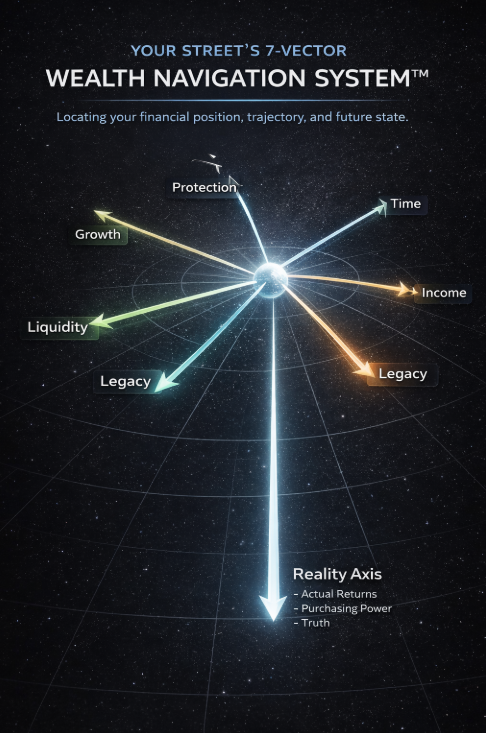
Real wealth doesn’t work in silos. Every financial decision you make creates a ripple effect across seven key dimensions of your life. At Your Street Wealth, we call these the 7-Vectors.
If you change one, you change them all. Wall Street wants you to look at one at a time. We insist you look at all seven simultaneously:
Growth: Is your money actually growing, or is it just "participating" in the market's mood swings?
Protection: Do you have a contractual floor, or are you just hoping for the best?
Income: Is your income guaranteed for life, or is it a "probability" based on a 4% rule that was written in a different era?
Taxes: Are you building a tax-free legacy or a ticking tax time bomb for your heirs?
Time: The most valuable asset. Are you spending your time worrying about market tickers, or is your wealth engineered to buy your time back?
Legacy: Will your wealth transfer efficiently, or will it be eroded by probate and mismanagement?
Control: Do you own the rules of your money, or does the government and the custodian own them?
For a deeper look at the mathematical difference between Wall Street's flat map and our multi-vector navigation, read our breakdown on 2D vs 7D Wealth Architecture.
One of the fastest ways to uncover hidden risk is to take our 7 Question Retirement Stress Test.
Participation vs. Engineered Performance
Most investors are simply "participating." They are passengers on the Wall Street bus. When the market goes up, they feel like geniuses. When the market crashes, they are told to "stay the course."
This "stay the course" advice is a classic Silo Trap tactic. It ignores the Math of Recovery.
Consider this: If your portfolio takes a 30% hit in a market crash, you don't just need a 30% gain to get back to even. You need a 42% gain just to return to the starting line. While you are waiting years for that recovery, you are losing the one thing you can never get back: Time.

Suggested Image: A graphic showing the Math of Recovery (e.g., -30% = +42% to break even) to illustrate "Volatility Recovery Analysis."
At Your Street Wealth, we trade "Participation" for Engineered Performance.
Think of it like the transition from the old tools of the 1980s to the smartphone in your pocket. In the past, you needed a camera, a pager, a map, and a phone. Those were "single-pillar" tools. Today, the smartphone is a "multi-pillar" device that integrates everything into one sleek architecture.
Traditional assets like stocks, bonds, and real estate are single-pillar tools. They are a "Rolodex in a SpaceX world." They might do one thing okay, but they fail to address the integration required for a modern retirement.
We utilize Fully Performing Assets (FPA). These are the "smartphones" of finance. An FPA can provide 5 to 15 pillars of value: including Uncapped Gains (UCG) and a 0% floor: within a single contractual vehicle. This is how you protect retirement savings from a market crash while still maintaining the ability to capture growth.
The 7D Priority Architecture: Designing Your Future
The solution to the Silo Trap is a shift in perspective. You must stop making isolated decisions and start designing an integrated future.
Instead of asking "What should I buy?", the question you should be asking is:
“What matters most to me: in priority order: across all dimensions of my future?”
Most people have never been guided through this process. They’ve been sold products, but they haven’t been given a Priority Architecture.
When you clearly define your priorities across the 7 Vectors, you take control. When you don’t, you unintentionally hand that control to the firms that benefit from your confusion.
This is the core of the 7-Vector Wealth Navigation System™. We don't guess; we engineer. We look at the "Margin Audit™" of your current path. We analyze the "Sequence of Return Margin" to ensure that a bad year in the market doesn't derail twenty years of retirement income planning.
Why Complexity is a Weapon
Wall Street uses hidden complexity to drive a "False Model" fueled by greed and fear. They want you checking your apps daily, addicted to the noise of macro headlines. Why? Because an anxious investor is a profitable client for a firm that charges for "activity."
But wealth isn't built on macro headlines; it’s built on micro margins.
By engineering your wealth with institutional-grade Asset Liability Management (ALM) principles, you move away from "probabilities" and into "certainties." You stop spinning sharp knives and start building a foundation.
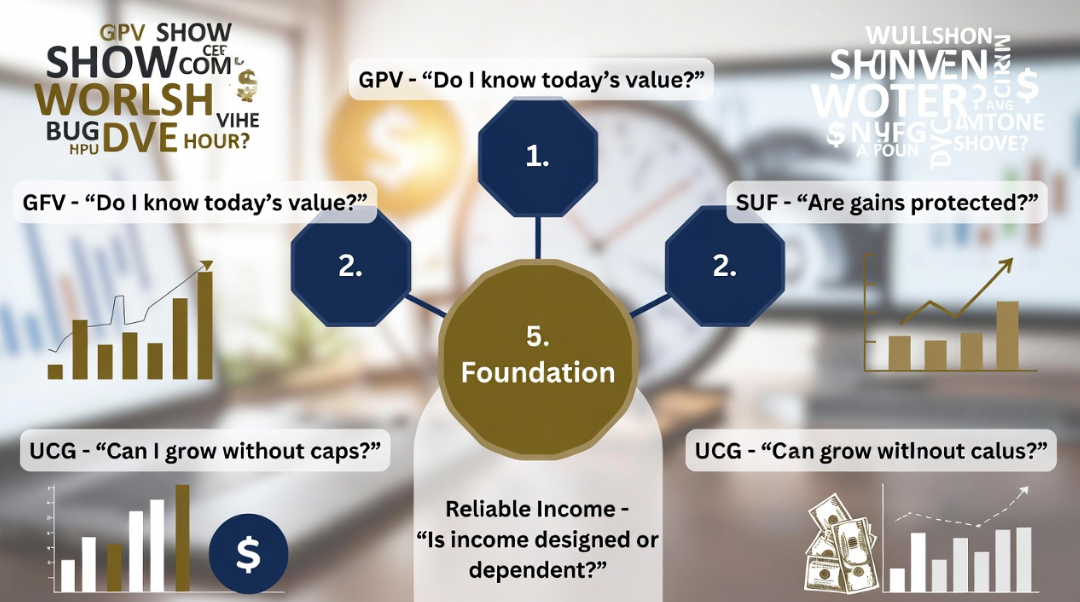
Audit the Margin, Protect the Time
If you are feeling financially fatigued, it’s likely because you are tired of managing silos that don't talk to each other. You are tired of the "2D Trap" of Risk vs. Return.
It is time to unlearn the myths of the "Participation" era.
Certainty vs. Uncertainty: Knowing your future value versus hoping for a projection.
Guarantees vs. Probabilities: Contractual floors versus S&P 500 "averages."
Growth Without Loss vs. Growth With Loss: Forward momentum versus resetting the clock every five years.
Money can recover. Time never does.
Your Next Step: The Million Dollar Hour™
We don't offer "free consultations" because we don't chase "mice" looking for free cheese. We work with Quiet Builders who understand that true financial architecture is a professional discipline worth the investment.
The Million Dollar Hour™ is a $995 deep-dive Engineering and Margin Audit. In sixty minutes, we strip away the Wall Street noise and look at your 7D Priority Architecture.
We don’t look at where you’ve been; we forecast exactly where your current path leads. We look for the "leaks": the fees, the taxes, and the volatility risks: and we show you how to engineer a path of certainty.
Stop making decisions in the dark. It’s time to turn the lights on.
Peace is the path, wisdom is the way.
Your Money. Your Rules. In Your Time. On Your Street.
Ready for clarity instead of confusion?
The Million Dollar Hour™ is your educational, one-on-one retirement review that reveals where your plan leads : not just where it’s been.
👉 Schedule your session today.
Discover Which Wealth Killers Are Affecting You
Most people are impacted by 6–9 and don’t realize it
Wealth Killer #1: The Granddaddy : Why Market Volatility is Your Retirement’s Greatest Enemy
Concerned about market losses, taxes, or income reliability?
Take the 7 Question Retirement Stress Test →
You can keep participating… Or you can finally see the outcome. The Million Dollar Hour™ shows you exactly:
✔ Where you are ✔ Where you’re going ✔ How to fix the gaps 👉 Book your session now
Check out the Retirement Blueprint