
Retirement Strategies That Maximize Income, Eliminate Risk, and Help Ensure You Never Run Out of Money How to Achieve The Retirement Future Everyone Seeks
Most retirement plans are built on assumptions that no longer hold up—market averages, predictable tax rates, and the belief that time will always recover losses. But as you approach or enter retirement, the rules change. What worked during your accumulation years can become a liability during the withdrawal phase.
This blog is designed to help you rethink traditional strategies and discover a more engineered approach to retirement income—one focused on certainty, efficiency, and control.
Here, you’ll learn how to reduce or eliminate the biggest threats to your financial future, including market losses, rising taxes, hidden fees, and the silent erosion caused by lost time. We break down complex financial concepts into clear, actionable insights so you can make better decisions about your 401(k), IRA, and retirement income strategy.
You’ll also discover why many conventional approaches—like relying on average returns or the 4% rule—can expose you to unnecessary risk, especially when withdrawals begin. Instead, we explore strategies designed to protect your principal, improve compounding efficiency, and create predictable income streams that last.
Our focus is on helping you transition from “assets at risk” to a more stable and structured approach using fully performing assets—where growth, income, and protection work together instead of against each other.
Whether you’re still working or already retired, the goal is simple:
help you keep more of what you earn, generate more reliable income, and build a plan that doesn’t depend on hope, timing, or market luck.
If you’ve ever wondered:
* How to create tax-efficient retirement income
* How to avoid sequence of returns risk
* How to reduce fees and increase net returns
* How to design income that doesn’t run out
—you’re in the right place.
Explore the articles below and start building a retirement strategy based on engineering, not guesswork.

Wall Street AI vs. Retirement Certainty: The Win-Lose Truth
The AI Illusion: Why Wall Street’s Digital "Savior" Can’t Fix a Win/Lose Game
One of the fastest ways to uncover hidden risk is to take our 7 Question Retirement Stress Test.

Start here: See what your retirement actually looks like → 👉 Book Your Million Dollar Hour™
The AI Illusion: Why Wall Street’s Digital "Savior" Can’t Fix a Win/Lose Game
If you’ve turned on a television or scrolled through a financial news feed lately, you’ve seen the ads. They feature soothing voices and sleek, high-tech visuals promising that Artificial Intelligence is the new "assurance" you need to build confidence in your portfolio.
They want you to believe that a more powerful algorithm can finally tame the wild beast of the market. They want you to think that "Participation" is safe now because a computer is watching the gate.
But here is the truth they will never publish: The platform of Wall Street is Win/Lose.
It is an architecture built on a zero-sum foundation. For every dollar won, a dollar must be lost. If that changed, it wouldn't be Wall Street anymore. AI isn't here to change the game; it’s here to make the house win faster.
The Architecture of the House: Why $1 Won = $1 Lost
Wall Street operates exactly like a high-end casino. The lights are brighter, the suits are more expensive, and the jargon is denser, but the mechanics are identical.
In a Win/Lose system, your "gain" is often just the mathematical byproduct of someone else’s "loss." When you buy a stock at what you think is a "low," you are buying it from someone who believes it’s going lower. One of you is right. One of you is wrong.
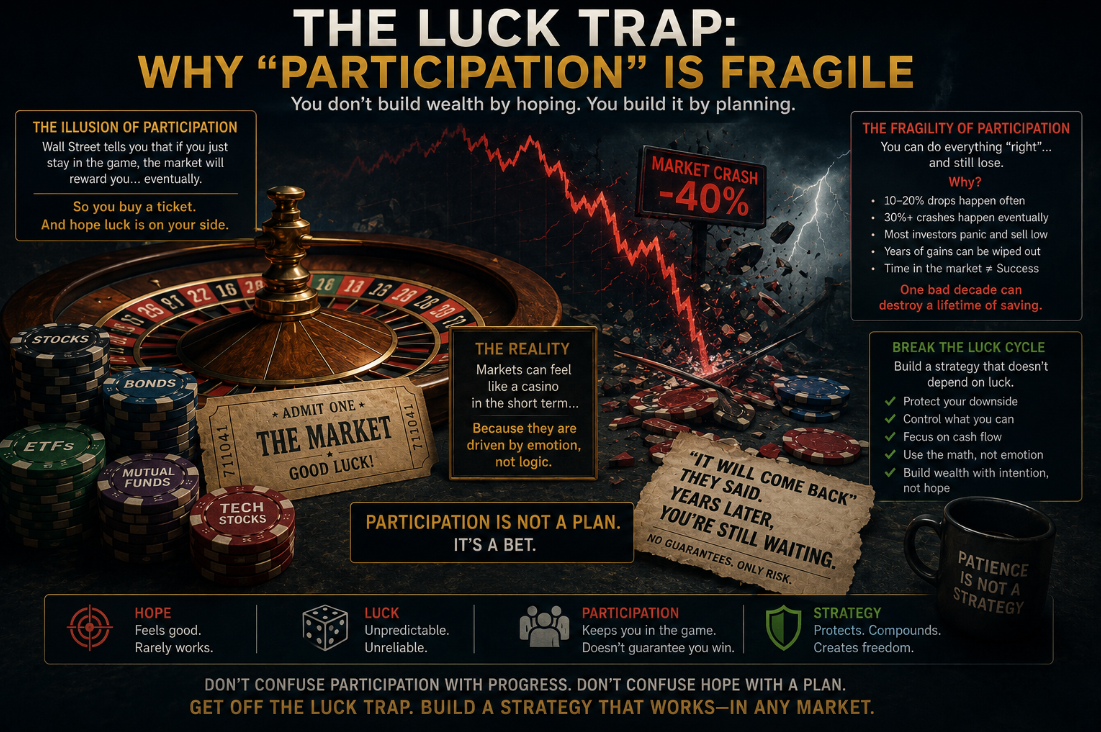
The "House" (Wall Street firms, brokers, and clearinghouses) doesn't care who wins the individual hand. They win 51% to 75% of the time simply through transaction volume.
The lower percentages of their win rate are due to probability, so their entire business model focuses on one thing: Increasing the volume of transactions. The more often you trade, roll forward, or "rebalance," the more they win. They thrive on activity; you thrive on compounding. These two goals are fundamentally at odds.
The Fear & Greed Design: FOMO and FOLO
To keep the volume high, Wall Street relies on a carefully engineered emotional cycle. They promote a "Greed/Fear" meter that they manipulate with precision:
FOMO (Fear Of Missing Out): When the market is high (Greed), they show you the "winners" to make you feel like the only one left behind. This lures you into Assets at Risk (AAR) at the exact moment they are most vulnerable.
FOLO (Fear Of Losing Out): When the market dips, they pivot to fear. They remind you that you could lose everything, encouraging a "sell" or a "rotation" that triggers more fees and locks in losses.
This is a "Sleight of Hand" operation. They promote the winners: the 3% of individuals who possess the segregated, professional mindset of a gambler: while ignoring the vast majority who are being harvested by the system.
The 1-to-Many Trap: Why One Trade Can Wipe Out Thousands
Wall Street doesn't just play "one-on-one." They play 1-to-Many.
Through sector weighting and market weighting, thousands of individual "Quiet Builders" can be wiped out by a single industry trade. When a major sector corrects, the "Market Weight" drags down every participant, regardless of their individual "savior" AI settings.
They never publish the truth of these industry-wide losses. They hide the decline behind a "Participation" mask, telling you to "stay the course" while the house edge expands from 51% to 75% due to the inevitable mistakes made by fatigued, emotional investors.
The Invisible Decline: Losing 10x Your Contribution
Most retirees don’t realize they are losing 5x to 10x their actual contributions over time. This happens through the Math of Recovery and hidden leaks.

When you suffer a 30% market loss, you don't need a 30% gain to get back to even. You need a 42% gain just to see $0 growth. While you are chasing that 42%, you are losing time: the one asset that never recovers.
When you combine market volatility with Non-Performing Assets (NPA) and the high fees of Single Pillar traditional assets, the "Compounding Efficiency" of your life’s work is shattered. Wall Street is a business intended to make money while appearing to be worthy of your confidence. It is a "False Model" driven by the need to extract value from your pocket to theirs.
Why AI is Not a Panacea
AI is being promoted as the digital savior of the retiree, but AI cannot contradict the architecture of the platform it runs on.
If you put a Ferrari engine in a car that’s driving toward a cliff, you just get to the edge faster. AI might help a broker trade more efficiently, but it doesn't change the fact that they are operating in a Win/Lose environment.
True financial architecture isn't about "guessing better" with a computer; it's about Engineering Certainty.
At Your Street Wealth, we move clients away from the "Gambling" of Wall Street and toward Fully Performing Assets (FPA). We contrast the "Participation" (Hoping) model with the "Performance" (Knowing) model.
Discover Which Wealth Killers Are Affecting You
Most people are impacted by 6–9 and don’t realize it
Wealth Killer #1: The Granddaddy : Why Market Volatility is Your Retirement’s Greatest Enemy
Concerned about market losses, taxes, or income reliability?
Take the 7 Question Retirement Stress Test →
You can keep participating… Or you can finally see the outcome. The Million Dollar Hour™ shows you exactly:
✔ Where you are ✔ Where you’re going ✔ How to fix the gaps 👉 Book your session now