
Retirement Strategies That Maximize Income, Eliminate Risk, and Help Ensure You Never Run Out of Money How to Achieve The Retirement Future Everyone Seeks
Most retirement plans are built on assumptions that no longer hold up—market averages, predictable tax rates, and the belief that time will always recover losses. But as you approach or enter retirement, the rules change. What worked during your accumulation years can become a liability during the withdrawal phase.
This blog is designed to help you rethink traditional strategies and discover a more engineered approach to retirement income—one focused on certainty, efficiency, and control.
Here, you’ll learn how to reduce or eliminate the biggest threats to your financial future, including market losses, rising taxes, hidden fees, and the silent erosion caused by lost time. We break down complex financial concepts into clear, actionable insights so you can make better decisions about your 401(k), IRA, and retirement income strategy.
You’ll also discover why many conventional approaches—like relying on average returns or the 4% rule—can expose you to unnecessary risk, especially when withdrawals begin. Instead, we explore strategies designed to protect your principal, improve compounding efficiency, and create predictable income streams that last.
Our focus is on helping you transition from “assets at risk” to a more stable and structured approach using fully performing assets—where growth, income, and protection work together instead of against each other.
Whether you’re still working or already retired, the goal is simple:
help you keep more of what you earn, generate more reliable income, and build a plan that doesn’t depend on hope, timing, or market luck.
If you’ve ever wondered:
* How to create tax-efficient retirement income
* How to avoid sequence of returns risk
* How to reduce fees and increase net returns
* How to design income that doesn’t run out
—you’re in the right place.
Explore the articles below and start building a retirement strategy based on engineering, not guesswork.

Why One 65-Year-Old Ran Out of Money and the Other Thrived
The Tale of Two 65-Year-Olds: Why One Retiree Ran Out of Money and the Other Thrived
One of the fastest ways to uncover hidden risk is to take our 7 Question Retirement Stress Test.
![[HERO] The Tale of Two 65-Year-Olds: Why One Retiree Ran Out of Money and the Other Thrived](https://cdn.marblism.com/vwl7N3_qfr9.webp "[HERO] The Tale of Two 65-Year-Olds: Why One Retiree Ran Out of Money and the Other Thrived")
Start here: See what your retirement actually looks like → 👉 Book Your Million Dollar Hour™
The $400k Coin Toss: How Two Identical Retirements Ended in Total Opposite Worlds
Imagine two neighbors, Bob and Sue. Both are 65 years old. Both have spent the last forty years working hard, staying disciplined, and saving exactly $400,000 for their "Golden Years."
On the day they retire, they have the exact same goal: they want to withdraw $24,000 a year (a 6% withdrawal rate) to supplement their Social Security and live a comfortable, stress-free life. They aren't asking for yachts; they’re asking for certainty.
But here is where the paths diverge. Bob takes the Wall Street Path. Sue takes the Your Street Path.
Fast forward twenty-four years. Bob is 89 years old, and he just received a notification that his account balance is $0. He is broke, stressed, and facing his 90s with nothing but a government check. Meanwhile, Sue is 89, her account is worth more than when she started, and she’s looking forward to a legacy that will last well past her 100th birthday.
What happened? Did Sue get "lucky" with the market? Did Bob pick the "wrong" stocks?
No. Bob relied on Probability. Sue relied on Certainty.
The Wall Street Path: Dancing in the "Red Zone"
Bob followed the standard advice. He was told that as long as the market "averaged" 7% or 8%, his 6% withdrawal would be "safe." This is what we call the Participation Model. You participate in the market’s gains, but you also participate in its destruction.

Bob’s downfall wasn't a lack of effort; it was a lack of Engineering. He fell victim to three specific "Wall Street Carnivores" that eat principal for breakfast:
1. Sequence of Returns Risk
This is the silent killer of retirement. When you are adding money to a 401(k), volatility can actually be your friend (dollar-cost averaging). But when you are withdrawing money, volatility becomes your enemy. If the market drops 20% in the first few years of your retirement and you still pull out your $24,000, you are selling shares at a massive discount. Those shares are gone forever. They can’t recover.
2. The Math of Recovery
Wall Street loves to talk about "averages," but you can’t spend an average. If Bob loses 30% of his portfolio, he doesn’t just need a 30% gain to get back to even. He needs a 42.8% gain just to break even. While he’s waiting for that 42.8% recovery, he’s still withdrawing $2,000 a month. He’s effectively spinning sharp knives while blindfolded.
3. The Dripping Faucet of Fees
Bob was paying 1.5% to 2% in management fees and internal fund costs. It sounds small, but over 20 years, that’s a massive leak in his boat. It’s a "Single Pillar" model where he’s paying for "hope" and getting "volatility."

The Your Street Path: Engineered Performance
Sue decided she was done with the "Rolodex in a SpaceX world" strategy. She didn't want a retirement based on a "Probability" (the hope that the market stays up). She wanted a retirement based on Contractual Certainty.
Sue moved her $400,000 into Fully Performing Assets (FPA). While Bob was stuck in "Assets at Risk" (AAR), Sue built a foundation of stability.
Here is how Sue’s math worked:
0% is the Hero: In years where the market crashed, Sue’s account stayed exactly where it was. She had Growth Without Loss.
Uncapped Gains (UCG) & Expanded Market Participation (EMP): In the good years, Sue didn't just participate; she used multipliers. If the market went up 10%, her EMP might have pushed her gain to 12% or 15%.
Increasing Income: Because she wasn't constantly digging out of a "recovery hole," her principal stayed intact, allowing her income to actually rise over time instead of depleting.
Sue’s path wasn't about "beating the market." It was about Compounding Efficiency. She eliminated the "Volatility Recovery Analysis" nightmares that kept Bob awake at night.
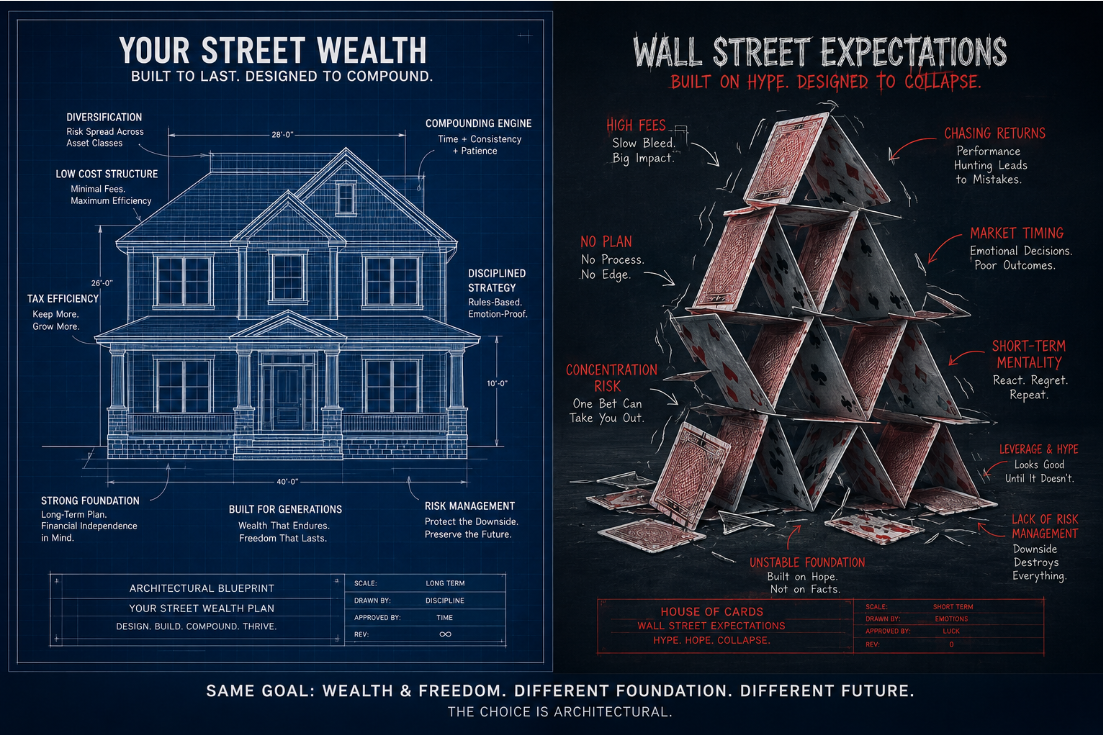
The "Smartphone" of Finance vs. The Rolodex
Think about your smartphone. It replaced your camera, your pager, your map, and your phone. It’s a multi-pillar device.
Traditional Wall Street assets (Stocks, Bonds, Real Estate) are "Single Pillar" assets. They do one thing, and they often come with high fees or high risk. Sue’s FPA strategy is the Smartphone of Finance. It consolidates 5 to 15 "pillars" of value: growth, protection, tax-free access, and long-term care benefits: into one engineered vehicle.
By moving to this modern architecture, Sue protected her Sequence of Return Margin. She didn't have to worry about "When" the market crashed, because her plan was designed to heal itself.
The 4% Rule Myth
For decades, the "4% Rule" was the gold standard. The idea was that if you withdrew 4% of your nest egg every year, you’d likely never run out.
But look at the math for Bob. He tried a 6% withdrawal ($24,000 on $400,000) and ran out of money at age 89. Even at 4%, many retirees today are finding that inflation and market "uncontrolled loss cycles" make that rule a dangerous gamble.
At Your Street Wealth, we don't believe in "Safe Withdrawal Rates." We believe in Income by Design. Why settle for a 4% "probability" when you can engineer a 6% or 7% "certainty"?

Peace is the Path, Wisdom is the Way
The difference between Bob and Sue wasn't their intelligence or their work ethic. The difference was their Architecture.
Bob was a "Participant." He was a passenger on the Wall Street roller coaster, paying for the privilege of the ride.
Sue was an "Architect." She used a Margin Audit™ to find the leaks in her plan and plugged them before she retired.
Wealth isn't built on macro headlines; it’s built on micro margins. It’s about ensuring that every dollar is performing multiple tasks simultaneously.

Which Path Are You On?
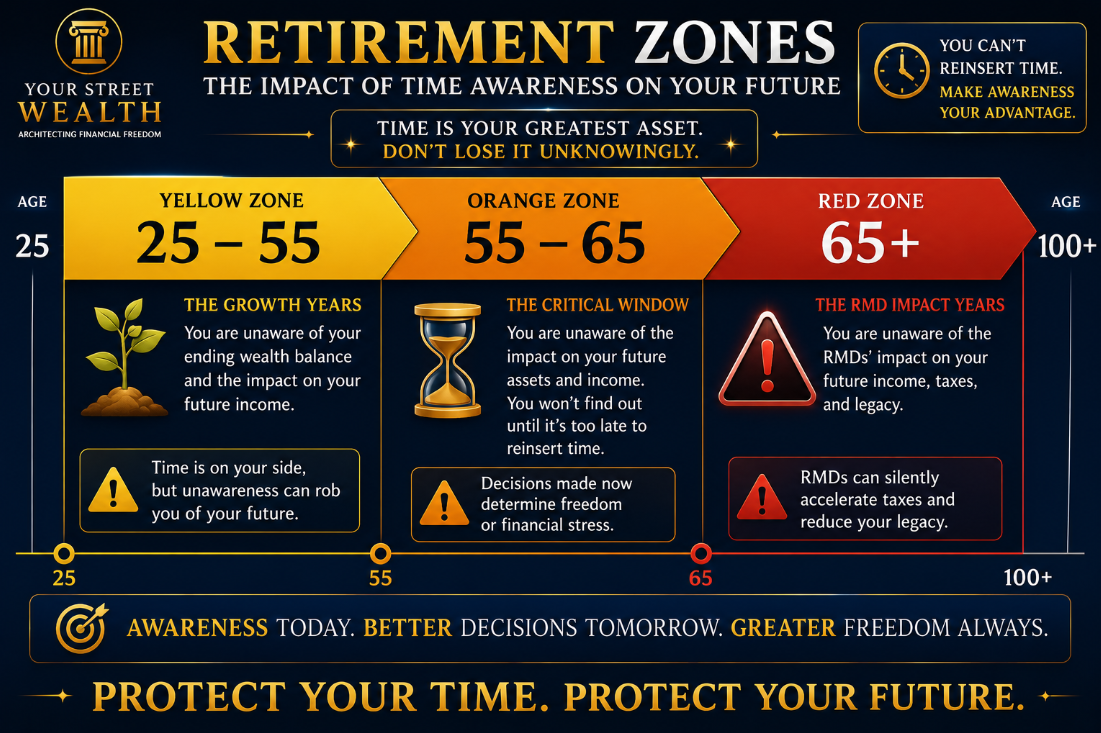
The "Red Zone" of retirement: the period where you are most vulnerable to market crashes: usually begins 5 years before you retire and lasts 10 years into it. If you are 55, 60, or 65, you are standing exactly where Bob and Sue stood.
The question is: Do you actually know where your current path leads?
Most people are flying blind, relying on a "False Model" driven by greed in the up years and fear in the down years. They hope the "Average" will save them. But as Bob found out, you can drown in a river that averages only two inches deep.
We offer a high-clarity, high-friction diagnostic called the Million Dollar Hour™ Forecast.
This isn't a "free consultation" where we try to sell you a mutual fund. This is a $995 professional Engineering and Margin Audit designed for "Quiet Builders": those who have worked hard and want to ensure their wealth is protected by institutional-grade Asset Liability Management (ALM). Guaranteed to show you how to Increase your account value by $20,000 - $100,000 immediately.
In one 60-minute session, we apply the same math used by major banks to your personal balance sheet. We reveal the "blind spots" that could lead to an age-89 depletion and show you how to shift into a strategy of Performance over Participation.
Your Money, Your Rules, In Your Time, On Your Street.
Don't leave your retirement to a coin toss. Stop participating in the risk and start engineering the result.
Ready for clarity instead of confusion?
The Million Dollar Hour™ is your educational, one-on-one retirement review that reveals where your plan leads : not just where it’s been.
👉 Schedule your session today.
Discover Which Wealth Killers Are Affecting You
Most people are impacted by 6–9 and don’t realize it
Wealth Killer #1: The Granddaddy : Why Market Volatility is Your Retirement’s Greatest Enemy
Concerned about market losses, taxes, or income reliability?
Take the 7 Question Retirement Stress Test →
You can keep participating… Or you can finally see the outcome. The Million Dollar Hour™ shows you exactly:
✔ Where you are ✔ Where you’re going ✔ How to fix the gaps 👉 Book your session now
Wealth Killer #2: The 4% Rule Myth : Why 'Safe' Withdrawal Rates Are Dangerous
Concerned about market losses, taxes, or income reliability?
Take the 7 Question Retirement Stress Test →