
Retirement Strategies That Maximize Income, Eliminate Risk, and Help Ensure You Never Run Out of Money How to Achieve The Retirement Future Everyone Seeks
Most retirement plans are built on assumptions that no longer hold up—market averages, predictable tax rates, and the belief that time will always recover losses. But as you approach or enter retirement, the rules change. What worked during your accumulation years can become a liability during the withdrawal phase.
This blog is designed to help you rethink traditional strategies and discover a more engineered approach to retirement income—one focused on certainty, efficiency, and control.
Here, you’ll learn how to reduce or eliminate the biggest threats to your financial future, including market losses, rising taxes, hidden fees, and the silent erosion caused by lost time. We break down complex financial concepts into clear, actionable insights so you can make better decisions about your 401(k), IRA, and retirement income strategy.
You’ll also discover why many conventional approaches—like relying on average returns or the 4% rule—can expose you to unnecessary risk, especially when withdrawals begin. Instead, we explore strategies designed to protect your principal, improve compounding efficiency, and create predictable income streams that last.
Our focus is on helping you transition from “assets at risk” to a more stable and structured approach using fully performing assets—where growth, income, and protection work together instead of against each other.
Whether you’re still working or already retired, the goal is simple:
help you keep more of what you earn, generate more reliable income, and build a plan that doesn’t depend on hope, timing, or market luck.
If you’ve ever wondered:
* How to create tax-efficient retirement income
* How to avoid sequence of returns risk
* How to reduce fees and increase net returns
* How to design income that doesn’t run out
—you’re in the right place.
Explore the articles below and start building a retirement strategy based on engineering, not guesswork.

Why Your Brokerage Statement Hides Real Retirement Growth
The Quiet Leak: Why Your Account Statements Are Designed to Hide the Truth
Start here: See what your retirement actually looks like → 👉 Book Your Million Dollar Hour™

One of the fastest ways to uncover hidden risk is to take our 7 Question Retirement Stress Test.
Is Your Retirement Statement Lying to You?
If you are a "Quiet Builder": a business owner, a retired engineer, or a former corporate executive: you value precision. You appreciate a blueprint that works because the math says it must, not because a salesman hopes it will.
Yet, every month, you receive a document that is fundamentally designed to obscure the truth.
Your brokerage or 401(k) statement arrives in your inbox or mailbox. It’s glossy. It has colorful charts. It usually has a "Personal Rate of Return" prominently displayed. But for most investors, these numbers are a mirage. They represent Participation, not Performance.
Wall Street thrives on hidden complexity. They want you focused on the "Average Return" while they quietly extract the "Compounding Efficiency" from your life’s work. At Your Street Wealth, we don't look at what the market did; we look at what you kept.
It’s time for a forensic deep-dive into the "Quiet Leak."
The Mirage of the "Average Return"
The first thing you must unlearn is the validity of the "Average Return" quoted by brokers. In the world of institutional-grade engineering, an average is often a useless metric.
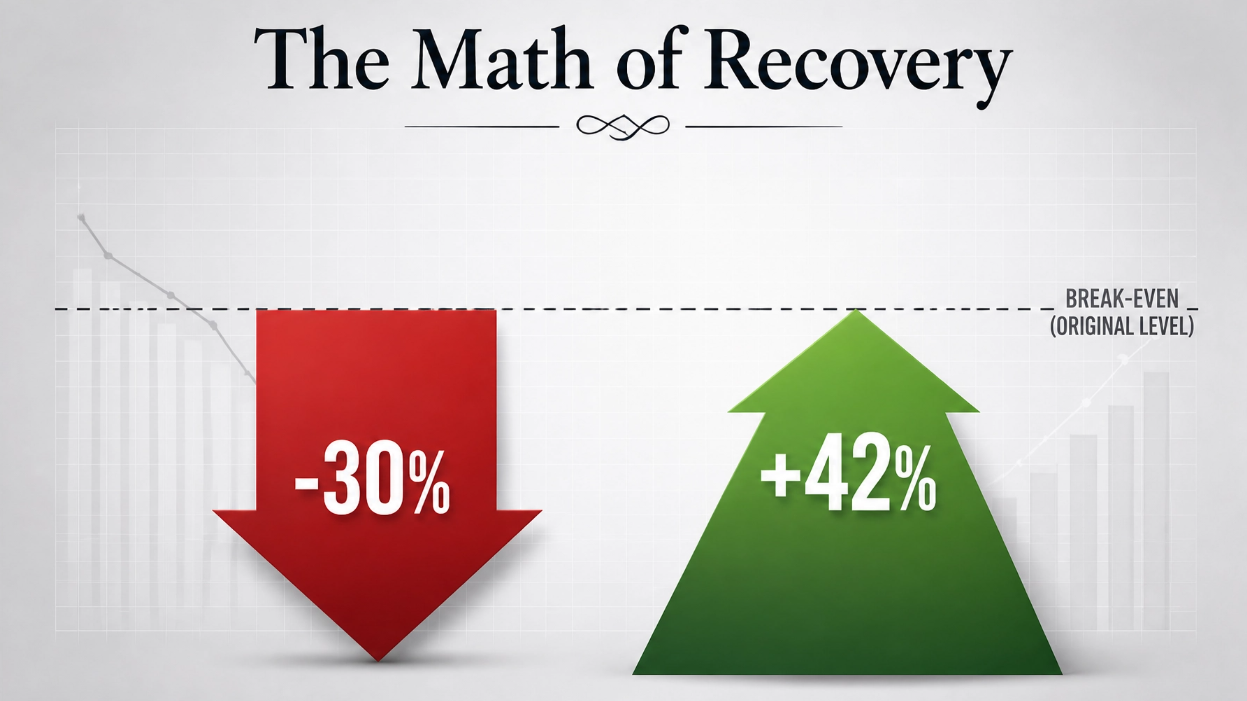
Imagine a portfolio that loses 30% in Year 1 and gains 30% in Year 2. Your broker might tell you that your "average return" is 0%. On paper, that sounds like you broke even.
But the math of reality: what we call The Math of Recovery: tells a different story.
If you start with $1,000,000 and lose 30%, you have $700,000. To get back to $1,000,000, you don't need a 30% gain; you need a 42.9% gain. If you only gain 30% on that remaining $700,000, you end up with $910,000.
You "averaged" 0%, but you actually lost $90,000 and, more importantly, you lost two years of compounding time. Money can recover. Time never does.
The Quiet Leak: The Compounding Efficiency Drain
Most investors are aware they pay fees. What they aren't aware of is how those fees are structured to hide within the architecture of the account. This is the Margin Audit™ territory: where we find the leaks that Wall Street hopes you’ll ignore.
There are three primary ways your statement hides the "Quiet Leak":
The Gross vs. Net Gap: Your statement often highlights the growth of the underlying assets (Participation) rather than the net compounded growth after all layers of fees.
Embedded Product Costs: Expense ratios inside mutual funds or ETFs are often deducted before the "price" is even reported on your statement. You see a lower return, but you never see a line item for the "bill."
The Dripping Faucet: A 1% or 2% fee sounds small. It’s framed as a "minor cost of doing business." But in the world of Compounding Efficiency, a 2% fee doesn't just take 2% of your money. Over a 30-year horizon, that 2% "leak" can eat 30% to 40% of your total ending wealth.

When we perform a Million Dollar Hour™ Forecast, we often find that a client’s "Statement Return" is 7%, but their Actual Compounded Growth is closer to 4%. That 3% delta is the price of participating in a system designed for the house to win.
Participation vs. Engineered Performance
Wall Street wants you to "participate." They use "opportunity language" to keep you addicted to the daily ticker. They frame volatility as a necessary evil.
We frame it differently. We call it False Architecture.
Traditional Wall Street models rely on "Single Pillar" assets: stocks, real estate, or traditional bank accounts that serve one purpose and carry high risk or high fees. It’s like using a Rolodex in a SpaceX world. It was durable in the 1980s, but it is inadequate for the speed and risk of modern retirement planning.
We move our clients toward Fully Performing Assets (FPA). These are "Multi-Pillar" vehicles that consolidate 5–15 pillars of value (growth, protection, tax-free income, LTC, and more) into one engineered structure.
Think of it like the consolidation of technology. You used to carry a pager, a camera, a map, and a phone. Now, you have a smartphone. The FPA is the "smartphone" of finance. It eliminates the need for high-risk gambling by engineering Uncapped Gains (UCG) and Expanded Market Participation (EMP) with a 0% Floor.

Audit Your Margin: The Path to Certainty
If your retirement plan is based on "probabilities" and "projections," you aren't planning; you’re hoping.
The Quiet Builder knows that hope is not a strategy. You need Contractual Guarantees. You need to know that your income is designed, not dependent on whether the S&P 500 has a good year.
When you look at your next statement, ask yourself these three forensic questions:
What is my Actual Compounded Growth (CAGR) after ALL fees and losses?
How many "years of life" have I lost to market volatility in the last decade?
If the market drops 30% tomorrow, how does my "Statement Return" help me pay my mortgage?
If you can’t answer these with precision, you are likely a victim of the Quiet Leak.
Our Asset Pyramid approach prioritizes the foundation first. We move assets from the "At Risk" (Teens/Wall Street) and "Non-Performing" (Infants/Cash) categories into Fully Performing Assets (The Foundation). This shift changes the math from -30%/+30% (Wall Street) to 0%/+30% (Your Street).

Stop Chasing Returns, Start Engineering Certainty
The financial industry is built on a "False Model" driven by greed and fear. When greed is high, they sell you risk. When fear is high, they sell you "protection" that often comes with hidden caps and high costs.
We invite you to unlearn these myths. Retirement isn't about hitting a "home run" in the stock market; it's about the precision of your Sequence of Return Margin. It’s about ensuring that your wealth heals and grows, rather than leaks and decays.
Peace is the path, wisdom is the way.
If you are ready to stop "participating" in Wall Street's game and start engineering your own certain future, the next step is a Margin Audit™.
Ready for clarity instead of confusion?
The Million Dollar Hour™ is your educational, one-on-one retirement review that reveals where your plan leads : not just where it’s been.
👉 Schedule your session today.
Discover Which Wealth Killers Are Affecting You
Most people are impacted by 6–9 and don’t realize it
Wealth Killer #1: The Granddaddy : Why Market Volatility is Your Retirement’s Greatest Enemy
Concerned about market losses, taxes, or income reliability?
Take the 7 Question Retirement Stress Test →
You can keep participating… Or you can finally see the outcome. The Million Dollar Hour™ shows you exactly:
✔ Where you are ✔ Where you’re going ✔ How to fix the gaps 👉 Book your session now