
Retirement Strategies That Maximize Income, Eliminate Risk, and Help Ensure You Never Run Out of Money How to Achieve The Retirement Future Everyone Seeks
Most retirement plans are built on assumptions that no longer hold up—market averages, predictable tax rates, and the belief that time will always recover losses. But as you approach or enter retirement, the rules change. What worked during your accumulation years can become a liability during the withdrawal phase.
This blog is designed to help you rethink traditional strategies and discover a more engineered approach to retirement income—one focused on certainty, efficiency, and control.
Here, you’ll learn how to reduce or eliminate the biggest threats to your financial future, including market losses, rising taxes, hidden fees, and the silent erosion caused by lost time. We break down complex financial concepts into clear, actionable insights so you can make better decisions about your 401(k), IRA, and retirement income strategy.
You’ll also discover why many conventional approaches—like relying on average returns or the 4% rule—can expose you to unnecessary risk, especially when withdrawals begin. Instead, we explore strategies designed to protect your principal, improve compounding efficiency, and create predictable income streams that last.
Our focus is on helping you transition from “assets at risk” to a more stable and structured approach using fully performing assets—where growth, income, and protection work together instead of against each other.
Whether you’re still working or already retired, the goal is simple:
help you keep more of what you earn, generate more reliable income, and build a plan that doesn’t depend on hope, timing, or market luck.
If you’ve ever wondered:
* How to create tax-efficient retirement income
* How to avoid sequence of returns risk
* How to reduce fees and increase net returns
* How to design income that doesn’t run out
—you’re in the right place.
Explore the articles below and start building a retirement strategy based on engineering, not guesswork.
Why Your Portfolio’s “Average Return” is a Bold-Faced Lie
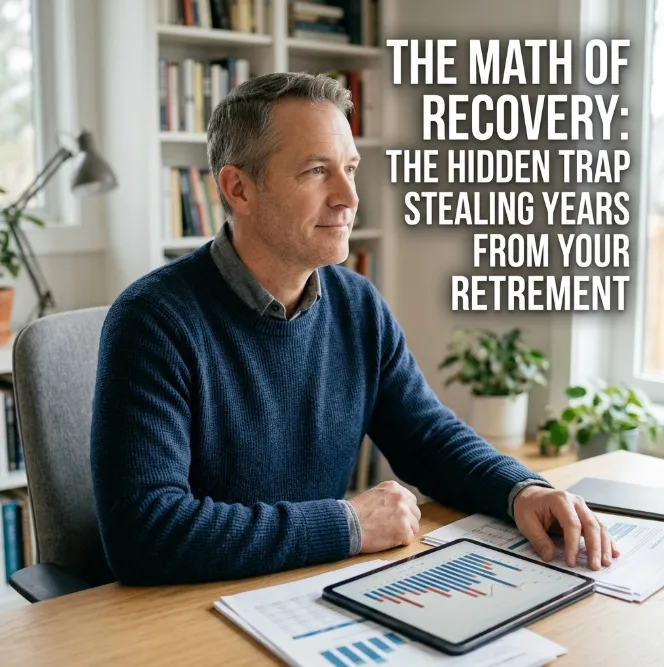
The Math of Recovery: The Hidden Trap Stealing Years From Your Retirement
One of the fastest ways to uncover hidden risk is to take our 7 Question Retirement Stress Test.
![[HERO] The Math of Recovery: The Hidden Trap Stealing Years From Your Retirement](https://cdn.marblism.com/mtqpjovFds-.webp "[HERO] The Math of Recovery: The Hidden Trap Stealing Years From Your Retirement")
Start here: See what your retirement actually looks like → 👉 Book Your Million Dollar Hour™
The Math of Recovery: Avoiding Sequence of Returns Risk
If you’ve spent any time talking to a traditional financial advisor, you’ve heard the "Average Return" pitch. It sounds comforting, doesn't it? "Don't worry about the dip, the S&P 500 averages 10% over the long haul!"
But averages are a Wall Street smoke screen. They are designed to keep you participating in a system that feeds on your uncertainty. In reality, you don’t eat "average" returns. You eat actual dollars.
There is a mathematical trap lurking in your portfolio that Wall Street rarely mentions. It’s called the Math of Recovery, and it is the engine behind one of the most dangerous Wealth Killers in existence: sequence of returns risk.
If you don't understand this math, you aren't just losing money during a market crash: you are losing the one thing you can never get back: Time.
The Brutal Reality of Math: Why Down 30% Doesn't Mean Up 30%
Most people think of their portfolio like a seesaw. If it goes down 10%, it just needs to go up 10% to get back to level, right?
Wrong.
Math doesn't work that way. When you lose money, you lose the capacity for that money to grow. You have to work twice as hard just to get back to the starting line. This is what we call "Volatility Recovery Analysis."
Let’s look at the numbers. They don't have an agenda, and they don't care about your feelings:
A 10% loss requires an 11.1% gain just to break even.
A 30% loss requires a 42.8% gain to get back to zero.
A 50% loss requires a 100% gain just to return to your original balance.

Think about that. If your $1,000,000 portfolio drops to $700,000 (a 30% correction, which happens more often than Wall Street likes to admit), you need almost a 43% return just to see $1,000,000 again.
While you are waiting years for that "recovery" to happen, your retirement clock is still ticking. You are spending your most valuable asset: time: treading water.
Sequence of Returns Risk: The "Hidden Trap" of Retirement
During your working years (the accumulation phase), the order of your returns doesn't matter much. But the moment you stop contributing and start withdrawing: the moment you enter the "Distribution Phase": the sequence of your returns becomes everything.
Sequence of returns risk is the danger that the market will take a dump right when you start taking money out.
When you withdraw money from a declining account, you are forced to sell more shares to get the same amount of cash. This "kills" those shares forever. They can’t participate in the eventual recovery because they are gone. You are effectively cannibalizing your future to pay for your present.
Imagine two retirees, both with $1 million. Both "average" a 6% return over 10 years.
Retiree A has great returns in the first three years and hits a slump at the end. They finish with plenty of money.
Retiree B hits a bear market in the first three years and then sees a boom.
Even though their "average" is the same, Retiree B likely runs out of money. Why? Because the early losses, combined with withdrawals, created a hole so deep that no "average" could ever fill it. This is why the first 36 to 60 months of your retirement are the most dangerous financial period of your life.
Wall Street is a Rolodex in a SpaceX World
Traditional Wall Street strategies are like a Rolodex: they were durable and "fine" for the 1980s, but they are woefully inadequate for the speed and risk of modern retirement.
The old model tells you to just "diversify" and "buy and hold." They want you to accept Uncertainty as a cost of doing business. They want you to depend on market probabilities rather than contractual guarantees.
At Your Street Wealth, we call this Participation. You are participating in their system, taking all the risk, while they collect fees regardless of whether you win or lose.
We prefer Engineered Performance.
Think about the consolidation of technology. You used to carry a camera, a pager, a map, and a phone. Now, they are all in one smartphone. Traditional assets like stocks, real estate, and basic bank accounts are "Single-Pillar" assets. They do one thing, often with high risk or high fees.
Fully Performing Assets (FPA) are the "smartphone" of finance. They are multi-pillar assets that can provide 5–15 pillars of value: like growth, protection, and tax-free income: all inside one vehicle with A+ guarantees and 0% floor protection.
Unlearning the "Average" Myth
To protect your retirement, you have to unlearn the myths Wall Street has fed you for decades.
Stop Chasing Macro Headlines: Wealth isn't built on what the Fed says today. It’s built on micro margins. Audit the margin.
Understand Growth Without Loss: In a "Your Street" strategy, we aim for a range of 0% to +30%. Contrast that with Wall Street’s -30% to +30%. When you eliminate the "Math of Recovery" trap (the 0% floor), your compounding efficiency skyrockets.
Time is Your Only Non-Renewable Resource: Money can recover. Time never does. Every year you spend waiting for a portfolio to "break even" is a year you’ve been robbed of.
The Solution: Engineering Certainty
You can estimate your income needs, but you cannot predict future portfolio value when you are playing the Wall Street game. The volatility is uncontrolled. The "leaks" (fees and taxes) are hidden.
If you are a Quiet Builder: someone who has worked hard, stayed out of the noise, and now feels a sense of unease about the "plan" your broker gave you: it’s time for a different approach. You need architecture, not just "participation."
We use Asset Liability Management (ALM) and institutional-grade banking architecture to build a foundation that doesn't crumble when the market catches a cold.
The first step is a Margin Audit™. We look at your current trajectory and identify the "Wealth Killers" (like sequence of returns risk) that are currently stealing your time. We don't guess; we engineer.

Take the Million Dollar Hour™ Challenge
Peace is the path, and wisdom is the way. You don’t need more "tips" or "daily research." You need a designed process that grows and heals.
The Million Dollar Hour™ Forecast is our premium, one-on-one engineering session. It’s not a "free consultation" designed to sell you a mutual fund. It is a $995 professional audit for high-intent individuals who want to see the real math of their retirement.
In 60 minutes, we apply the principles of financial architecture to your specific situation. We help you unlearn the myths and show you how to shift from "Single-Pillar" risks to "Multi-Pillar" certainty.
Stop spinning sharp knives with your retirement. Protect your time. Engineer your certainty. Because at the end of the day, it should be:
Your Money. Your Rules. In Your Time. On Your Street.
Ready for clarity instead of confusion?
The Million Dollar Hour™ is your educational, one-on-one retirement review that reveals where your plan leads : not just where it’s been.
👉 Schedule your session today.
Discover Which Wealth Killers Are Affecting You
Most people are impacted by 6–9 and don’t realize it
Wealth Killer #1: The Granddaddy : Why Market Volatility is Your Retirement’s Greatest Enemy
Concerned about market losses, taxes, or income reliability?
Take the 7 Question Retirement Stress Test →
You can keep participating… Or you can finally see the outcome. The Million Dollar Hour™ shows you exactly:
✔ Where you are ✔ Where you’re going ✔ How to fix the gaps 👉 Book your session now
Check out the Retirement Blueprint