
Retirement Strategies That Maximize Income, Eliminate Risk, and Help Ensure You Never Run Out of Money How to Achieve The Retirement Future Everyone Seeks
Most retirement plans are built on assumptions that no longer hold up—market averages, predictable tax rates, and the belief that time will always recover losses. But as you approach or enter retirement, the rules change. What worked during your accumulation years can become a liability during the withdrawal phase.
This blog is designed to help you rethink traditional strategies and discover a more engineered approach to retirement income—one focused on certainty, efficiency, and control.
Here, you’ll learn how to reduce or eliminate the biggest threats to your financial future, including market losses, rising taxes, hidden fees, and the silent erosion caused by lost time. We break down complex financial concepts into clear, actionable insights so you can make better decisions about your 401(k), IRA, and retirement income strategy.
You’ll also discover why many conventional approaches—like relying on average returns or the 4% rule—can expose you to unnecessary risk, especially when withdrawals begin. Instead, we explore strategies designed to protect your principal, improve compounding efficiency, and create predictable income streams that last.
Our focus is on helping you transition from “assets at risk” to a more stable and structured approach using fully performing assets—where growth, income, and protection work together instead of against each other.
Whether you’re still working or already retired, the goal is simple:
help you keep more of what you earn, generate more reliable income, and build a plan that doesn’t depend on hope, timing, or market luck.
If you’ve ever wondered:
* How to create tax-efficient retirement income
* How to avoid sequence of returns risk
* How to reduce fees and increase net returns
* How to design income that doesn’t run out
—you’re in the right place.
Explore the articles below and start building a retirement strategy based on engineering, not guesswork.

Would You Bet Your Retirement on a Prediction?
Would You Bet Your Retirement on a Prediction?
One of the fastest ways to uncover hidden risk is to take our 7 Question Retirement Stress Test.
![[HERO] Would You Bet Your Retirement on a Prediction?](https://cdn.marblism.com/53dT1uKr4hg.webp "[HERO] Would You Bet Your Retirement on a Prediction?")
Start here: See what your retirement actually looks like → 👉 Book Your Million Dollar Hour™
Is Your Retirement Plan a Strategy or a Coin Flip?
If you turn on any financial news channel right now, you’ll see a chaotic whirlwind of red and green flashes. You’ll hear "experts" in expensive suits talking about an "88% chance of a market rally" or "predicting a 12% correction by Q3."
It’s the Prediction Market. It’s Wall Street’s favorite game.
But here’s the question for you: the Quiet Builder who has spent thirty or forty years disciplined, saving, and sacrificing: Would you bet your entire lifestyle on a weather forecast?
Because that’s exactly what a prediction is. It’s a guess based on probabilities. And while probabilities are fine when you’re thirty and have decades to recover from a "oops," they are a catastrophic foundation for a retirement plan when you’re sixty.
At Your Street Wealth, we don't do predictions. We do principles. We don't care about the "noise" of the macro headlines; we care about the micro margins of your specific architecture. That’s the difference between Participation vs. Engineered Performance: one model asks you to hope, the other is built to produce reliable outcomes.
The Prediction Market vs. The Principle Market
Wall Street sells Participation. They want you to "participate" in the market, which is really just a polite way of saying "gamble on the ups and downs and pay us a fee regardless of what happens." They use hidden complexity to keep you addicted to the daily research, the buying, and the selling. It’s a false model driven by a Greed/Fear meter. When greed is high, they push you into risk. When fear is high, they sell you "protection" that often just locks in your losses.
On Your Street, we focus on Engineered Performance.
Think of it like this: Wall Street is like trying to cross a canyon by jumping and hoping the wind carries you to the other side (Prediction). Your Street is building a steel-reinforced bridge based on the laws of physics (Principles).
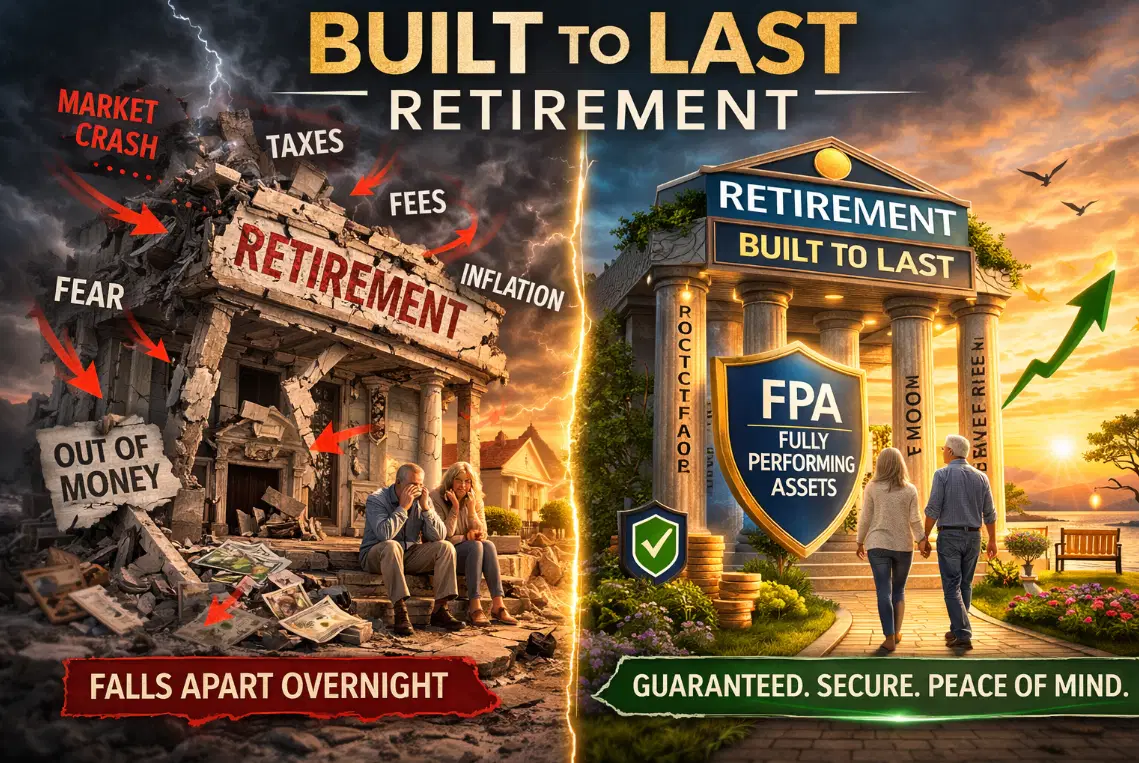
If your income is guaranteed for life... you’ve already won the game. The market can go up, down, or sideways, and your life doesn't change. That isn't a "hope." It’s an outcome of institutional-grade engineering and a path toward guaranteed lifetime income.
The Math of Recovery: Why "Almost" Isn't Good Enough
Most retirement plans are built on the "Assumption of Recovery." The broker tells you, "Don't worry, the market always comes back."
Mathematically, that is a dangerous half-truth. Let’s look at the Volatility Recovery Analysis.
If your portfolio takes a 30% hit: which happens more often than Wall Street likes to admit: you don't just need a 30% gain to get back to even. You need a 42.8% gain just to return to your starting point.
While you are waiting for that 42.8% gain to happen, two things are occurring:
You are losing time. This is the "Time Leak." You can never get back the years your money spent "treading water" instead of compounding.
You are still withdrawing income. If you are retired and taking money out of a declining account, you are accelerating the burn rate. This is called Sequence of Return Risk, and it’s the silent killer of many "predicted" retirements.
This is also where a typical retirement income calculator falls short. Most calculators assume a neat average return and a straight-line future. Real life doesn’t work that way. They often ignore market volatility, sequence risk, and the time lost recovering from downturns. A principled engineering approach starts with The Math of Recovery, tests the weak points, and designs for stability before growth.

The Four Principles of Your Street
To move from a plan based on luck to a plan based on certainty, we adhere to four non-negotiable principles of financial architecture:
Never Lose Money: We establish a mathematical floor. When the market drops, you stay at zero. You never participate in the "Math of Recovery" because you never go backward.
Never Lose Time: By eliminating the recovery cycles, every gain: no matter how small: compounds from a new, higher baseline.
Always Increase Income: Your plan should be designed to provide reliable, increasing income that you cannot outlive, with the goal of producing guaranteed lifetime income instead of guesswork.
Eliminate Unnecessary Risk, Fees, and Taxes: We perform a Margin Audit™ to find the "leaks" that are draining your wealth without you even noticing.
The Financial "Smartphone" (Fully Performing Assets)
In the 1980s, if you wanted to take a photo, make a call, and check the weather, you needed a camera, a rotary phone, and a newspaper. Today, you have a smartphone. It’s a Consolidation of Technology.
Traditional financial planning is still in the "Rolodex" era. It uses "Single-Pillar" assets.
Banks: Safe, but zero growth.
Stocks: Growth potential, but high risk of loss.
Real Estate: Cash flow, but high fees and low liquidity.
We use Fully Performing Assets (FPA). Think of FPA as the "smartphone" of finance. It’s a multi-pillar vehicle that consolidates 5 to 15 pillars of value into one structure. This is why the old single-pillar model feels like a Rolodex in a SpaceX world.
An FPA offers Uncapped Gains (UCG) and Expanded Market Participation (EMP). While a traditional broker might tell you that indexed products have a "3% cap," they are operating on an outdated model. With EMP, we can create a 110%–200% multiplier on market gains. If the market goes up 10%, your engineered performance could result in an 11% to 20% gain: all while maintaining a 0% floor against losses.

The Margin Audit™: Stopping the Bleed
Most people are worried about the "Big Crash," but they are being slowly bled to death by micro-margins.
Between investment fees, advisory fees, and the "tax lien" the government holds on your 401(k), most people are losing 30% to 50% of their actual buying power before they even spend a dime.

A Margin Audit™ isn't about looking at your returns; it’s about looking at your efficiency. We look for the "Wealth Killers": the hidden fees and the future tax liabilities that act as a lien against your lifestyle. If we can stop the leaks, your current assets can often perform better than a "predicted" high-risk portfolio ever could. It also helps cut through the noise around annuities pros and cons retirement conversations, because most of those debates stay generic while a real Margin Audit™ measures whether a product improves your actual compounding efficiency, protection, and income architecture.
Risk is for Business, Not Retirement
When you were building your career or your business, risk was your friend. You took risks to get rewards. But the rules of the game change once you reach the "Red Zone" (the 5–10 years before and after retirement).
In retirement, risk is an intruder.

Wall Street wants you to believe that "Risk vs. Reward" is a law of nature. It isn't. It’s a rule of their game. In the world of institutional Asset Liability Management (ALM), we use engineering to decouple risk from reward. We use the same principles that banks use to ensure they never lose, no matter what the economy does.
Are You Ready for a Guarantee?
If you’re tired of the "noise," the "probablys," and the "88% chances," it’s time to move from the Prediction Market to Your Street.
We don't offer "free" consultations because we don't offer "free" cheese. We provide institutional-grade financial architecture for Quiet Builders who value certainty over speculation.
The Million Dollar Hour™ is a $995 deep-dive Engineering and Margin Audit. In sixty minutes, we don't give you a forecast; we give you a blueprint. We use Volatility Recovery Analysis and Compounding Efficiency metrics to show you exactly where your current plan is leaking: and how to plug the holes. If you've been relying on a retirement income calculator or trying to sort through endless articles on annuities pros and cons retirement, this is where generic advice gives way to precision.
You can spend the next decade hoping the predictions come true. Or you can spend one hour engineering an outcome that is guaranteed.
Peace is the path, wisdom is the way.
Your Money, Your Rules, In Your Time, On Your Street.
Ready for clarity instead of confusion?
The Million Dollar Hour™ is your educational, one-on-one retirement review that reveals where your plan leads — not just where it’s been.
👉 Schedule your session today.
Discover Which Wealth Killers Are Affecting You
Most people are impacted by 6–9 and don’t realize it
Wealth Killer #1: The Granddaddy : Why Market Volatility is Your Retirement’s Greatest Enemy
Concerned about market losses, taxes, or income reliability?
Take the 7 Question Retirement Stress Test →
You can keep participating… Or you can finally see the outcome. The Million Dollar Hour™ shows you exactly:
✔ Where you are ✔ Where you’re going ✔ How to fix the gaps 👉 Book your session now
Check out the Retirement Blueprint