
Retirement Strategies That Maximize Income, Eliminate Risk, and Help Ensure You Never Run Out of Money How to Achieve The Retirement Future Everyone Seeks
Most retirement plans are built on assumptions that no longer hold up—market averages, predictable tax rates, and the belief that time will always recover losses. But as you approach or enter retirement, the rules change. What worked during your accumulation years can become a liability during the withdrawal phase.
This blog is designed to help you rethink traditional strategies and discover a more engineered approach to retirement income—one focused on certainty, efficiency, and control.
Here, you’ll learn how to reduce or eliminate the biggest threats to your financial future, including market losses, rising taxes, hidden fees, and the silent erosion caused by lost time. We break down complex financial concepts into clear, actionable insights so you can make better decisions about your 401(k), IRA, and retirement income strategy.
You’ll also discover why many conventional approaches—like relying on average returns or the 4% rule—can expose you to unnecessary risk, especially when withdrawals begin. Instead, we explore strategies designed to protect your principal, improve compounding efficiency, and create predictable income streams that last.
Our focus is on helping you transition from “assets at risk” to a more stable and structured approach using fully performing assets—where growth, income, and protection work together instead of against each other.
Whether you’re still working or already retired, the goal is simple:
help you keep more of what you earn, generate more reliable income, and build a plan that doesn’t depend on hope, timing, or market luck.
If you’ve ever wondered:
* How to create tax-efficient retirement income
* How to avoid sequence of returns risk
* How to reduce fees and increase net returns
* How to design income that doesn’t run out
—you’re in the right place.
Explore the articles below and start building a retirement strategy based on engineering, not guesswork.

33%, 50%, or 100? The Allocation Math for Retirement
33%, 50%, or 100? The Allocation Math That Ends the Retirement Darkness
One of the fastest ways to uncover hidden risk is to take our 7 Question Retirement Stress Test.
![[HERO] 33%, 50%, or 100? The Allocation Math That Ends the Retirement Darkness](https://cdn.marblism.com/rJjk0xJ2_00.webp "[HERO] 33%, 50%, or 100? The Allocation Math That Ends the Retirement Darkness")
Start here: See what your retirement actually looks like → 👉 Book Your Million Dollar Hour™
The Irrecoverable Time Multiplier: Why Your Current Allocation is Stealing Your Future
When does a "Quiet Builder": someone who has spent thirty years working hard, saving quietly, and following the rules: suddenly decide to reconsider their entire financial approach?
It usually happens the moment their expected future is put in doubt.
You’ve seen the charts. You’ve felt that low-level hum of anxiety when the market headlines turn red. But the real "darkness" of retirement uncertainty isn't just about the dollar signs on your statement. It’s about the one resource you can never, ever earn back: Time.
At Your Street Wealth, we don’t look at retirement through the lens of "participation" (Wall Street’s fancy word for gambling). We look at it through the lens of institutional-grade engineering. If you are feeling financially fatigued, it’s likely because you’re using a "Rolodex" strategy in a "SpaceX" world.
It’s time to shine a light on the math that actually matters.
The Irrecoverable Time Multiplier
Wall Street loves to talk about "Average Annual Returns" (AAR). It sounds great in a brochure. But AAR is a deceptive metric because it hides the most lethal weapon in the financial world: The Irrecoverable Time Multiplier.
When your Assets at Risk (AAR) take a hit, most people falsely believe that losing time is an acceptable cost of doing business. It isn't.
Consider the Math of Recovery. If your portfolio drops by 30%, you don’t need a 30% gain to get back to even. You need a 42% gain just to return to the starting line. While you’re busy waiting for that 42% recovery, the clock is still ticking. If it takes you three years to recover those losses, those are three years where your money wasn't compounding: it was just "treading water."
Money can recover. Time never does.
When you lose time, you lose the multiplier effect that fuels your entire retirement lifestyle. Every market dip is essentially a "time thief" that steals the years of compounding you’ve worked so hard to build. Reliability and repeatability are the only ways to banish this darkness.

The False Belief: AAR vs. FPA
There is a pervasive myth that Assets at Risk (the stock market) will always outperform Fully Performing Assets (FPAs) over the long haul.
This belief is usually based on "macro headlines" rather than "micro margins." People see the S&P 500 hit a new high and think they are missing out if they aren't 100% "in." But they haven't run a Volatility Recovery Analysis.
If you take a 10-year horizon and compare a traditional market-based portfolio (AAR) against an engineered FPA, the results often shock the "uninitiated."
AAR (Assets at Risk): You participate in the ups, but you also participate in the downs. Your growth is constantly interrupted by retractions.
FPA (Fully Performing Assets): These are the "smartphones" of finance. They offer a 0% floor (meaning you never lose a dime to market volatility) while providing Uncapped Gains (UCG) and Expanded Market Participation (EMP).
When you remove the "recovery years": those periods where you are just fighting to get back to zero: the FPA often outpaces the market-risk strategy. Why? Because you are moving forward every single year. There are no "resetting the clock" moments. In an FPA, a 10% gain is a 10% gain you keep forever. In the market, a 10% gain might just be the first step in recovering from last year's 15% drop.

Suggested Image: Visualizing the "Math of Recovery" contrast: a jagged red line vs. a steady, climbing gold line.
33%, 50%, or the Rule of 100?
Most people have never properly considered their allocation because they’ve been told there’s only one way to play the game. They stay over-leveraged in risk because they fear the "opportunity cost" of being safe.
But what if safety was actually the higher-performing engine?
Let’s look at the math of three common allocation strategies:
1. The Rule of 100
This is the old-school "Rolodex" model. You subtract your age from 100, and that’s the percentage you keep in "risky" assets (stocks). If you’re 65, you keep 35% in stocks and 65% in "safe" assets (usually bonds). The problem? In today’s interest-rate environment, traditional bonds are like spinning sharp knives: they carry more risk and less reward than they did in the 80s.
2. The 50% Balanced Approach
This is for the builder who wants to keep one foot in the "participation" game while trying to protect the other half. It’s better, but it still leaves 50% of your hard-earned wealth exposed to the "Time Thief."
3. The 33% "Safety First" Shift
For many Quiet Builders, moving a significant portion of their wealth: sometimes even 100% of their "must-have" retirement income: into Fully Performing Assets is the only way to achieve certainty.
When you shift your allocation to FPAs, you aren't just "buying a product." You are upgrading from Single-Pillar Assets to Multi-Pillar Architecture.
The Smartphone Analogy: Single-Pillar vs. Multi-Pillar
Think back to the year 2000. If you wanted to take a photo, make a call, and check your email, you needed a camera, a flip phone, and a bulky laptop. These were "single-pillar" tools.
Traditional assets: Banks (NPA), Stocks (AAR), and Real Estate: are single-pillar assets. They do one thing, often with high fees and high risk.
Fully Performing Assets are the "smartphone" of the financial world. One FPA vehicle can consolidate 5 to 15 pillars of value into a single structure:
Growth: Linked to market indices but with a 0% contractual floor.
Protection: Guarded against market volatility and loss.
Tax-Free Income: Engineered to provide cash flow without the IRS "leak."
Long-Term Care: Multi-use benefits that trigger if you get sick.
Legacy: Guaranteed death benefits for the next generation.
Why carry around a bag full of outdated single-use tools when you can engineer one "SpaceX-grade" solution?

Reliability Ends the Darkness
Darkness surrounds your retirement when you lack reliability and repeatability.
If you can’t predict your future portfolio value because of market volatility, taxes, and hidden fees, you are operating on a "False Model" driven by the Greed/Fear meter of Wall Street. They want you addicted to the daily news cycle so you keep buying and selling.
Institutional-grade engineering: the kind Frank L Day focuses on: replaces that noise with precision. We use the Margin Audit™ to identify exactly where your wealth is leaking. We look at your Sequence of Return Margin to ensure that a market crash in year one of your retirement doesn't bankrupt you by year ten.
Wealth is built on micro margins, not macro headlines.
The 10-Year Test
Take 10 years. Don't use less.
If you look at your allocation over a decade and adjust it to your actual goals: not the goals your broker wants you to have: the choice becomes clear. Do you want to "participate" in a gamble, or do you want "engineered performance"?
Do you want to depend on the market, or do you want to control the outcome?
The difference between these two paths isn't just a few percentage points. It’s the difference between $2.9 million more in lifetime wealth and a retirement spent wondering if you’ll outlive your money.
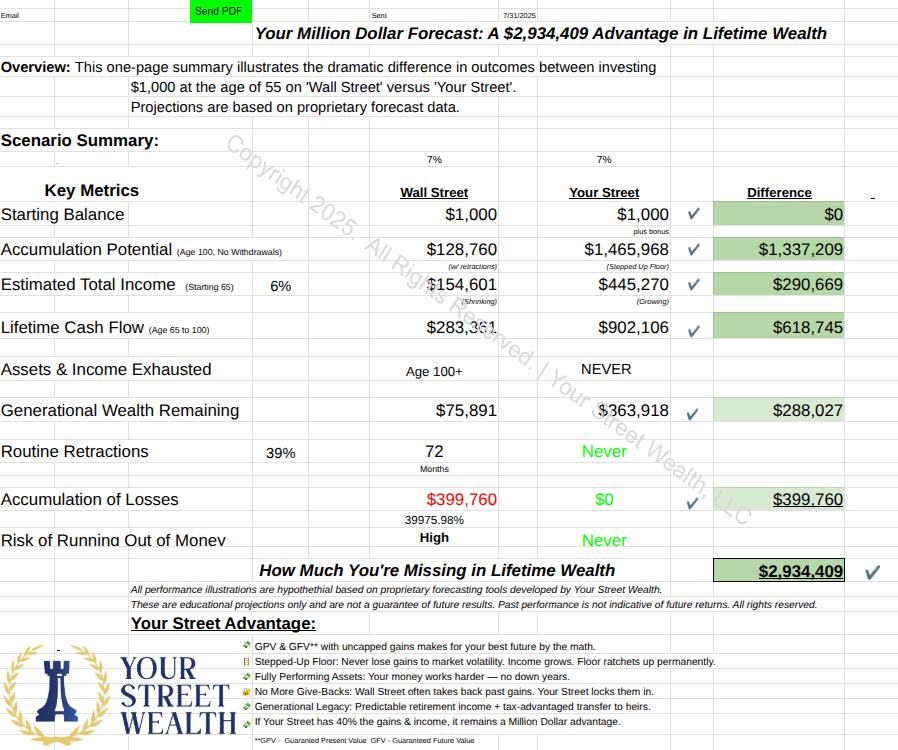
Audit the Margin. Protect Your Time.
If your "expected future" is in doubt, it’s time to stop guessing. You can estimate your income needs, but you cannot predict portfolio value when losses are uncontrollable.
The Million Dollar Hour™ is the bridge between the uncertainty you feel today and the certainty of an engineered plan. This isn't a "free consultation" where you get a sales pitch. This is a $995 high-friction, high-clarity engineering session designed for the Quiet Builder who is ready to unlearn the myths and learn fundamental financial architecture.
In one 60-minute session, we conduct a Margin Audit™ and a Volatility Recovery Analysis. We show you your AAR, NPA, and FPA choices side-by-side.
Peace is the path. Wisdom is the way.
Your Money, Your Rules, In Your Time, On Your Street.
Ready for clarity instead of confusion?
The Million Dollar Hour™ is your educational, one-on-one retirement review that reveals where your plan leads : not just where it’s been.
👉 Schedule your session today.
Discover Which Wealth Killers Are Affecting You
Most people are impacted by 6–9 and don’t realize it
Wealth Killer #1: The Granddaddy : Why Market Volatility is Your Retirement’s Greatest Enemy
Concerned about market losses, taxes, or income reliability?
Take the 7 Question Retirement Stress Test →
You can keep participating… Or you can finally see the outcome. The Million Dollar Hour™ shows you exactly:
✔ Where you are ✔ Where you’re going ✔ How to fix the gaps 👉 Book your session now
Check out the Retirement Blueprint